NV_path_rendering 
Functional Improvements 
Mark Kilgard 
NVIDIA 
March 25, 2014 
(Updated July 9, 2014)
Motivation for Improvements 
• Make NV_path_rendering extension a 
better match for web usage 
– For Skia, Chromium browser, and web 
standards generally 
• Better performance 
– Driven by profiling & usage experience 
• OpenGL ES support 
– NV_path_rendering intended for non-subset 
OpenGL functionality (full OpenGL 4.4)
New Functionality 
• More efficient GL commands 
– One command for “stencil then cover” 
– 2D matrix commands 
• New path commands 
– Rational quadratics 
– Rounded rectangles 
• Path objects from font’s glyph indices 
• OpenGL ES support
Single Command 
“Stencil then Cover” 
• glStencilThenCover{Fill,Stroke}PathNV 
– Does glStencil{Fill,Stroke}PathNV, then 
glCover{Fill,Stroke}PathNV 
– On the same path object 
• Also instanced versions 
– glStencilThenCover{Stroke,Stroke}PathInstancedNV 
• 100% functionally identical to just calling 
equivalent stencil & cover commands 
sequentially 
– (Only different if there is erroneous usage) 
• Any error ignores steps of the command
Single Command 
“Stencil then Cover” Details 
• Minor performance advantage 
– Halves object locking and name lookup overhead 
– Instanced versions “display list” well since only one 
set of per-path transform values 
• Advice to programmers 
– Easy to adopt if you keep your glStencil*Path* and 
glCover*Path* commands in the same function 
– Easy to emulate for older driver 
• Just register helper function that calls old commands 
sequentially
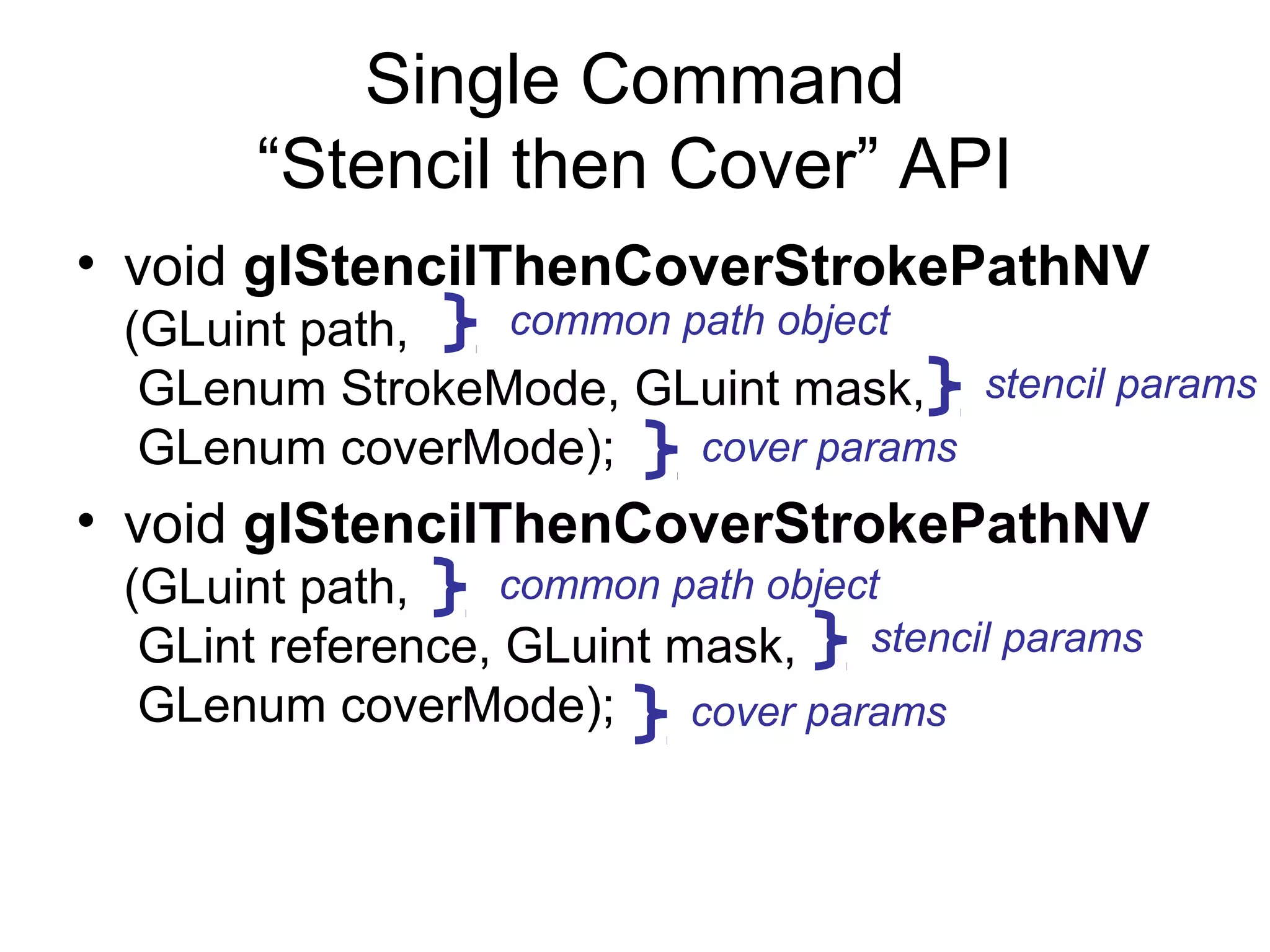
Single Command 
“Stencil then Cover” API 
• void glStencilThenCoverStrokePathNV 
(GLuint path, 
common path object 
GLenum StrokeMode, GLuint mask, 
GLenum coverMode); 
• void glStencilThenCoverStrokePathNV 
(GLuint path, 
common path object 
GLint reference, GLuint mask, 
stencil params 
GLenum coverMode); 
cover params 
stencil params 
cover params
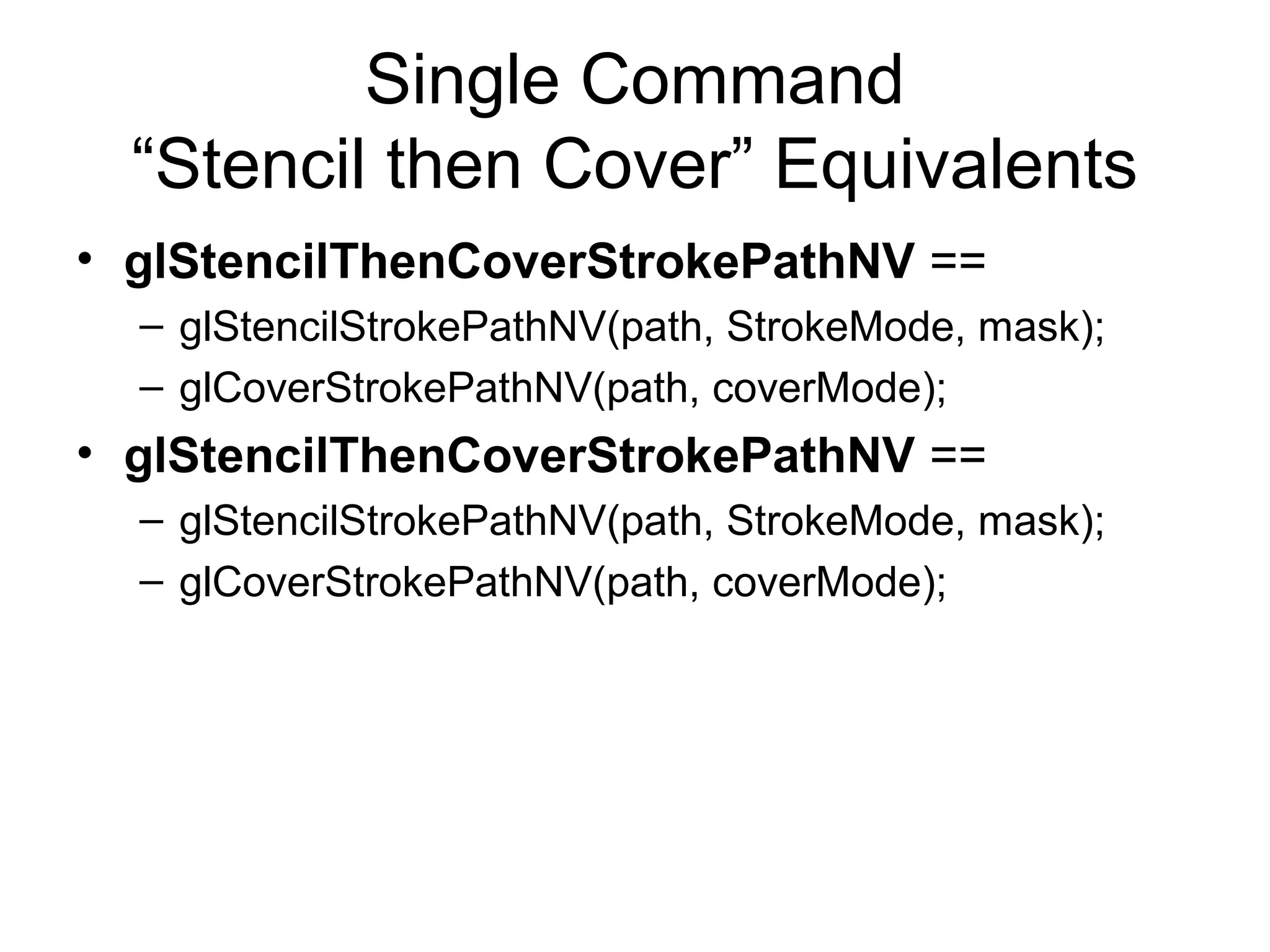
Single Command 
“Stencil then Cover” Equivalents 
• glStencilThenCoverStrokePathNV == 
– glStencilStrokePathNV(path, StrokeMode, mask); 
– glCoverStrokePathNV(path, coverMode); 
• glStencilThenCoverStrokePathNV == 
– glStencilStrokePathNV(path, StrokeMode, mask); 
– glCoverStrokePathNV(path, coverMode);
Single Command 
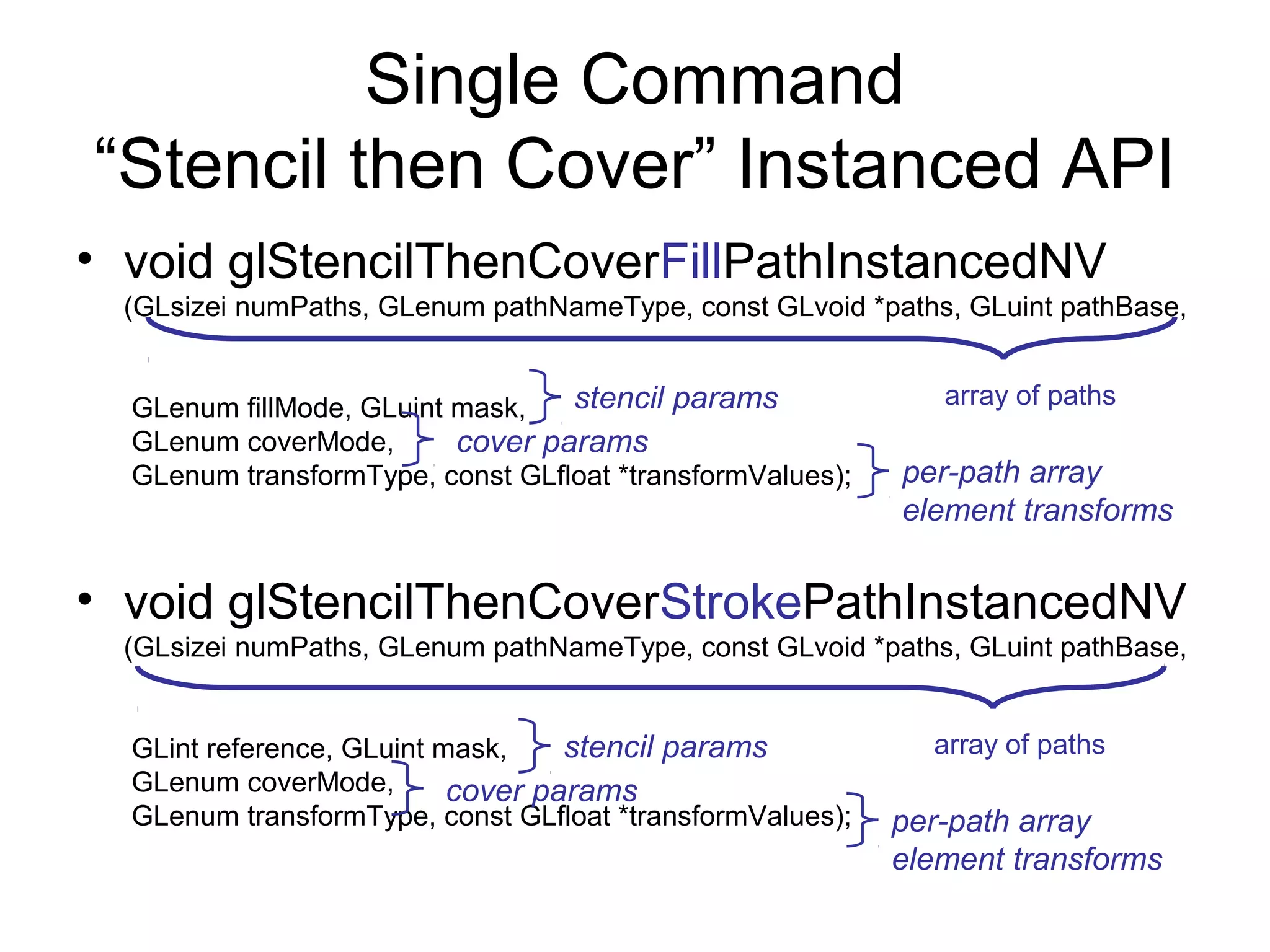
“Stencil then Cover” Instanced API 
• void glStencilThenCoverFillPathInstancedNV 
(GLsizei numPaths, GLenum pathNameType, const GLvoid *paths, GLuint pathBase, 
stencil params array of paths 
GLenum fillMode, GLuint mask, 
GLenum coverMode, 
cover params 
GLenum transformType, const GLfloat *transformValues); 
• void glStencilThenCoverStrokePathInstancedNV 
(GLsizei numPaths, GLenum pathNameType, const GLvoid *paths, GLuint pathBase, 
GLint reference, GLuint mask, 
GLenum coverMode, 
GLenum transformType, const GLfloat *transformValues); 
per-path array 
element transforms 
stencil params array of paths 
cover params 
per-path array 
element transforms
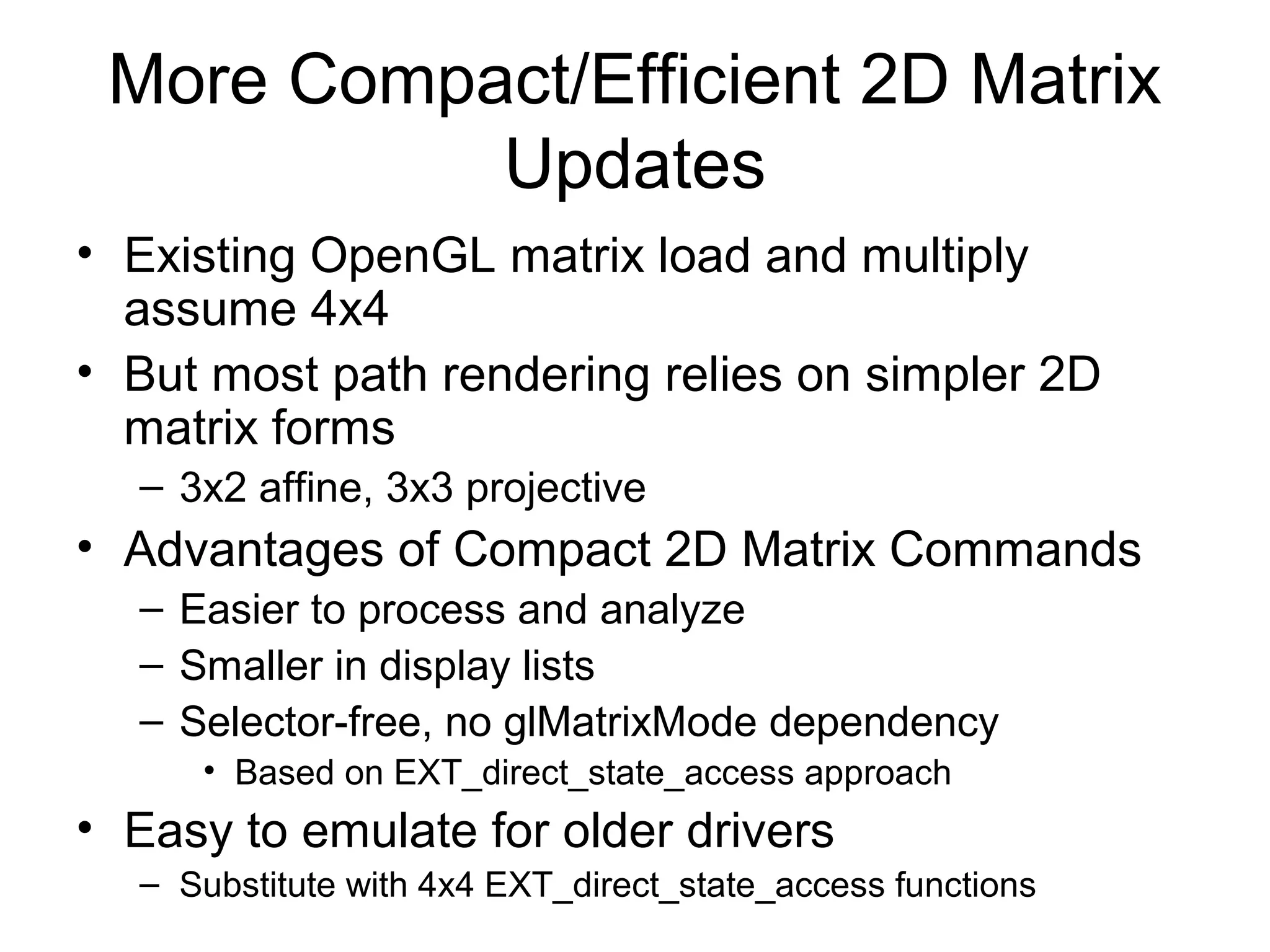
More Compact/Efficient 2D Matrix 
Updates 
• Existing OpenGL matrix load and multiply 
assume 4x4 
• But most path rendering relies on simpler 2D 
matrix forms 
– 3x2 affine, 3x3 projective 
• Advantages of Compact 2D Matrix Commands 
– Easier to process and analyze 
– Smaller in display lists 
– Selector-free, no glMatrixMode dependency 
• Based on EXT_direct_state_access approach 
• Easy to emulate for older drivers 
– Substitute with 4x4 EXT_direct_state_access functions
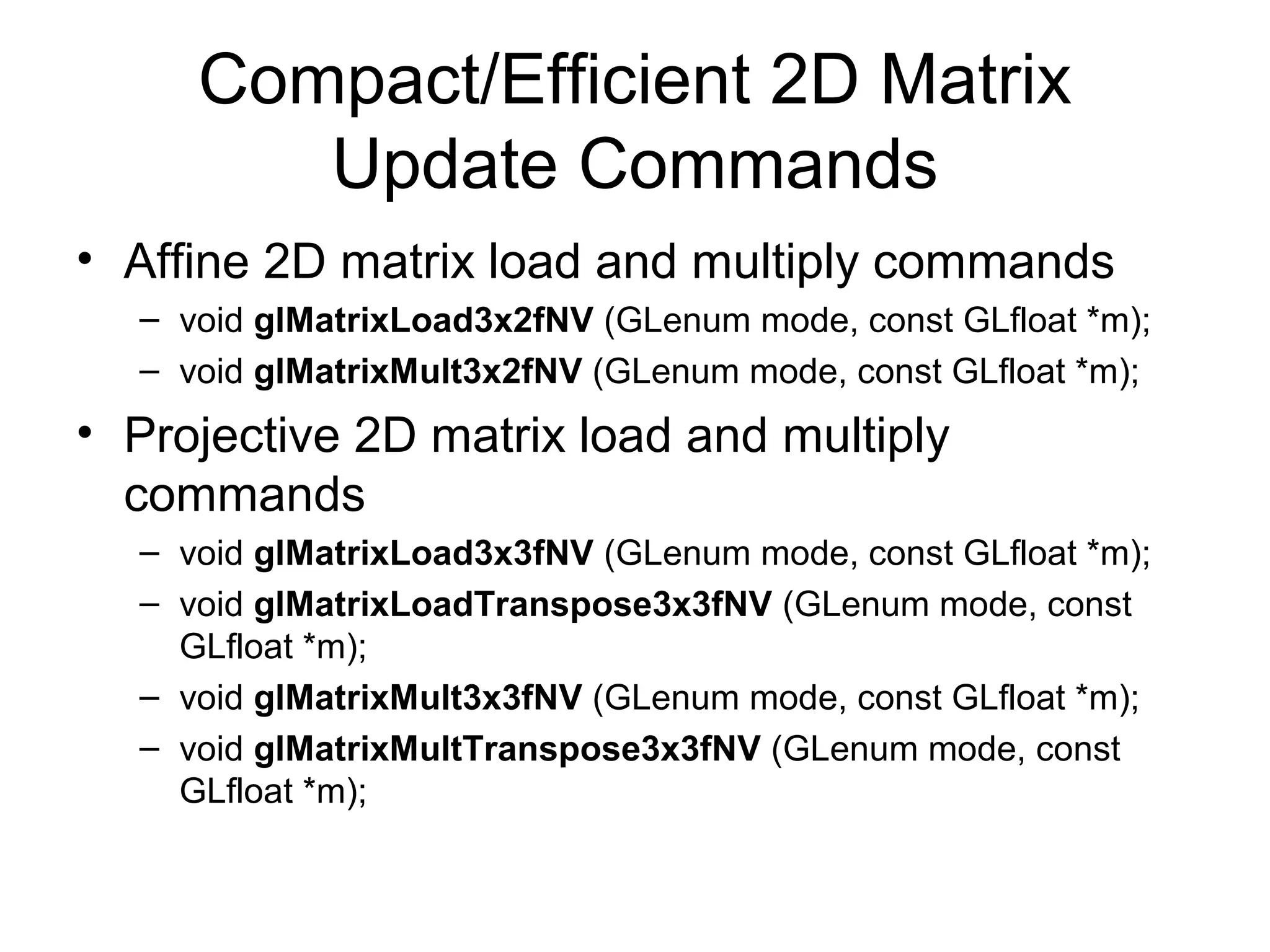
Compact/Efficient 2D Matrix 
Update Commands 
• Affine 2D matrix load and multiply commands 
– void glMatrixLoad3x2fNV (GLenum mode, const GLfloat *m); 
– void glMatrixMult3x2fNV (GLenum mode, const GLfloat *m); 
• Projective 2D matrix load and multiply 
commands 
– void glMatrixLoad3x3fNV (GLenum mode, const GLfloat *m); 
– void glMatrixLoadTranspose3x3fNV (GLenum mode, const 
GLfloat *m); 
– void glMatrixMult3x3fNV (GLenum mode, const GLfloat *m); 
– void glMatrixMultTranspose3x3fNV (GLenum mode, const 
GLfloat *m);
Compact Matrix Commands by API 
Standard Type Component order Corresponding Load command 
Skia SkMatrix [0,1,2] 
[3,4,5] 
[6,7,8] 
glMatrixLoadTranspose3x3fNV 
SkScalar [6] [0,2,4] 
[1,3,5] 
glMatrixLoad3x2fNV 
Cairo cairo_matrix_t [0,2,4] 
[1,3,5] 
glMatrixLoad3x2fNV 
Qt QMatrix [0,2,4] 
[1,3,5] 
glMatrixLoad3x2fNV 
OpenVG VGfloat [9] [0,3,6] 
[1,4,7] 
[2,5,8] 
glMatrixLoad3x3fNV 
Direct2D D2D_MATRIX_3X2_F [0,2,4] 
[1,3,5] 
glMatrixLoad3x2fNV
Rational Quadratic Path 
Commands 
• Inspired by Skia support 
– Rational quadratics allow circular, elliptical arcs, and hyperbola 
• Also known as conic curves 
• Instead of just parabolas 
• Easy to support, just 2 new paths commands 
– GL_CONIC_CURVE_TO_NV (0x1A) 
• 5 coordinates 
– [ x, y, w, x, y ] 
– First (x,y,w) is extrapolating control point 
– Second (x,y) is interpolating end point 
– GL_RELATIVE_CONIC_CURVE_TO_NV (0x1B) 
• 5 coordinates 
– [ dx, dy, w, dx, dy ]
GL_CONIC_CURVE_TO_NV 
Details 
• Normal GL_QUADRATIC_CURVE_TO_NV 
– Takes four scalar components 
• (P1x,P1y,P2x,P2y) 
– With end-point of the last path command, these 
provide three control points: 
• (P0x,P0y), (P1x,P1y), (P2x,P2y) 
• Rational quadratic version supports quadratics 
– Call this command GL_CONIC_CURVE_TO_NV 
• Google wants this, and for good reason 
– Takes five scalar components 
• (P1x,P1y,P1w,P2x,P2y) 
– Make 3 homogeneous control points 
• (P0x,P0y,1), (P1x,P1y,P1w), (P2x,P2y,1)
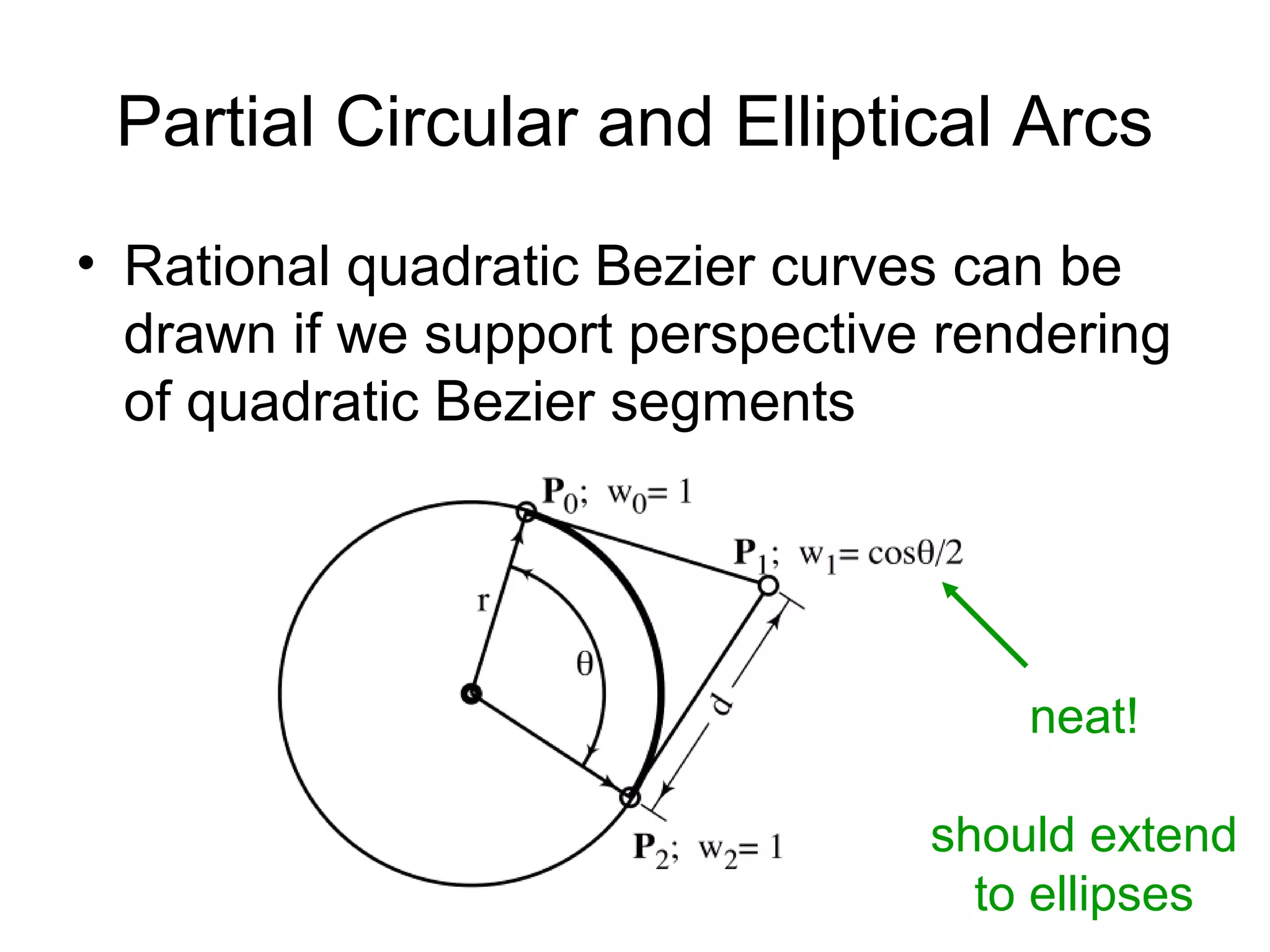
Partial Circular and Elliptical Arcs 
• Rational quadratic Bezier curves can be 
drawn if we support perspective rendering 
of quadratic Bezier segments 
neat! 
should extend 
to ellipses
Conics Details 
• If the interpolating control points (P0 & P2) have unit W 
values 
– Meaning if P0w and P2w are both 1.0 
• Then P1w controls the type of conic generated 
– P1w = 1 generates a parabolic segments 
• Basically a normal integral (non-rational) quadratic Bezier segments 
– P1w > 1 generates a hyperbolic segment 
• A portion of a hyperbola 
– P1w < 1 generates a partial elliptical or circular arc 
• To maintain the convex hull property, we need to avoid 
negative values for P1w 
– So use the absolute value of the coordinate for P1w
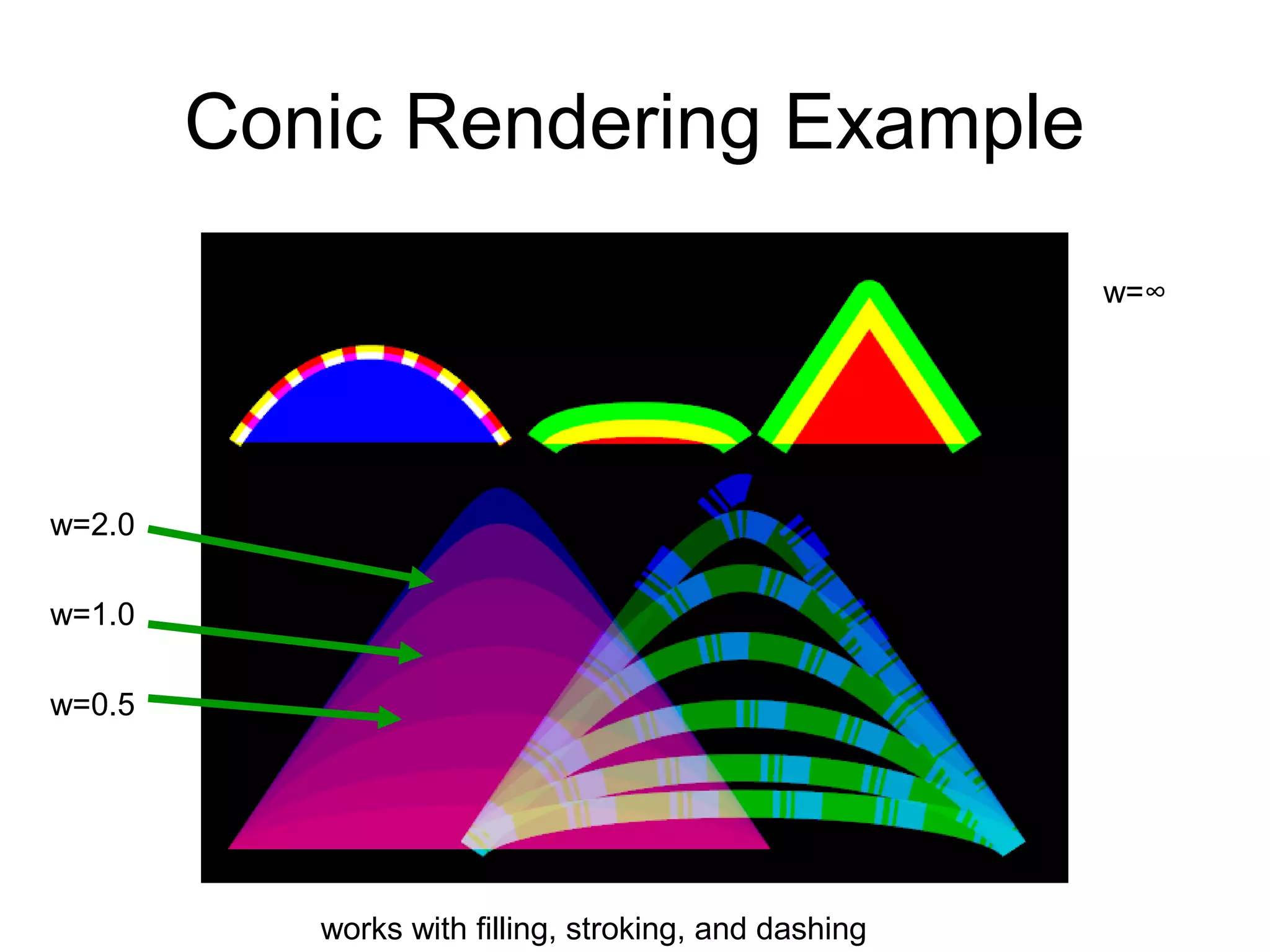
Conic Rendering Example 
w=2.0 
w=1.0 
w=0.5 
works with filling, stroking, and dashing 
w=∞
Rounded Rectangles 
• Very common primitive on web pages 
– Standardized by “ 
CSS Backgrounds and Borders Module Level 3” specification 
– Google cites rounded rectangles as the only “non-trivial” paths in 
most web pages 
• Already have GL_RECT_NV path command 
– PDF standardizes this path command 
• Rationale for first-class support 
– Common in web content 
– Faster to bake 
– Faster to render 
– Easy parameterization, more compact to specify 
• Represents sequence of 4 lines and 4 arcs
Rounded Rectangle 
Path Commands 
• New rounded rectangle path commands 
– Uniform circular radius: GL_ROUNDED_RECT_NV 
– Uniform elliptical radius: GL_ROUNDED_RECT2_NV 
– Per-corner circular radii: GL_ROUNDED_RECT4: NV 
– Per-corner elliptical radii: 
GL_ROUNDED_RECT8_NV 
• Relative versions too 
– GL_RELATIVE_RECT_NV, 
GL_RELATIVE_ROUNDED_RECT_NV, 
GL_RELATIVE_ROUNDED_RECT2_NV, 
GL_RELATIVE_ROUNDED_RECT4_NV, 
GL_RELATIVE_ROUNDED_RECT8_NV
Rounded Rectangle 
Circular Corners 
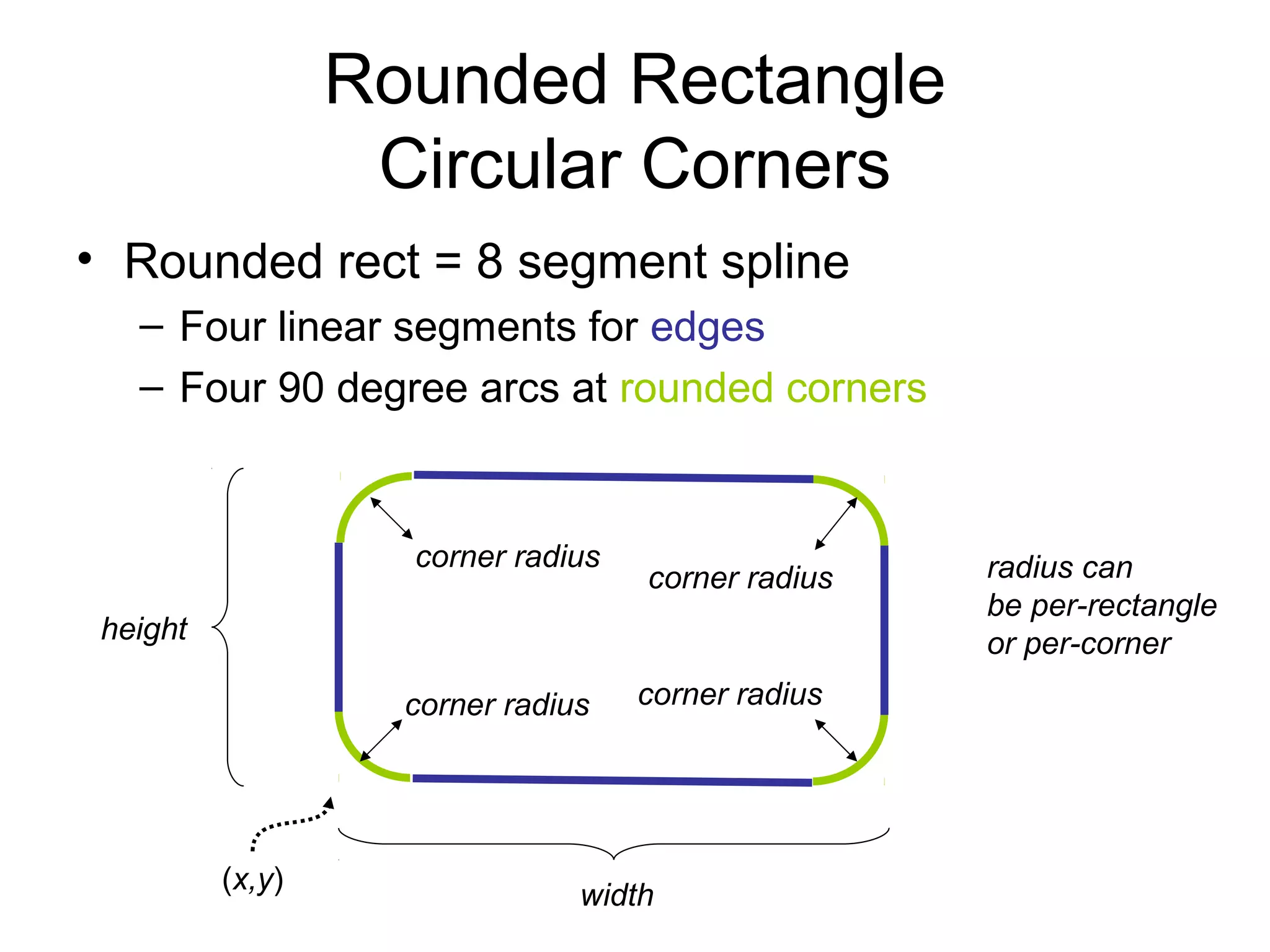
• Rounded rect = 8 segment spline 
– Four linear segments for edges 
– Four 90 degree arcs at rounded corners 
(x,y) 
height 
corner radius corner radius 
corner radius 
corner radius 
width 
radius can 
be per-rectangle 
or per-corner
Rounded Rectangle 
Elliptical Corners 
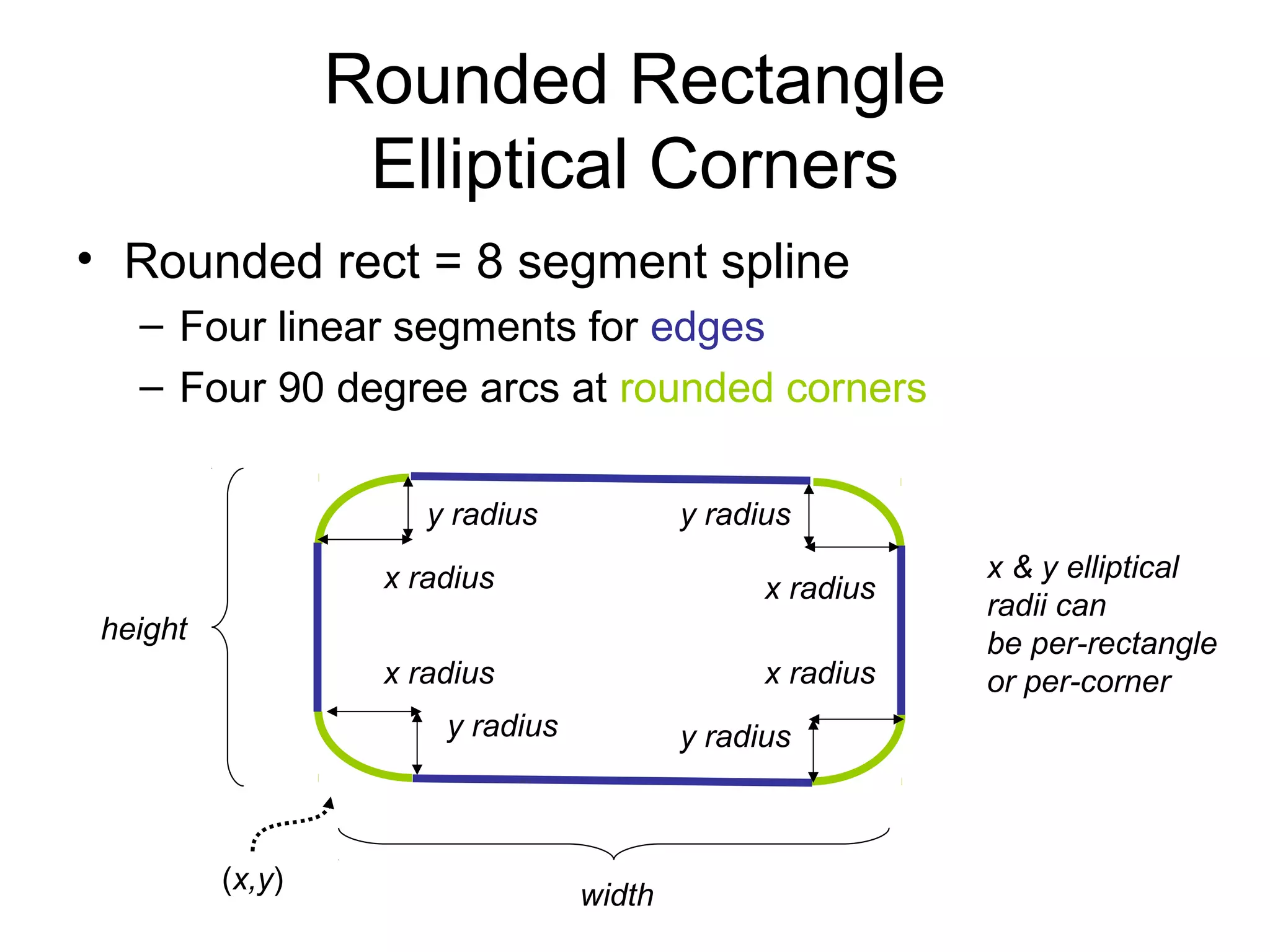
• Rounded rect = 8 segment spline 
– Four linear segments for edges 
– Four 90 degree arcs at rounded corners 
(x,y) 
height 
width 
y radius 
x & y elliptical 
radii can 
be per-rectangle 
or per-corner 
x radius 
y radius 
x radius 
x radius 
x radius 
y radius y radius
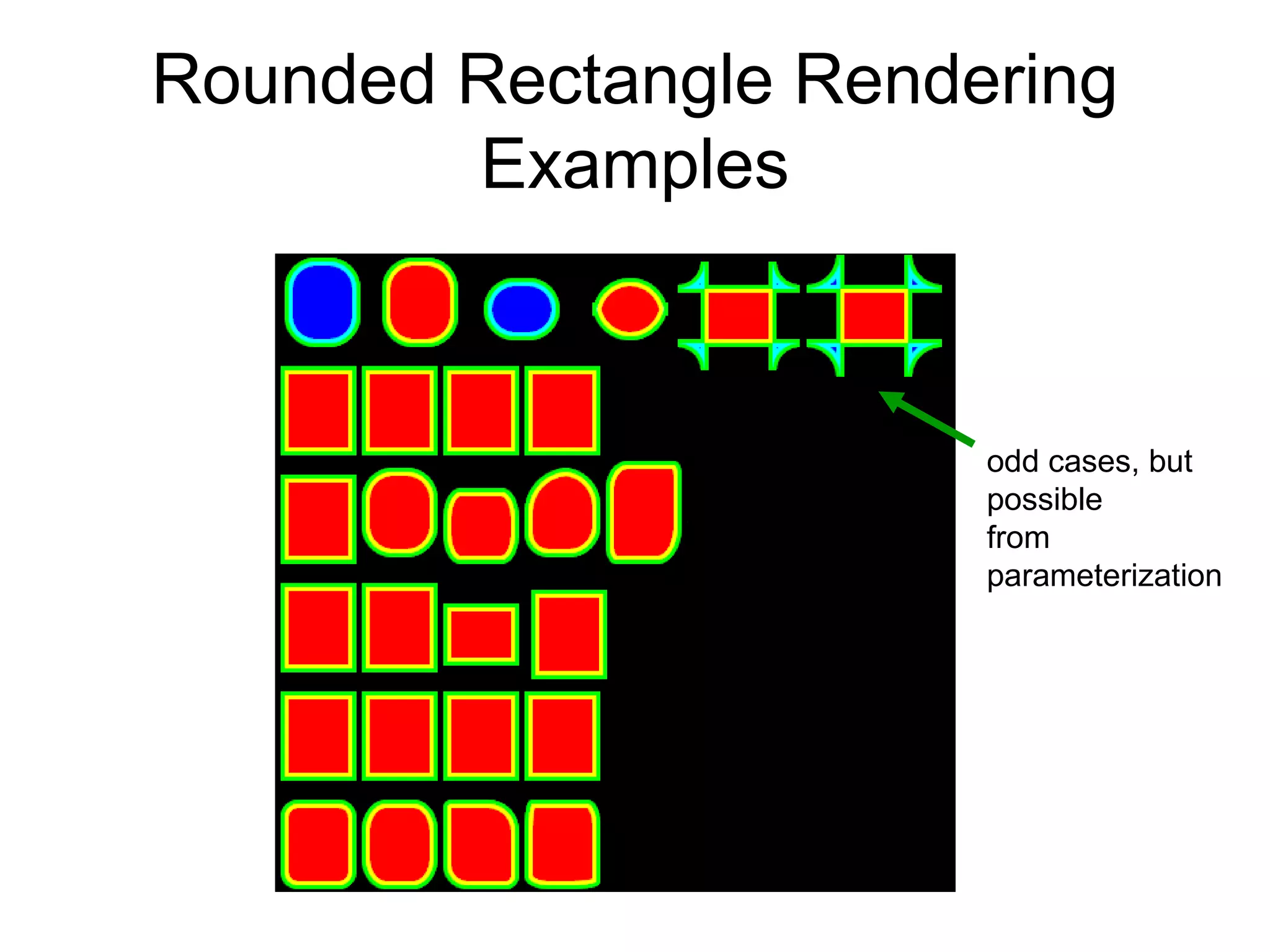
Rounded Rectangle Rendering 
Examples 
odd cases, but 
possible 
from 
parameterization
Glyph Index Font Support 
Motivation 
• Problem 
– Existing NV_path_rendering allows glyphs to be created from a font 
based on Unicode character point 
– Very handy/useful for “toy” or “simple” text layout 
• Advantage of Unicode approach: multiple font faces can “overlap” to 
provide fallback to some supported glyph 
– BUT quite insufficient for sophisticated text layout 
• Browsers definitiely need sophisticated text layout 
• Solution 
– Add glyphs created based on font glyph index 
– Facilities sophisticated text layout 
• Awareness: Application request a specific font face and have 
avaialble the font’s metrics and shading rules 
– Note: NV_path_rendering does NOT provide this information 
– Apps are expected to get it from the font directly 
• Natural to use FreeType 2 + Harfbuzz for this
Glyph Index-based Path 
Specification API 
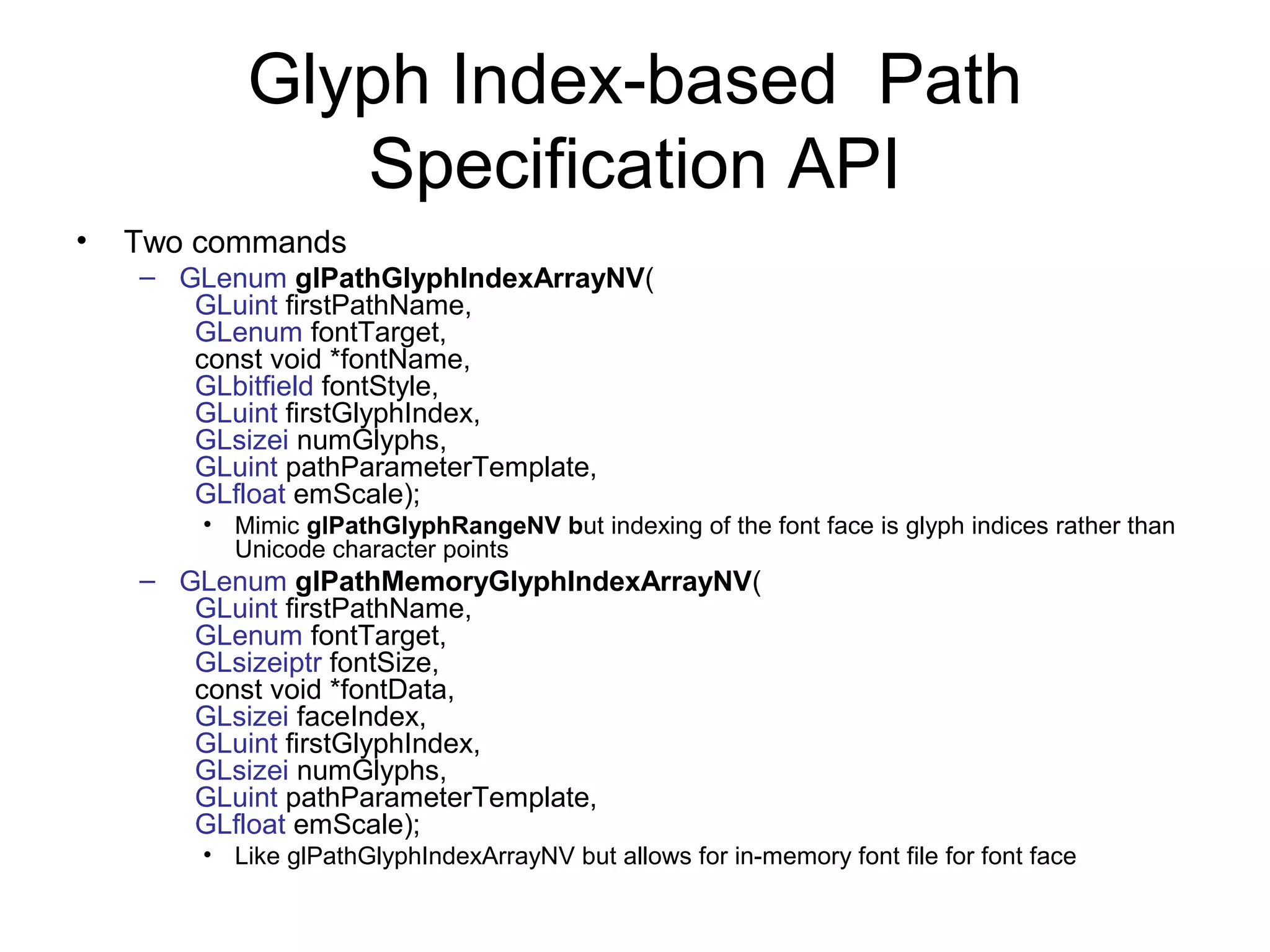
• Two commands 
– GLenum glPathGlyphIndexArrayNV( 
GLuint firstPathName, 
GLenum fontTarget, 
const void *fontName, 
GLbitfield fontStyle, 
GLuint firstGlyphIndex, 
GLsizei numGlyphs, 
GLuint pathParameterTemplate, 
GLfloat emScale); 
• Mimic glPathGlyphRangeNV but indexing of the font face is glyph indices rather than 
Unicode character points 
– GLenum glPathMemoryGlyphIndexArrayNV( 
GLuint firstPathName, 
GLenum fontTarget, 
GLsizeiptr fontSize, 
const void *fontData, 
GLsizei faceIndex, 
GLuint firstGlyphIndex, 
GLsizei numGlyphs, 
GLuint pathParameterTemplate, 
GLfloat emScale); 
• Like glPathGlyphIndexArrayNV but allows for in-memory font file for font face
Glyph Index-based Path 
Specification Discussion 
• App or library decides how glyph indices are arranged in 
path object name space 
– Example: Glyph indices can be arranged to match Skia’s 
fallback font ordering of glyph indices 
• Assumes app has a-priori knowledge of the number of 
glyphs in the font face 
• glPathMemoryGlyphIndexArrayNV: in-memory font 
data needed is copied 
– At least the font data needed to maintain the glyph outlines 
– Not referenced 
– Works like FreeType’s FT_New_Memory_Face 
• Expectation is app will use FT_New_Memory_Face for it’s a-prior 
knowledge of glyph count, metrics, etc.
Extra Glyph Index Range with 
Allocation Command 
• Generates range of glyphs for a particular font 
– Good if you don’t know how many glyph indices there 
might be in a font 
• (But you probably know that if you are shaping your own text) 
– GLenum glPathGlyphIndexRangeNV ( 
GLenum fontTarget, 
const GLvoid *fontName, 
GLbitfield fontStyle, 
GLuint pathParameterTemplate, 
GLfloat emScale, 
GLuint baseAndCount[2]); 
first path object ID & 
count returned here 
• Like calling glGenPathsNV for the font’s glyph index 
count, and then populating the range with 
glPathGlyphIndexArrayNV
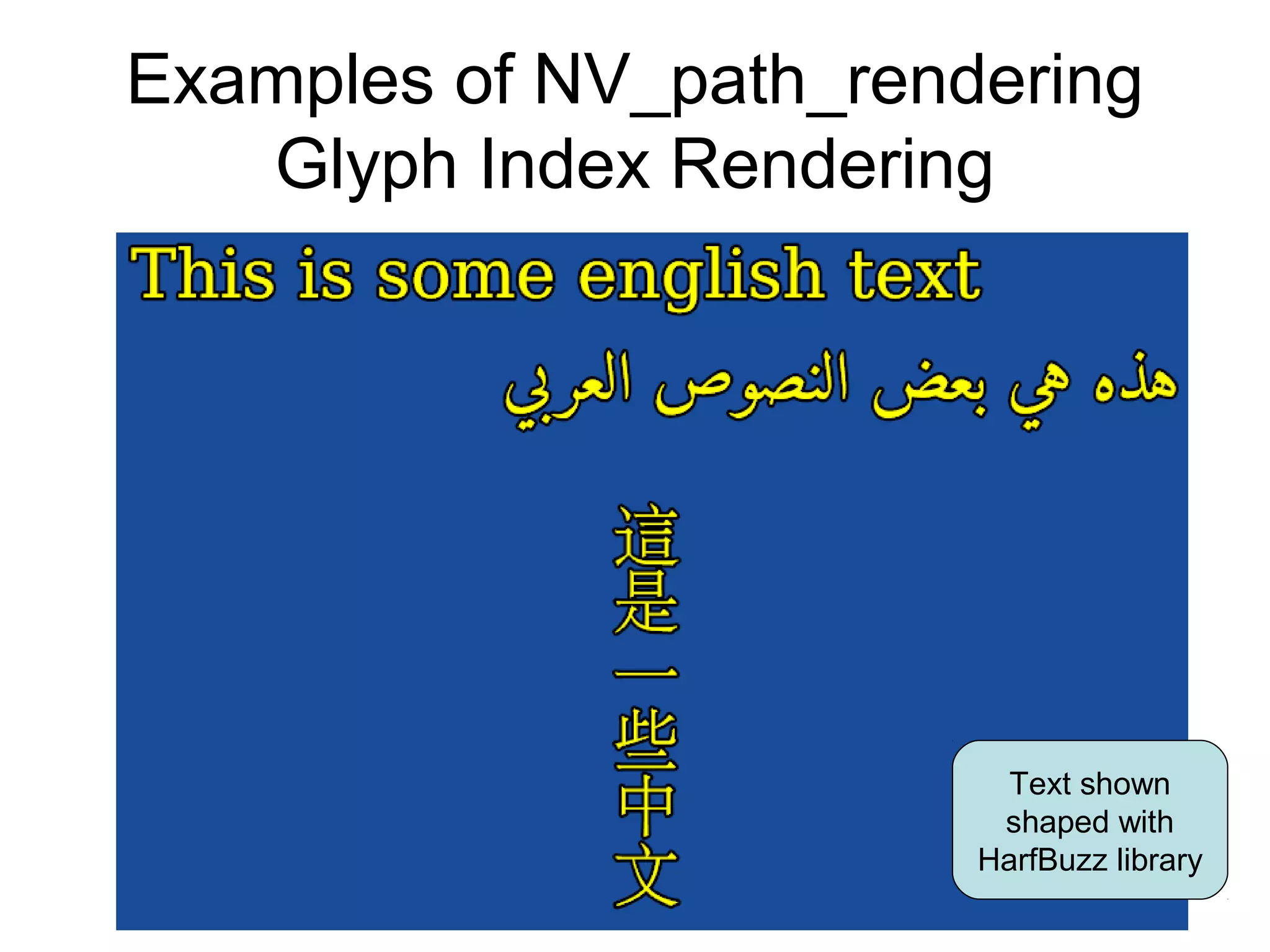
Examples of NV_path_rendering 
Glyph Index Rendering 
Text shown 
shaped with 
HarfBuzz library
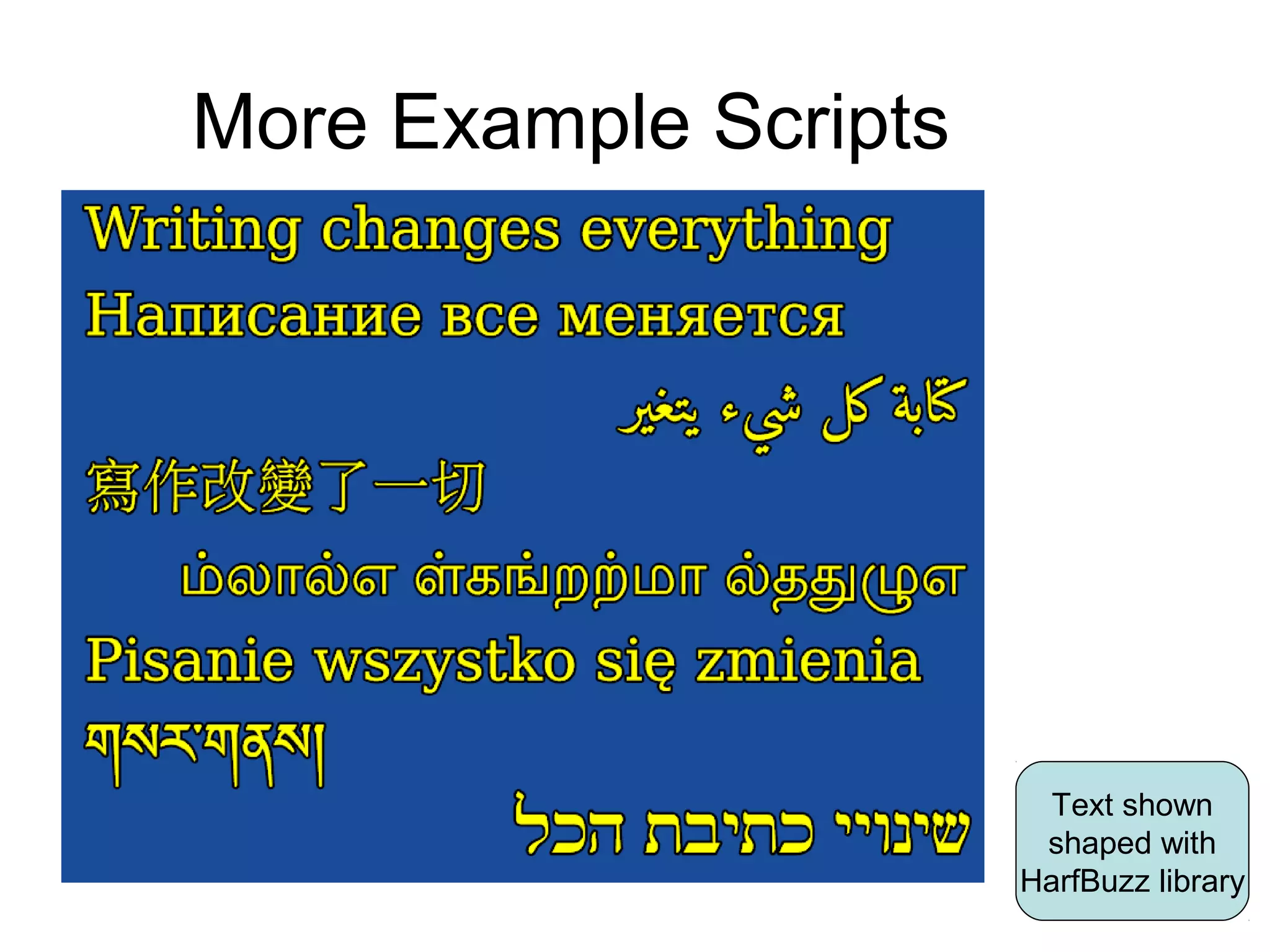
More Example Scripts 
Text shown 
shaped with 
HarfBuzz library
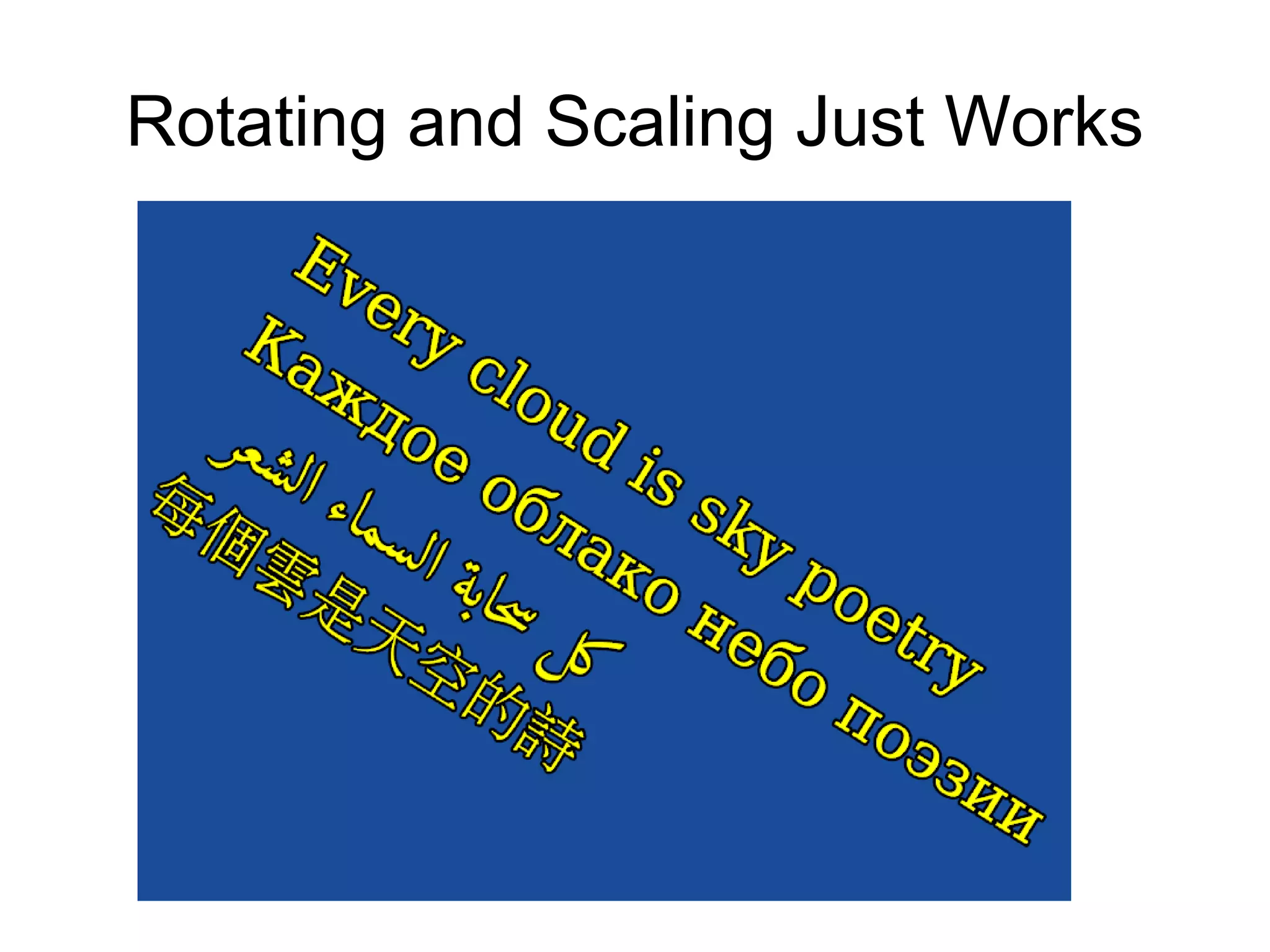
Rotating and Scaling Just Works
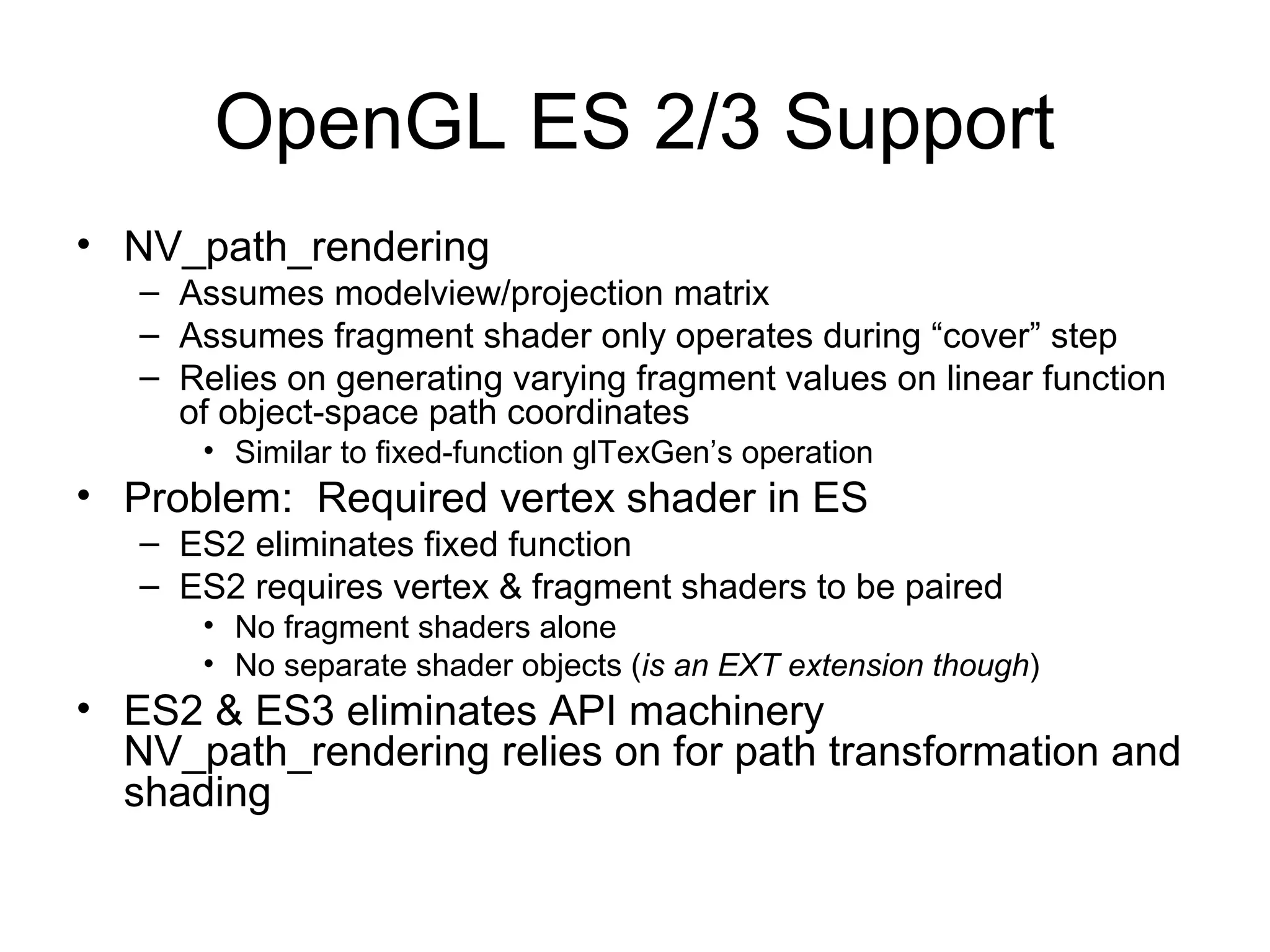
OpenGL ES 2/3 Support 
• NV_path_rendering 
– Assumes modelview/projection matrix 
– Assumes fragment shader only operates during “cover” step 
– Relies on generating varying fragment values on linear function 
of object-space path coordinates 
• Similar to fixed-function glTexGen’s operation 
• Problem: Required vertex shader in ES 
– ES2 eliminates fixed function 
– ES2 requires vertex & fragment shaders to be paired 
• No fragment shaders alone 
• No separate shader objects (is an EXT extension though) 
• ES2 & ES3 eliminates API machinery 
NV_path_rendering relies on for path transformation and 
shading
OpenGL ES 2/3 Support Goals 
• Invent as little new API as possible 
– Leverage existing extensions 
• EXT_separate_shader_objects 
• EXT_direct_state_access 
• ARB_program_interface_query 
– Reuse token values and match prototypes for matrix commands 
• Same NVpr code for ES, Core Profile, and Compatibility 
Profile 
• Rationale 
– Developers don’t like “same, only different” APIs 
– Testing effort easier 
– Re-use is less controversial than invention
Proposed NVpr for ES Solution 
• Add back into ES 2.0 and 3.x 
– Transformation state 
• Modelview and projection transforms 
– Rely on selector-free matrix routines from 
EXT_direct_state_access for this 
– Clip planes operating in eye-space 
• Leverage (assume/require!) separate shader 
objects (SSO) functionality 
– Currently ES 2.0/3.0 extension 
• EXT_separate_shader_objects 
– Slated for inclusion in ES 3.1 standard
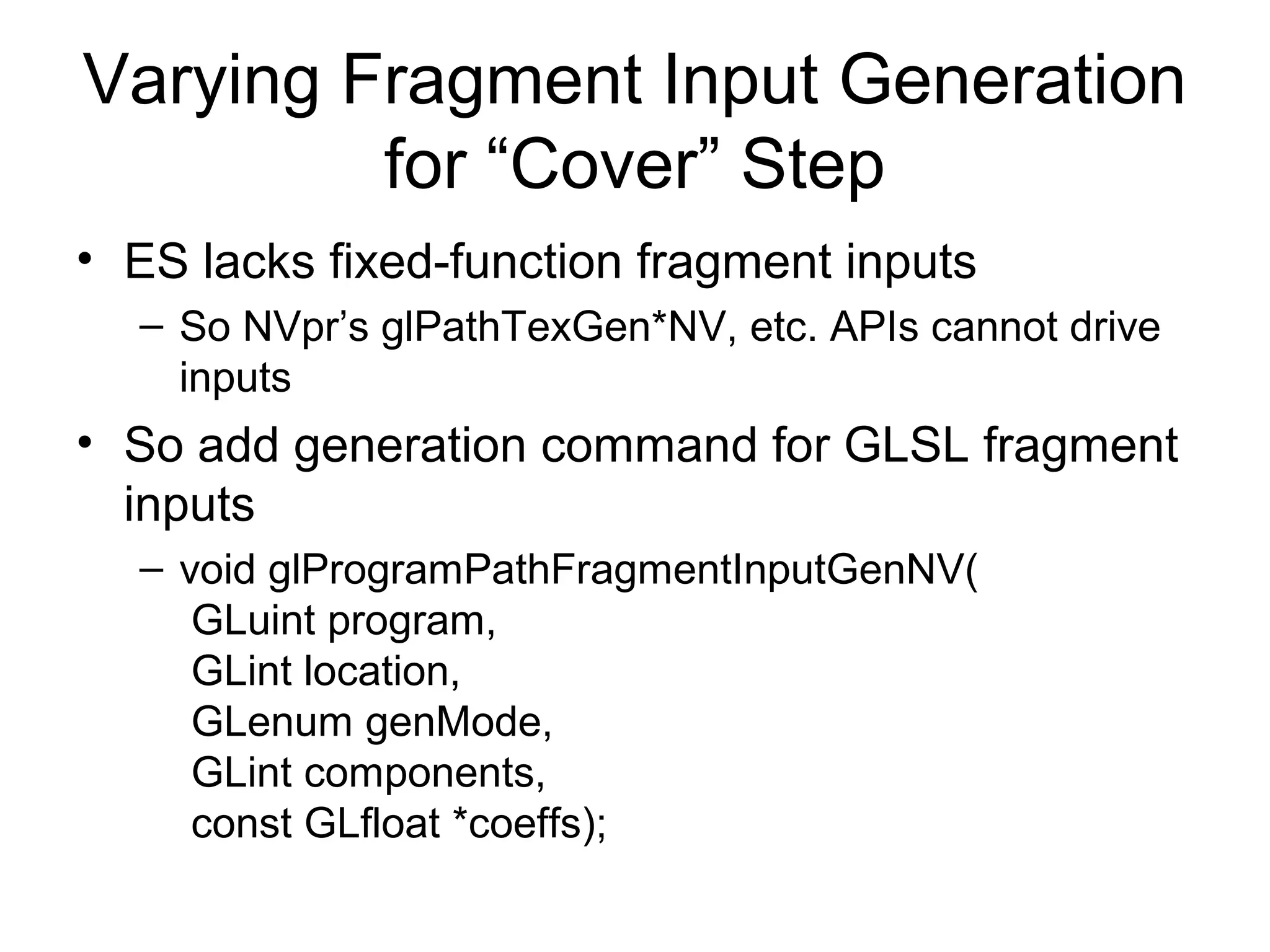
Varying Fragment Input Generation 
for “Cover” Step 
• ES lacks fixed-function fragment inputs 
– So NVpr’s glPathTexGen*NV, etc. APIs cannot drive 
inputs 
• So add generation command for GLSL fragment 
inputs 
– void glProgramPathFragmentInputGenNV( 
GLuint program, 
GLint location, 
GLenum genMode, 
GLint components, 
const GLfloat *coeffs);
ES “Cover” Fragment Shader 
Usage Notes 
• Use “layout” qualifiers to assign locations to fragment 
inputs 
– Example: layout(location=0) int vec2 st; 
– SSO introduces layout qualifiers for every shader domain 
• Prior to SSO, just layout locations just allowed for the vertex shader 
• ARB_program_interface_query is useful related 
extension 
– Allows programmatic querying of locations for fragment program 
inputs 
• When fragment shader is “first” domain in the SSO pipeline program 
– Provides introspection when explicit layout locations not used in 
the shader or shader is from an “outside” source
ES “Cover” Fragment Shader 
Example 
• Complete example for radial gradient: 
– #version 300 es 
layout(location=0) in vec2 st; 
uniform sampler1D ramp; 
uniform vec4 color; 
void main() { 
gl_FragColor = color*texture(ramp, length(st)); 
} 
• Driving the “st” varying 
– GLfloat params[3][3] = { 
/* radial gradient linear coefficients */ }; 
glProgramPathFragmentInputGenNV(radGradProg, 
/*location*/0, GL_OBJECT_LINEAR, 2, 
&params[0][0]); 
– Generation state is per-program 
• (not per-GL context)
ES Matrix Additions 
• Require EXT_direct_state_access (DSA) matrix functions be available 
– When NV_path_rendering exposed on ES 
– (Doesn’t require DSA itself) 
• Matrix commands: 
– glMatrixLoadfEXT, glMatrixLoaddEXT, glMatrixMultfEXT, glMatrixMultdEXT, 
glMatrixLoadIdentityEXT, glMatrixRotatefEXT, glMatrixRotatedEXT, glMatrixScalefEXT, 
glMatrixScaledEXT, glMatrixTranslatefEXT, glTranslateMatrixdEXT, glMatrixOrthoEXT, 
glMatrixFrustumEXT, glMatrixPushEXT, glPopMatrixEXT 
• Matrix values should be GL_PATH_PROJECTION_NV or 
GL_PATH_MODELVIEW_NV 
– Aliases (same token values) for GL_MODELVIEW and GL_PROJECTION 
– No other matrices included (texture matrix, color matrix) 
• Includes matrix stack for both these matices 
– Important to commands can be rendered with respect to other views 
• Unresolved 
– Reintroduce built-in variables for these so non-NVpr rendering can reference the same 
matrices? 
• Likely YES, otherwise hard for non-NVpr rendering to be consistent 
• gl_PathModelviewMatrixNV, gl_PathProjectionMatrixNV 
– Reintroduce a glPathClipPlane (and glPathClipRect) for clip plane usage? 
• Likely YES
Approach to Additions 
• Simply extend exist NV_path_rendering with new 
functions and tokens 
– No new extension; documented as minor revisions in 
specification 
– Detect minor update by querying if new command functions exist 
– Or detecting errors from new tokens 
• Rationales 
– Just adding functionality; fully backward compatible 
– Few actual users of NV_path_rendering today 
– None of these additions tied to actual hardware features 
– Stuff NV_path_rendering really “should have always had” 
– Relative to emulate the lack of these features
Availability 
• In latest drivers (now public) 
– Single command “StencilThenCover” 
– 2D matrix commands 
• Glyph index support 
– Implemented 
• Conic curves & round rectangles 
– Implemented 
• OpenGL ES support 
– Implemented 
• In 337.88 public drivers circa June 2014
Appendix material
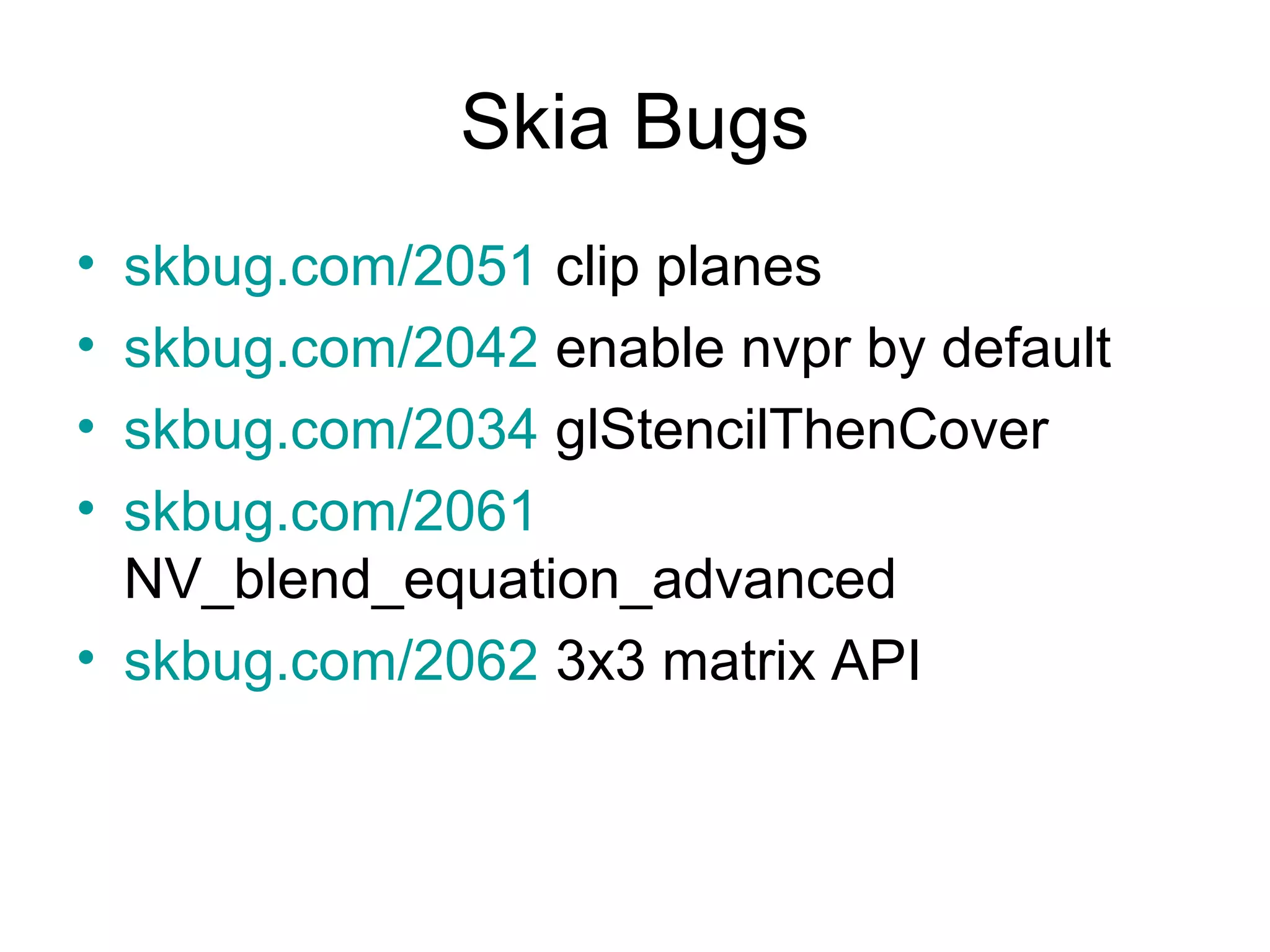
Skia Bugs 
• skbug.com/2051 clip planes 
• skbug.com/2042 enable nvpr by default 
• skbug.com/2034 glStencilThenCover 
• skbug.com/2061 
NV_blend_equation_advanced 
• skbug.com/2062 3x3 matrix API
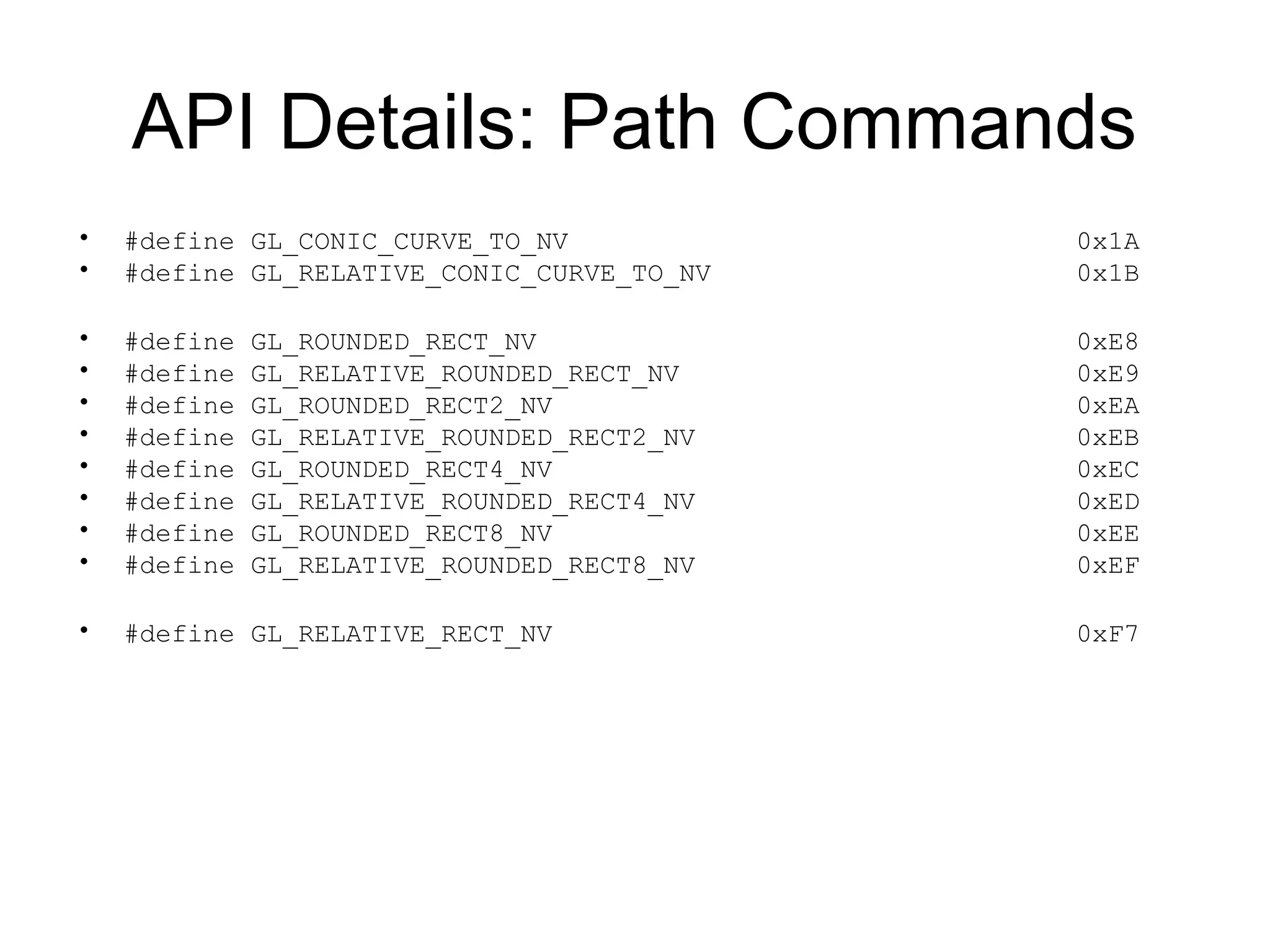
API Details: Path Commands 
• #define GL_CONIC_CURVE_TO_NV 0x1A 
• #define GL_RELATIVE_CONIC_CURVE_TO_NV 0x1B 
• #define GL_ROUNDED_RECT_NV 0xE8 
• #define GL_RELATIVE_ROUNDED_RECT_NV 0xE9 
• #define GL_ROUNDED_RECT2_NV 0xEA 
• #define GL_RELATIVE_ROUNDED_RECT2_NV 0xEB 
• #define GL_ROUNDED_RECT4_NV 0xEC 
• #define GL_RELATIVE_ROUNDED_RECT4_NV 0xED 
• #define GL_ROUNDED_RECT8_NV 0xEE 
• #define GL_RELATIVE_ROUNDED_RECT8_NV 0xEF 
• #define GL_RELATIVE_RECT_NV 0xF7
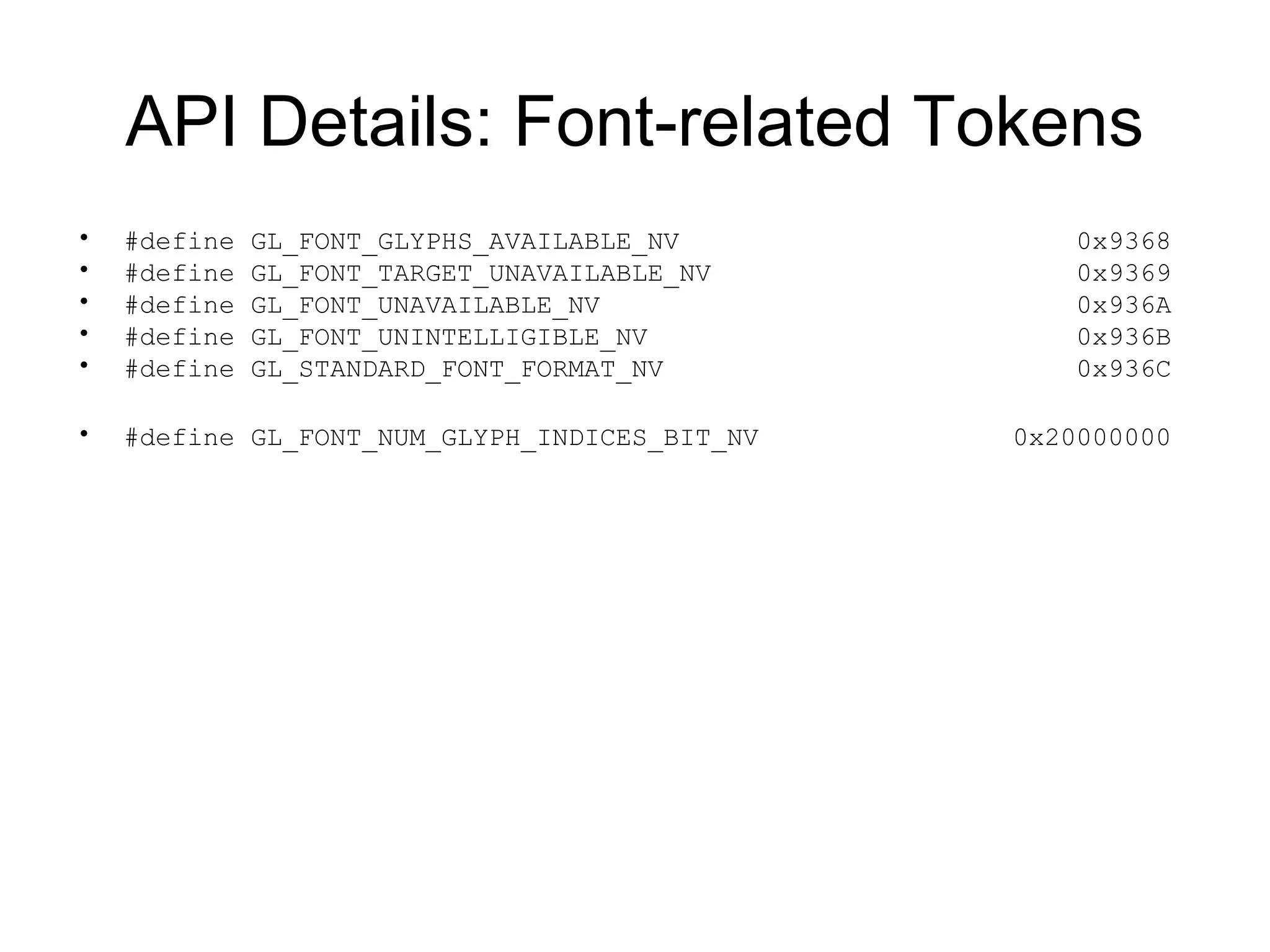
API Details: Font-related Tokens 
• #define GL_FONT_GLYPHS_AVAILABLE_NV 0x9368 
• #define GL_FONT_TARGET_UNAVAILABLE_NV 0x9369 
• #define GL_FONT_UNAVAILABLE_NV 0x936A 
• #define GL_FONT_UNINTELLIGIBLE_NV 0x936B 
• #define GL_STANDARD_FONT_FORMAT_NV 0x936C 
• #define GL_FONT_NUM_GLYPH_INDICES_BIT_NV 0x20000000
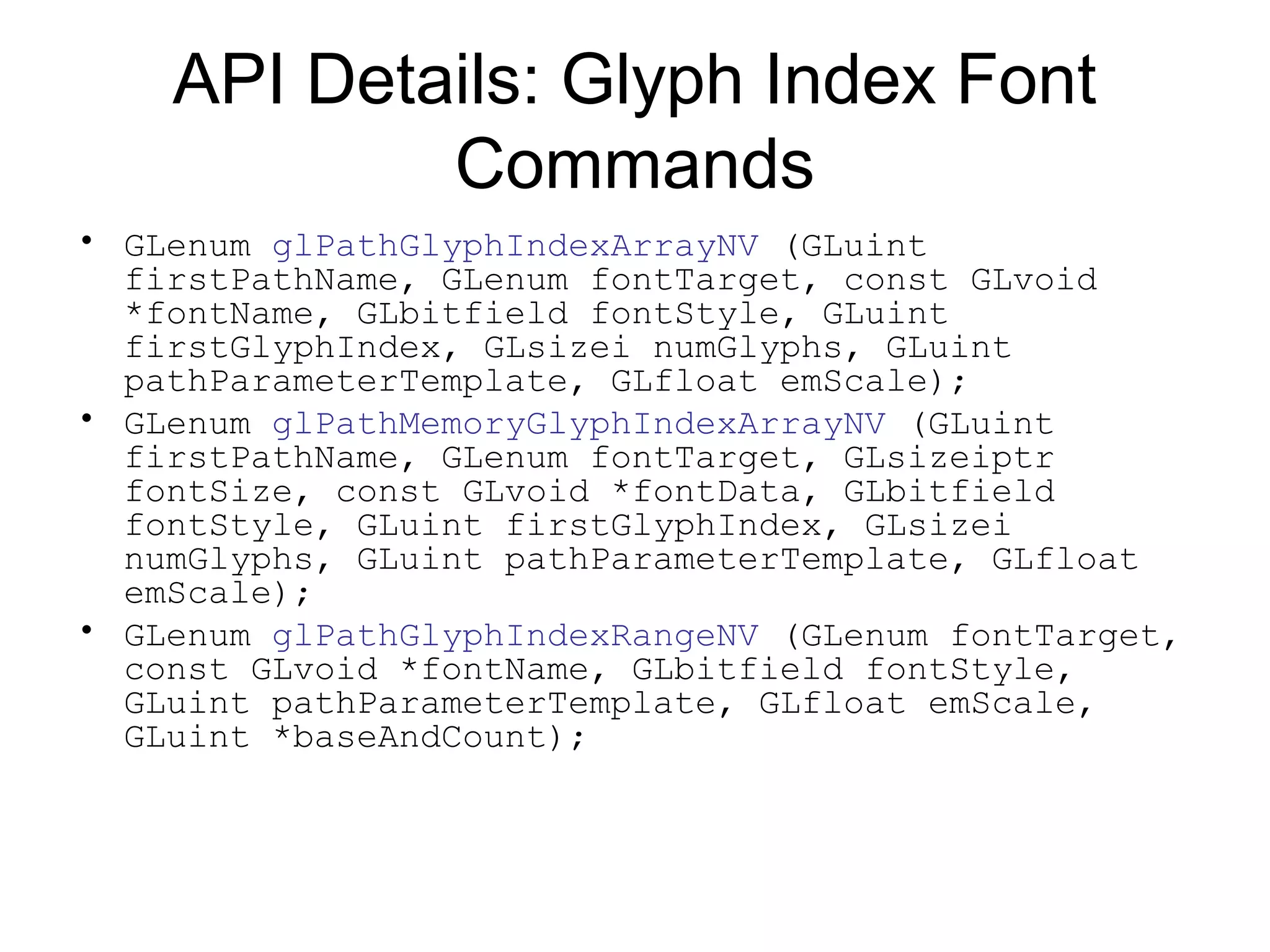
API Details: Glyph Index Font 
Commands 
• GLenum glPathGlyphIndexArrayNV (GLuint 
firstPathName, GLenum fontTarget, const GLvoid 
*fontName, GLbitfield fontStyle, GLuint 
firstGlyphIndex, GLsizei numGlyphs, GLuint 
pathParameterTemplate, GLfloat emScale); 
• GLenum glPathMemoryGlyphIndexArrayNV (GLuint 
firstPathName, GLenum fontTarget, GLsizeiptr 
fontSize, const GLvoid *fontData, GLbitfield 
fontStyle, GLuint firstGlyphIndex, GLsizei 
numGlyphs, GLuint pathParameterTemplate, GLfloat 
emScale); 
• GLenum glPathGlyphIndexRangeNV (GLenum fontTarget, 
const GLvoid *fontName, GLbitfield fontStyle, 
GLuint pathParameterTemplate, GLfloat emScale, 
GLuint *baseAndCount);
API Details: Glyph Index Font 
Command Typedefs 
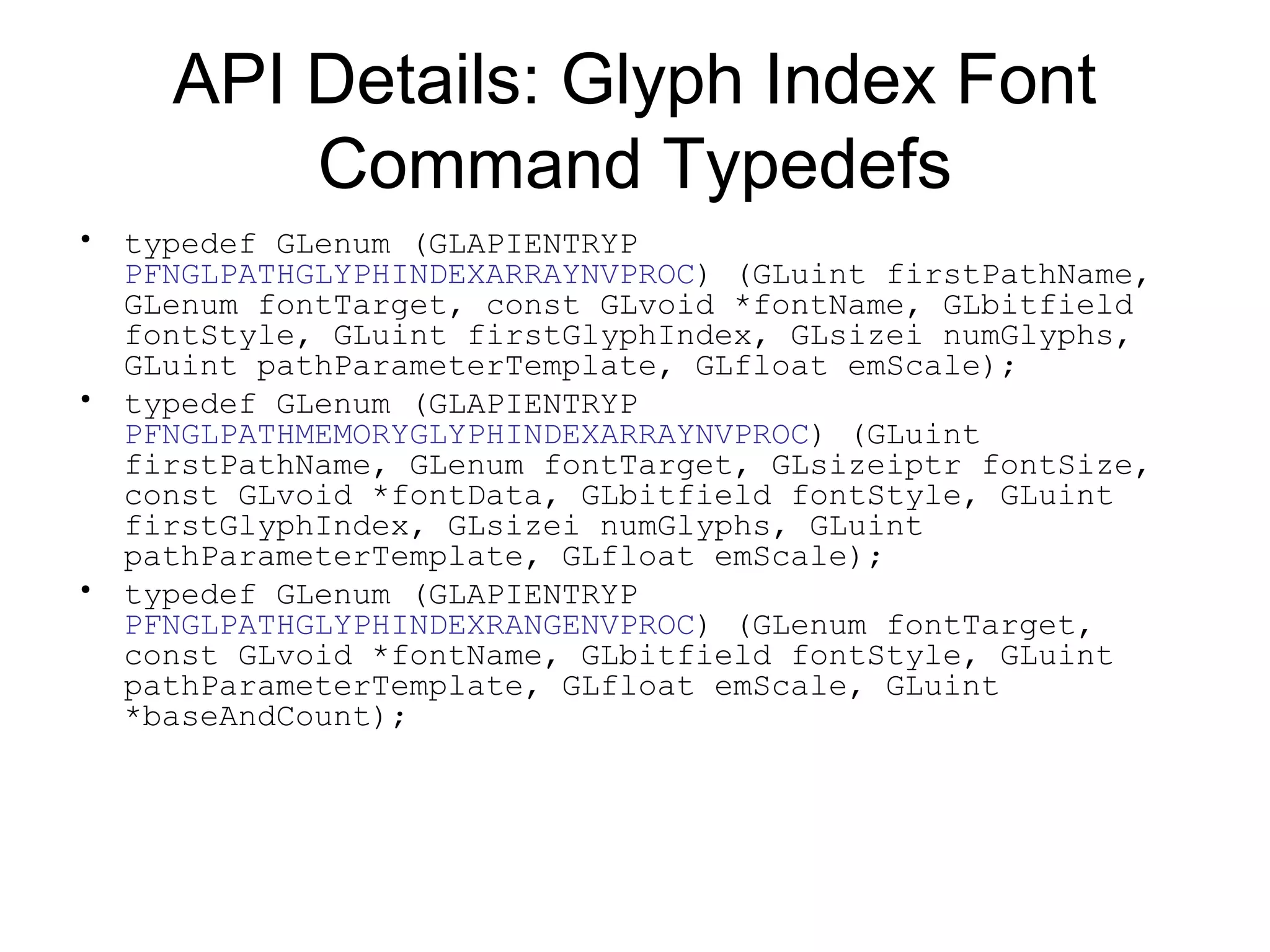
• typedef GLenum (GLAPIENTRYP 
PFNGLPATHGLYPHINDEXARRAYNVPROC) (GLuint firstPathName, 
GLenum fontTarget, const GLvoid *fontName, GLbitfield 
fontStyle, GLuint firstGlyphIndex, GLsizei numGlyphs, 
GLuint pathParameterTemplate, GLfloat emScale); 
• typedef GLenum (GLAPIENTRYP 
PFNGLPATHMEMORYGLYPHINDEXARRAYNVPROC) (GLuint 
firstPathName, GLenum fontTarget, GLsizeiptr fontSize, 
const GLvoid *fontData, GLbitfield fontStyle, GLuint 
firstGlyphIndex, GLsizei numGlyphs, GLuint 
pathParameterTemplate, GLfloat emScale); 
• typedef GLenum (GLAPIENTRYP 
PFNGLPATHGLYPHINDEXRANGENVPROC) (GLenum fontTarget, 
const GLvoid *fontName, GLbitfield fontStyle, GLuint 
pathParameterTemplate, GLfloat emScale, GLuint 
*baseAndCount);
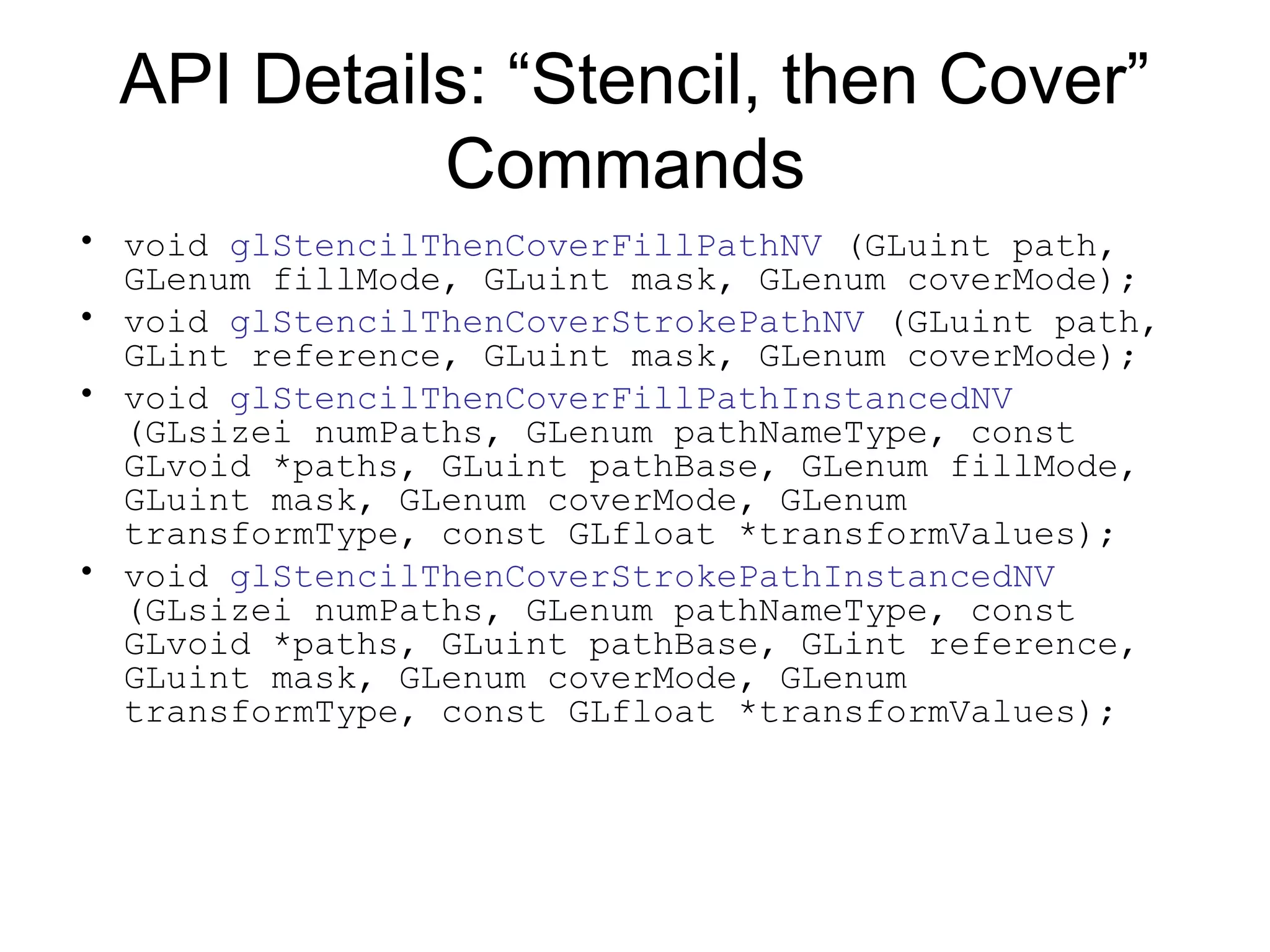
API Details: “Stencil, then Cover” 
Commands 
• void glStencilThenCoverFillPathNV (GLuint path, 
GLenum fillMode, GLuint mask, GLenum coverMode); 
• void glStencilThenCoverStrokePathNV (GLuint path, 
GLint reference, GLuint mask, GLenum coverMode); 
• void glStencilThenCoverFillPathInstancedNV 
(GLsizei numPaths, GLenum pathNameType, const 
GLvoid *paths, GLuint pathBase, GLenum fillMode, 
GLuint mask, GLenum coverMode, GLenum 
transformType, const GLfloat *transformValues); 
• void glStencilThenCoverStrokePathInstancedNV 
(GLsizei numPaths, GLenum pathNameType, const 
GLvoid *paths, GLuint pathBase, GLint reference, 
GLuint mask, GLenum coverMode, GLenum 
transformType, const GLfloat *transformValues);
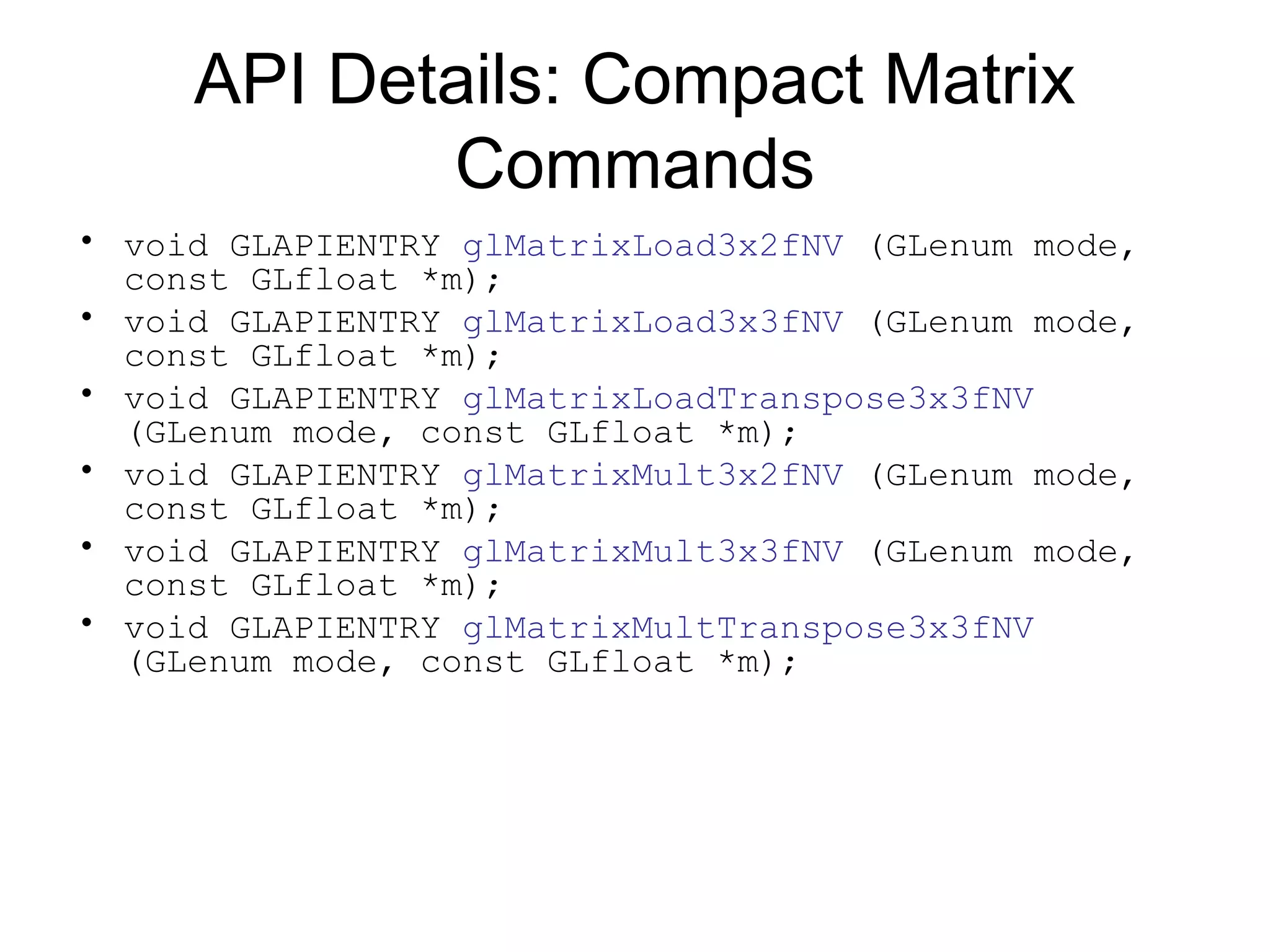
API Details: Compact Matrix 
Commands 
• void GLAPIENTRY glMatrixLoad3x2fNV (GLenum mode, 
const GLfloat *m); 
• void GLAPIENTRY glMatrixLoad3x3fNV (GLenum mode, 
const GLfloat *m); 
• void GLAPIENTRY glMatrixLoadTranspose3x3fNV 
(GLenum mode, const GLfloat *m); 
• void GLAPIENTRY glMatrixMult3x2fNV (GLenum mode, 
const GLfloat *m); 
• void GLAPIENTRY glMatrixMult3x3fNV (GLenum mode, 
const GLfloat *m); 
• void GLAPIENTRY glMatrixMultTranspose3x3fNV 
(GLenum mode, const GLfloat *m);
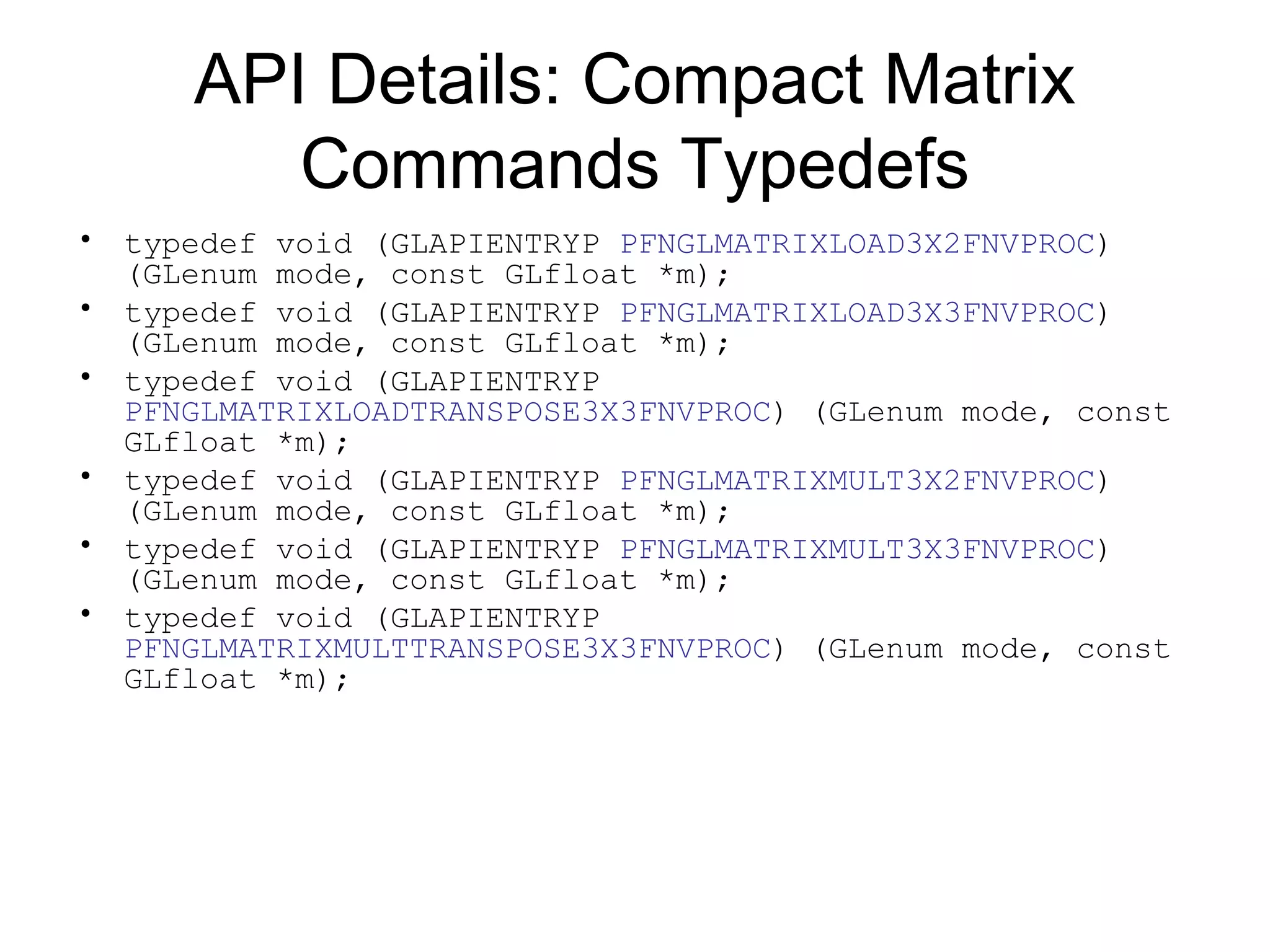
API Details: Compact Matrix 
Commands Typedefs 
• typedef void (GLAPIENTRYP PFNGLMATRIXLOAD3X2FNVPROC) 
(GLenum mode, const GLfloat *m); 
• typedef void (GLAPIENTRYP PFNGLMATRIXLOAD3X3FNVPROC) 
(GLenum mode, const GLfloat *m); 
• typedef void (GLAPIENTRYP 
PFNGLMATRIXLOADTRANSPOSE3X3FNVPROC) (GLenum mode, const 
GLfloat *m); 
• typedef void (GLAPIENTRYP PFNGLMATRIXMULT3X2FNVPROC) 
(GLenum mode, const GLfloat *m); 
• typedef void (GLAPIENTRYP PFNGLMATRIXMULT3X3FNVPROC) 
(GLenum mode, const GLfloat *m); 
• typedef void (GLAPIENTRYP 
PFNGLMATRIXMULTTRANSPOSE3X3FNVPROC) (GLenum mode, const 
GLfloat *m);
API Details: GLSL Path Fragment 
Varying Generation 
• void GLAPIENTRY glProgramPathFragmentInputGenNV 
(GLuint program, GLint location, GLenum genMode, 
GLint components, const GLfloat *coeffs); 
• typedef void (GLAPIENTRYP 
PFNGLPROGRAMPATHFRAGMENTINPUTGENNVPROC) (GLuint 
program, GLint location, GLenum genMode, GLint 
components, const GLfloat *coeffs);

NV_path rendering Functional Improvements

  • 1.
    NV_path_rendering Functional Improvements Mark Kilgard NVIDIA March 25, 2014 (Updated July 9, 2014)
  • 2.
    Motivation for Improvements • Make NV_path_rendering extension a better match for web usage – For Skia, Chromium browser, and web standards generally • Better performance – Driven by profiling & usage experience • OpenGL ES support – NV_path_rendering intended for non-subset OpenGL functionality (full OpenGL 4.4)
  • 3.
    New Functionality •More efficient GL commands – One command for “stencil then cover” – 2D matrix commands • New path commands – Rational quadratics – Rounded rectangles • Path objects from font’s glyph indices • OpenGL ES support
  • 4.
    Single Command “Stencilthen Cover” • glStencilThenCover{Fill,Stroke}PathNV – Does glStencil{Fill,Stroke}PathNV, then glCover{Fill,Stroke}PathNV – On the same path object • Also instanced versions – glStencilThenCover{Stroke,Stroke}PathInstancedNV • 100% functionally identical to just calling equivalent stencil & cover commands sequentially – (Only different if there is erroneous usage) • Any error ignores steps of the command
  • 5.
    Single Command “Stencilthen Cover” Details • Minor performance advantage – Halves object locking and name lookup overhead – Instanced versions “display list” well since only one set of per-path transform values • Advice to programmers – Easy to adopt if you keep your glStencil*Path* and glCover*Path* commands in the same function – Easy to emulate for older driver • Just register helper function that calls old commands sequentially
  • 6.
    Single Command “Stencilthen Cover” API • void glStencilThenCoverStrokePathNV (GLuint path, common path object GLenum StrokeMode, GLuint mask, GLenum coverMode); • void glStencilThenCoverStrokePathNV (GLuint path, common path object GLint reference, GLuint mask, stencil params GLenum coverMode); cover params stencil params cover params
  • 7.
    Single Command “Stencilthen Cover” Equivalents • glStencilThenCoverStrokePathNV == – glStencilStrokePathNV(path, StrokeMode, mask); – glCoverStrokePathNV(path, coverMode); • glStencilThenCoverStrokePathNV == – glStencilStrokePathNV(path, StrokeMode, mask); – glCoverStrokePathNV(path, coverMode);
  • 8.
    Single Command “Stencilthen Cover” Instanced API • void glStencilThenCoverFillPathInstancedNV (GLsizei numPaths, GLenum pathNameType, const GLvoid *paths, GLuint pathBase, stencil params array of paths GLenum fillMode, GLuint mask, GLenum coverMode, cover params GLenum transformType, const GLfloat *transformValues); • void glStencilThenCoverStrokePathInstancedNV (GLsizei numPaths, GLenum pathNameType, const GLvoid *paths, GLuint pathBase, GLint reference, GLuint mask, GLenum coverMode, GLenum transformType, const GLfloat *transformValues); per-path array element transforms stencil params array of paths cover params per-path array element transforms
  • 9.
    More Compact/Efficient 2DMatrix Updates • Existing OpenGL matrix load and multiply assume 4x4 • But most path rendering relies on simpler 2D matrix forms – 3x2 affine, 3x3 projective • Advantages of Compact 2D Matrix Commands – Easier to process and analyze – Smaller in display lists – Selector-free, no glMatrixMode dependency • Based on EXT_direct_state_access approach • Easy to emulate for older drivers – Substitute with 4x4 EXT_direct_state_access functions
  • 10.
    Compact/Efficient 2D Matrix Update Commands • Affine 2D matrix load and multiply commands – void glMatrixLoad3x2fNV (GLenum mode, const GLfloat *m); – void glMatrixMult3x2fNV (GLenum mode, const GLfloat *m); • Projective 2D matrix load and multiply commands – void glMatrixLoad3x3fNV (GLenum mode, const GLfloat *m); – void glMatrixLoadTranspose3x3fNV (GLenum mode, const GLfloat *m); – void glMatrixMult3x3fNV (GLenum mode, const GLfloat *m); – void glMatrixMultTranspose3x3fNV (GLenum mode, const GLfloat *m);
  • 11.
    Compact Matrix Commandsby API Standard Type Component order Corresponding Load command Skia SkMatrix [0,1,2] [3,4,5] [6,7,8] glMatrixLoadTranspose3x3fNV SkScalar [6] [0,2,4] [1,3,5] glMatrixLoad3x2fNV Cairo cairo_matrix_t [0,2,4] [1,3,5] glMatrixLoad3x2fNV Qt QMatrix [0,2,4] [1,3,5] glMatrixLoad3x2fNV OpenVG VGfloat [9] [0,3,6] [1,4,7] [2,5,8] glMatrixLoad3x3fNV Direct2D D2D_MATRIX_3X2_F [0,2,4] [1,3,5] glMatrixLoad3x2fNV
  • 12.
    Rational Quadratic Path Commands • Inspired by Skia support – Rational quadratics allow circular, elliptical arcs, and hyperbola • Also known as conic curves • Instead of just parabolas • Easy to support, just 2 new paths commands – GL_CONIC_CURVE_TO_NV (0x1A) • 5 coordinates – [ x, y, w, x, y ] – First (x,y,w) is extrapolating control point – Second (x,y) is interpolating end point – GL_RELATIVE_CONIC_CURVE_TO_NV (0x1B) • 5 coordinates – [ dx, dy, w, dx, dy ]
  • 13.
    GL_CONIC_CURVE_TO_NV Details •Normal GL_QUADRATIC_CURVE_TO_NV – Takes four scalar components • (P1x,P1y,P2x,P2y) – With end-point of the last path command, these provide three control points: • (P0x,P0y), (P1x,P1y), (P2x,P2y) • Rational quadratic version supports quadratics – Call this command GL_CONIC_CURVE_TO_NV • Google wants this, and for good reason – Takes five scalar components • (P1x,P1y,P1w,P2x,P2y) – Make 3 homogeneous control points • (P0x,P0y,1), (P1x,P1y,P1w), (P2x,P2y,1)
  • 14.
    Partial Circular andElliptical Arcs • Rational quadratic Bezier curves can be drawn if we support perspective rendering of quadratic Bezier segments neat! should extend to ellipses
  • 15.
    Conics Details •If the interpolating control points (P0 & P2) have unit W values – Meaning if P0w and P2w are both 1.0 • Then P1w controls the type of conic generated – P1w = 1 generates a parabolic segments • Basically a normal integral (non-rational) quadratic Bezier segments – P1w > 1 generates a hyperbolic segment • A portion of a hyperbola – P1w < 1 generates a partial elliptical or circular arc • To maintain the convex hull property, we need to avoid negative values for P1w – So use the absolute value of the coordinate for P1w
  • 16.
    Conic Rendering Example w=2.0 w=1.0 w=0.5 works with filling, stroking, and dashing w=∞
  • 17.
    Rounded Rectangles •Very common primitive on web pages – Standardized by “ CSS Backgrounds and Borders Module Level 3” specification – Google cites rounded rectangles as the only “non-trivial” paths in most web pages • Already have GL_RECT_NV path command – PDF standardizes this path command • Rationale for first-class support – Common in web content – Faster to bake – Faster to render – Easy parameterization, more compact to specify • Represents sequence of 4 lines and 4 arcs
  • 18.
    Rounded Rectangle PathCommands • New rounded rectangle path commands – Uniform circular radius: GL_ROUNDED_RECT_NV – Uniform elliptical radius: GL_ROUNDED_RECT2_NV – Per-corner circular radii: GL_ROUNDED_RECT4: NV – Per-corner elliptical radii: GL_ROUNDED_RECT8_NV • Relative versions too – GL_RELATIVE_RECT_NV, GL_RELATIVE_ROUNDED_RECT_NV, GL_RELATIVE_ROUNDED_RECT2_NV, GL_RELATIVE_ROUNDED_RECT4_NV, GL_RELATIVE_ROUNDED_RECT8_NV
  • 19.
    Rounded Rectangle CircularCorners • Rounded rect = 8 segment spline – Four linear segments for edges – Four 90 degree arcs at rounded corners (x,y) height corner radius corner radius corner radius corner radius width radius can be per-rectangle or per-corner
  • 20.
    Rounded Rectangle EllipticalCorners • Rounded rect = 8 segment spline – Four linear segments for edges – Four 90 degree arcs at rounded corners (x,y) height width y radius x & y elliptical radii can be per-rectangle or per-corner x radius y radius x radius x radius x radius y radius y radius
  • 21.
    Rounded Rectangle Rendering Examples odd cases, but possible from parameterization
  • 22.
    Glyph Index FontSupport Motivation • Problem – Existing NV_path_rendering allows glyphs to be created from a font based on Unicode character point – Very handy/useful for “toy” or “simple” text layout • Advantage of Unicode approach: multiple font faces can “overlap” to provide fallback to some supported glyph – BUT quite insufficient for sophisticated text layout • Browsers definitiely need sophisticated text layout • Solution – Add glyphs created based on font glyph index – Facilities sophisticated text layout • Awareness: Application request a specific font face and have avaialble the font’s metrics and shading rules – Note: NV_path_rendering does NOT provide this information – Apps are expected to get it from the font directly • Natural to use FreeType 2 + Harfbuzz for this
  • 23.
    Glyph Index-based Path Specification API • Two commands – GLenum glPathGlyphIndexArrayNV( GLuint firstPathName, GLenum fontTarget, const void *fontName, GLbitfield fontStyle, GLuint firstGlyphIndex, GLsizei numGlyphs, GLuint pathParameterTemplate, GLfloat emScale); • Mimic glPathGlyphRangeNV but indexing of the font face is glyph indices rather than Unicode character points – GLenum glPathMemoryGlyphIndexArrayNV( GLuint firstPathName, GLenum fontTarget, GLsizeiptr fontSize, const void *fontData, GLsizei faceIndex, GLuint firstGlyphIndex, GLsizei numGlyphs, GLuint pathParameterTemplate, GLfloat emScale); • Like glPathGlyphIndexArrayNV but allows for in-memory font file for font face
  • 24.
    Glyph Index-based Path Specification Discussion • App or library decides how glyph indices are arranged in path object name space – Example: Glyph indices can be arranged to match Skia’s fallback font ordering of glyph indices • Assumes app has a-priori knowledge of the number of glyphs in the font face • glPathMemoryGlyphIndexArrayNV: in-memory font data needed is copied – At least the font data needed to maintain the glyph outlines – Not referenced – Works like FreeType’s FT_New_Memory_Face • Expectation is app will use FT_New_Memory_Face for it’s a-prior knowledge of glyph count, metrics, etc.
  • 25.
    Extra Glyph IndexRange with Allocation Command • Generates range of glyphs for a particular font – Good if you don’t know how many glyph indices there might be in a font • (But you probably know that if you are shaping your own text) – GLenum glPathGlyphIndexRangeNV ( GLenum fontTarget, const GLvoid *fontName, GLbitfield fontStyle, GLuint pathParameterTemplate, GLfloat emScale, GLuint baseAndCount[2]); first path object ID & count returned here • Like calling glGenPathsNV for the font’s glyph index count, and then populating the range with glPathGlyphIndexArrayNV
  • 26.
    Examples of NV_path_rendering Glyph Index Rendering Text shown shaped with HarfBuzz library
  • 27.
    More Example Scripts Text shown shaped with HarfBuzz library
  • 28.
  • 29.
    OpenGL ES 2/3Support • NV_path_rendering – Assumes modelview/projection matrix – Assumes fragment shader only operates during “cover” step – Relies on generating varying fragment values on linear function of object-space path coordinates • Similar to fixed-function glTexGen’s operation • Problem: Required vertex shader in ES – ES2 eliminates fixed function – ES2 requires vertex & fragment shaders to be paired • No fragment shaders alone • No separate shader objects (is an EXT extension though) • ES2 & ES3 eliminates API machinery NV_path_rendering relies on for path transformation and shading
  • 30.
    OpenGL ES 2/3Support Goals • Invent as little new API as possible – Leverage existing extensions • EXT_separate_shader_objects • EXT_direct_state_access • ARB_program_interface_query – Reuse token values and match prototypes for matrix commands • Same NVpr code for ES, Core Profile, and Compatibility Profile • Rationale – Developers don’t like “same, only different” APIs – Testing effort easier – Re-use is less controversial than invention
  • 31.
    Proposed NVpr forES Solution • Add back into ES 2.0 and 3.x – Transformation state • Modelview and projection transforms – Rely on selector-free matrix routines from EXT_direct_state_access for this – Clip planes operating in eye-space • Leverage (assume/require!) separate shader objects (SSO) functionality – Currently ES 2.0/3.0 extension • EXT_separate_shader_objects – Slated for inclusion in ES 3.1 standard
  • 32.
    Varying Fragment InputGeneration for “Cover” Step • ES lacks fixed-function fragment inputs – So NVpr’s glPathTexGen*NV, etc. APIs cannot drive inputs • So add generation command for GLSL fragment inputs – void glProgramPathFragmentInputGenNV( GLuint program, GLint location, GLenum genMode, GLint components, const GLfloat *coeffs);
  • 33.
    ES “Cover” FragmentShader Usage Notes • Use “layout” qualifiers to assign locations to fragment inputs – Example: layout(location=0) int vec2 st; – SSO introduces layout qualifiers for every shader domain • Prior to SSO, just layout locations just allowed for the vertex shader • ARB_program_interface_query is useful related extension – Allows programmatic querying of locations for fragment program inputs • When fragment shader is “first” domain in the SSO pipeline program – Provides introspection when explicit layout locations not used in the shader or shader is from an “outside” source
  • 34.
    ES “Cover” FragmentShader Example • Complete example for radial gradient: – #version 300 es layout(location=0) in vec2 st; uniform sampler1D ramp; uniform vec4 color; void main() { gl_FragColor = color*texture(ramp, length(st)); } • Driving the “st” varying – GLfloat params[3][3] = { /* radial gradient linear coefficients */ }; glProgramPathFragmentInputGenNV(radGradProg, /*location*/0, GL_OBJECT_LINEAR, 2, &params[0][0]); – Generation state is per-program • (not per-GL context)
  • 35.
    ES Matrix Additions • Require EXT_direct_state_access (DSA) matrix functions be available – When NV_path_rendering exposed on ES – (Doesn’t require DSA itself) • Matrix commands: – glMatrixLoadfEXT, glMatrixLoaddEXT, glMatrixMultfEXT, glMatrixMultdEXT, glMatrixLoadIdentityEXT, glMatrixRotatefEXT, glMatrixRotatedEXT, glMatrixScalefEXT, glMatrixScaledEXT, glMatrixTranslatefEXT, glTranslateMatrixdEXT, glMatrixOrthoEXT, glMatrixFrustumEXT, glMatrixPushEXT, glPopMatrixEXT • Matrix values should be GL_PATH_PROJECTION_NV or GL_PATH_MODELVIEW_NV – Aliases (same token values) for GL_MODELVIEW and GL_PROJECTION – No other matrices included (texture matrix, color matrix) • Includes matrix stack for both these matices – Important to commands can be rendered with respect to other views • Unresolved – Reintroduce built-in variables for these so non-NVpr rendering can reference the same matrices? • Likely YES, otherwise hard for non-NVpr rendering to be consistent • gl_PathModelviewMatrixNV, gl_PathProjectionMatrixNV – Reintroduce a glPathClipPlane (and glPathClipRect) for clip plane usage? • Likely YES
  • 36.
    Approach to Additions • Simply extend exist NV_path_rendering with new functions and tokens – No new extension; documented as minor revisions in specification – Detect minor update by querying if new command functions exist – Or detecting errors from new tokens • Rationales – Just adding functionality; fully backward compatible – Few actual users of NV_path_rendering today – None of these additions tied to actual hardware features – Stuff NV_path_rendering really “should have always had” – Relative to emulate the lack of these features
  • 37.
    Availability • Inlatest drivers (now public) – Single command “StencilThenCover” – 2D matrix commands • Glyph index support – Implemented • Conic curves & round rectangles – Implemented • OpenGL ES support – Implemented • In 337.88 public drivers circa June 2014
  • 38.
  • 39.
    Skia Bugs •skbug.com/2051 clip planes • skbug.com/2042 enable nvpr by default • skbug.com/2034 glStencilThenCover • skbug.com/2061 NV_blend_equation_advanced • skbug.com/2062 3x3 matrix API
  • 40.
    API Details: PathCommands • #define GL_CONIC_CURVE_TO_NV 0x1A • #define GL_RELATIVE_CONIC_CURVE_TO_NV 0x1B • #define GL_ROUNDED_RECT_NV 0xE8 • #define GL_RELATIVE_ROUNDED_RECT_NV 0xE9 • #define GL_ROUNDED_RECT2_NV 0xEA • #define GL_RELATIVE_ROUNDED_RECT2_NV 0xEB • #define GL_ROUNDED_RECT4_NV 0xEC • #define GL_RELATIVE_ROUNDED_RECT4_NV 0xED • #define GL_ROUNDED_RECT8_NV 0xEE • #define GL_RELATIVE_ROUNDED_RECT8_NV 0xEF • #define GL_RELATIVE_RECT_NV 0xF7
  • 41.
    API Details: Font-relatedTokens • #define GL_FONT_GLYPHS_AVAILABLE_NV 0x9368 • #define GL_FONT_TARGET_UNAVAILABLE_NV 0x9369 • #define GL_FONT_UNAVAILABLE_NV 0x936A • #define GL_FONT_UNINTELLIGIBLE_NV 0x936B • #define GL_STANDARD_FONT_FORMAT_NV 0x936C • #define GL_FONT_NUM_GLYPH_INDICES_BIT_NV 0x20000000
  • 42.
    API Details: GlyphIndex Font Commands • GLenum glPathGlyphIndexArrayNV (GLuint firstPathName, GLenum fontTarget, const GLvoid *fontName, GLbitfield fontStyle, GLuint firstGlyphIndex, GLsizei numGlyphs, GLuint pathParameterTemplate, GLfloat emScale); • GLenum glPathMemoryGlyphIndexArrayNV (GLuint firstPathName, GLenum fontTarget, GLsizeiptr fontSize, const GLvoid *fontData, GLbitfield fontStyle, GLuint firstGlyphIndex, GLsizei numGlyphs, GLuint pathParameterTemplate, GLfloat emScale); • GLenum glPathGlyphIndexRangeNV (GLenum fontTarget, const GLvoid *fontName, GLbitfield fontStyle, GLuint pathParameterTemplate, GLfloat emScale, GLuint *baseAndCount);
  • 43.
    API Details: GlyphIndex Font Command Typedefs • typedef GLenum (GLAPIENTRYP PFNGLPATHGLYPHINDEXARRAYNVPROC) (GLuint firstPathName, GLenum fontTarget, const GLvoid *fontName, GLbitfield fontStyle, GLuint firstGlyphIndex, GLsizei numGlyphs, GLuint pathParameterTemplate, GLfloat emScale); • typedef GLenum (GLAPIENTRYP PFNGLPATHMEMORYGLYPHINDEXARRAYNVPROC) (GLuint firstPathName, GLenum fontTarget, GLsizeiptr fontSize, const GLvoid *fontData, GLbitfield fontStyle, GLuint firstGlyphIndex, GLsizei numGlyphs, GLuint pathParameterTemplate, GLfloat emScale); • typedef GLenum (GLAPIENTRYP PFNGLPATHGLYPHINDEXRANGENVPROC) (GLenum fontTarget, const GLvoid *fontName, GLbitfield fontStyle, GLuint pathParameterTemplate, GLfloat emScale, GLuint *baseAndCount);
  • 44.
    API Details: “Stencil,then Cover” Commands • void glStencilThenCoverFillPathNV (GLuint path, GLenum fillMode, GLuint mask, GLenum coverMode); • void glStencilThenCoverStrokePathNV (GLuint path, GLint reference, GLuint mask, GLenum coverMode); • void glStencilThenCoverFillPathInstancedNV (GLsizei numPaths, GLenum pathNameType, const GLvoid *paths, GLuint pathBase, GLenum fillMode, GLuint mask, GLenum coverMode, GLenum transformType, const GLfloat *transformValues); • void glStencilThenCoverStrokePathInstancedNV (GLsizei numPaths, GLenum pathNameType, const GLvoid *paths, GLuint pathBase, GLint reference, GLuint mask, GLenum coverMode, GLenum transformType, const GLfloat *transformValues);
  • 45.
    API Details: CompactMatrix Commands • void GLAPIENTRY glMatrixLoad3x2fNV (GLenum mode, const GLfloat *m); • void GLAPIENTRY glMatrixLoad3x3fNV (GLenum mode, const GLfloat *m); • void GLAPIENTRY glMatrixLoadTranspose3x3fNV (GLenum mode, const GLfloat *m); • void GLAPIENTRY glMatrixMult3x2fNV (GLenum mode, const GLfloat *m); • void GLAPIENTRY glMatrixMult3x3fNV (GLenum mode, const GLfloat *m); • void GLAPIENTRY glMatrixMultTranspose3x3fNV (GLenum mode, const GLfloat *m);
  • 46.
    API Details: CompactMatrix Commands Typedefs • typedef void (GLAPIENTRYP PFNGLMATRIXLOAD3X2FNVPROC) (GLenum mode, const GLfloat *m); • typedef void (GLAPIENTRYP PFNGLMATRIXLOAD3X3FNVPROC) (GLenum mode, const GLfloat *m); • typedef void (GLAPIENTRYP PFNGLMATRIXLOADTRANSPOSE3X3FNVPROC) (GLenum mode, const GLfloat *m); • typedef void (GLAPIENTRYP PFNGLMATRIXMULT3X2FNVPROC) (GLenum mode, const GLfloat *m); • typedef void (GLAPIENTRYP PFNGLMATRIXMULT3X3FNVPROC) (GLenum mode, const GLfloat *m); • typedef void (GLAPIENTRYP PFNGLMATRIXMULTTRANSPOSE3X3FNVPROC) (GLenum mode, const GLfloat *m);
  • 47.
    API Details: GLSLPath Fragment Varying Generation • void GLAPIENTRY glProgramPathFragmentInputGenNV (GLuint program, GLint location, GLenum genMode, GLint components, const GLfloat *coeffs); • typedef void (GLAPIENTRYP PFNGLPROGRAMPATHFRAGMENTINPUTGENNVPROC) (GLuint program, GLint location, GLenum genMode, GLint components, const GLfloat *coeffs);