Association Analysis
UE 141 Spring 2013
1
Jing Gao
SUNY Buffalo
Association Rule Mining
• Given a set of transactions, find rules that will predict the
occurrence of an item based on the occurrences of other items
in the transaction
Market-Basket transactions
TID Items
1 Bread, Milk
2 Bread, Diaper, Beer, Eggs
3 Milk, Diaper, Beer, Coke
4 Bread, Milk, Diaper, Beer
5 Bread, Milk, Diaper, Coke
Example of Association Rules
{Diaper}  {Beer},
{Milk, Bread}  {Eggs,Coke},
{Beer, Bread}  {Milk},
Implication means co-occurrence,
not causality!
Definition: Frequent Itemset
• Itemset
– A collection of one or more items
• Example: {Milk, Bread, Diaper}
– k-itemset
• An itemset that contains k items
• Support count ()
– Frequency of occurrence of an itemset
– E.g. ({Milk, Bread,Diaper}) = 2
• Support
– Fraction of transactions that contain an
itemset
– E.g. s({Milk, Bread, Diaper}) = 2/5
• Frequent Itemset
– An itemset whose support is greater than
or equal to a minsup threshold
TID Items
1 Bread, Milk
2 Bread, Diaper, Beer, Eggs
3 Milk, Diaper, Beer, Coke
4 Bread, Milk, Diaper, Beer
5 Bread, Milk, Diaper, Coke
Definition: Association Rule
Example:
Beer
}
Diaper
,
Milk
{ 
4
.
0
5
2
|
T
|
)
Beer
Diaper,
,
Milk
(




s
67
.
0
3
2
)
Diaper
,
Milk
(
)
Beer
Diaper,
Milk,
(





c
 Association Rule
– An implication expression of the form X 
Y, where X and Y are itemsets
– Example:
{Milk, Diaper}  {Beer}
 Rule Evaluation Metrics
– Support (s)
 Fraction of transactions that contain both
X and Y
– Confidence (c)
 Measures how often items in Y
appear in transactions that
contain X
TID Items
1 Bread, Milk
2 Bread, Diaper, Beer, Eggs
3 Milk, Diaper, Beer, Coke
4 Bread, Milk, Diaper, Beer
5 Bread, Milk, Diaper, Coke
Association Rule Mining Task
• Given a set of transactions T, the goal of
association rule mining is to find all rules having
– support ≥ minsup threshold
– confidence ≥ minconf threshold
• Brute-force approach:
– List all possible association rules
– Compute the support and confidence for each rule
– Prune rules that fail the minsup and minconf
thresholds
 Computationally prohibitive!
Mining Association Rules
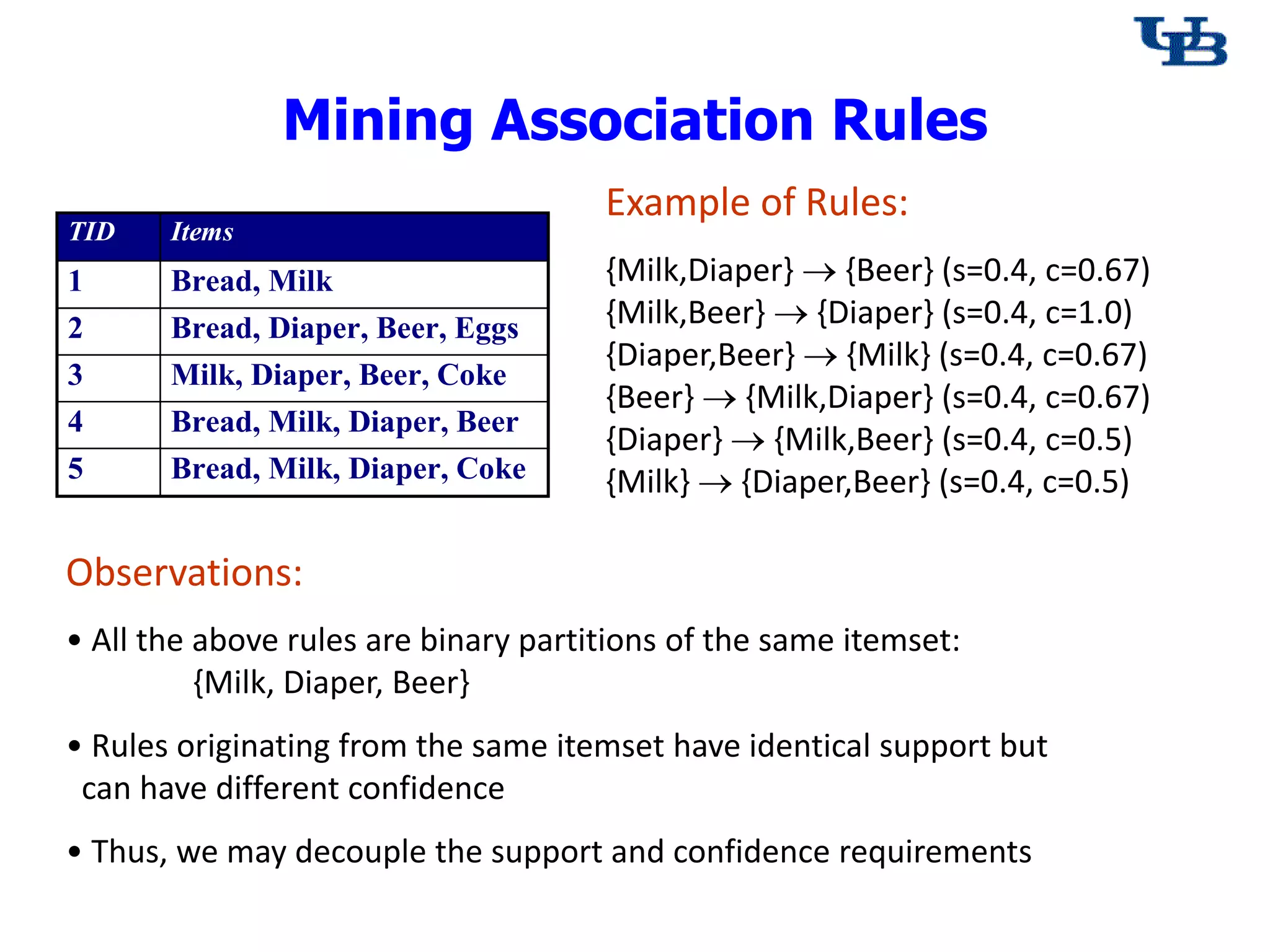
Example of Rules:
{Milk,Diaper}  {Beer} (s=0.4, c=0.67)
{Milk,Beer}  {Diaper} (s=0.4, c=1.0)
{Diaper,Beer}  {Milk} (s=0.4, c=0.67)
{Beer}  {Milk,Diaper} (s=0.4, c=0.67)
{Diaper}  {Milk,Beer} (s=0.4, c=0.5)
{Milk}  {Diaper,Beer} (s=0.4, c=0.5)
TID Items
1 Bread, Milk
2 Bread, Diaper, Beer, Eggs
3 Milk, Diaper, Beer, Coke
4 Bread, Milk, Diaper, Beer
5 Bread, Milk, Diaper, Coke
Observations:
• All the above rules are binary partitions of the same itemset:
{Milk, Diaper, Beer}
• Rules originating from the same itemset have identical support but
can have different confidence
• Thus, we may decouple the support and confidence requirements
Mining Association Rules
• Two-step approach:
1. Frequent Itemset Generation
– Generate all itemsets whose support  minsup
2. Rule Generation
– Generate high confidence rules from each frequent
itemset, where each rule is a binary partitioning of a
frequent itemset
• Frequent itemset generation is still
computationally expensive
Frequent Itemset Generation
null
AB AC AD AE BC BD BE CD CE DE
A B C D E
ABC ABD ABE ACD ACE ADE BCD BCE BDE CDE
ABCD ABCE ABDE ACDE BCDE
ABCDE
Given d items, there are
2d possible candidate
itemsets
Frequent Itemset Generation
• Brute-force approach:
– Each itemset in the lattice is a candidate frequent itemset
– Count the support of each candidate by scanning the
database
– Match each transaction against every candidate
TID Items
1 Bread, Milk
2 Bread, Diaper, Beer, Eggs
3 Milk, Diaper, Beer, Coke
4 Bread, Milk, Diaper, Beer
5 Bread, Milk, Diaper, Coke
N
Transactions List of
Candidates
M
w
Reducing Number of Candidates
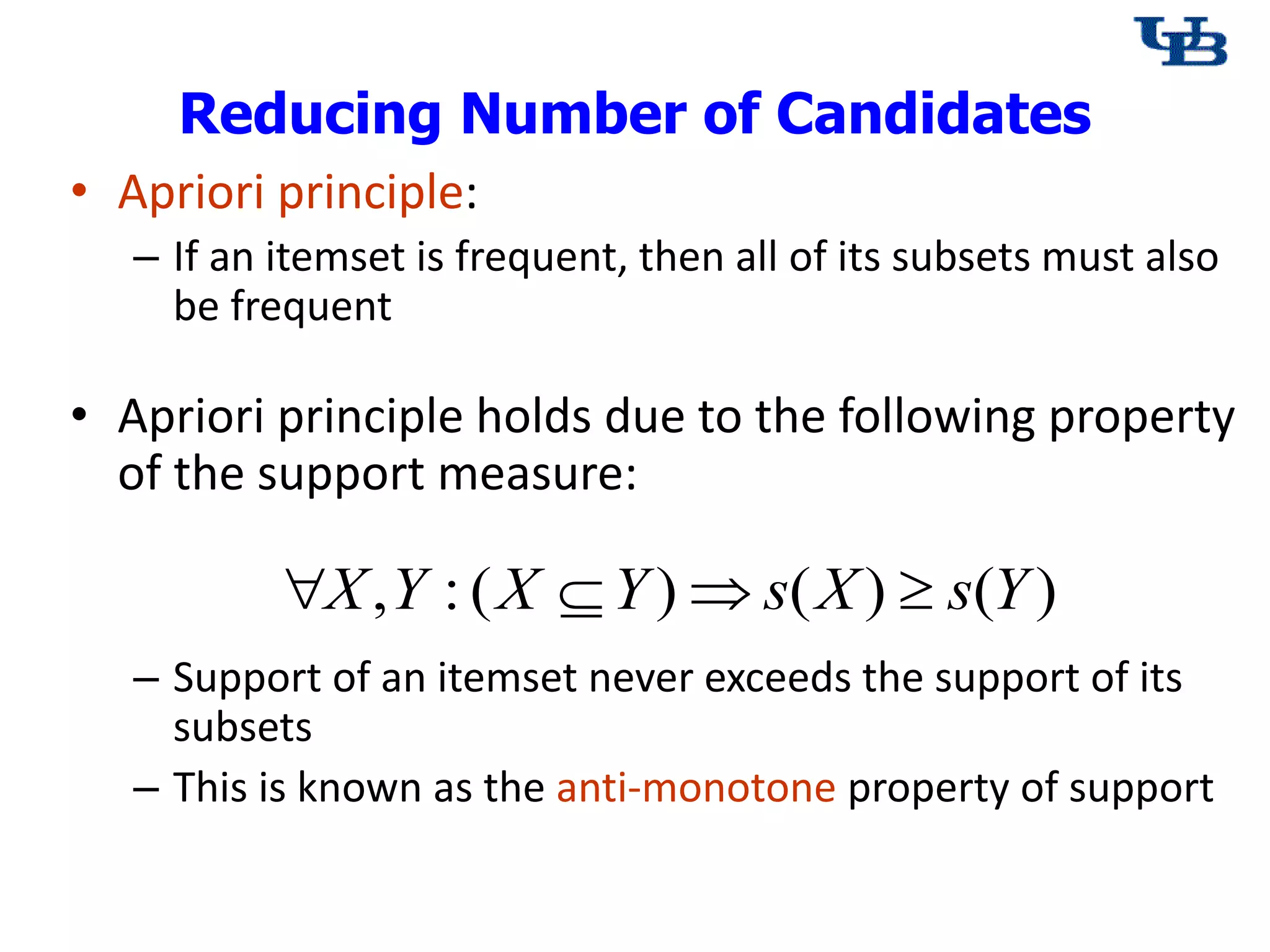
• Apriori principle:
– If an itemset is frequent, then all of its subsets must also
be frequent
• Apriori principle holds due to the following property
of the support measure:
– Support of an itemset never exceeds the support of its
subsets
– This is known as the anti-monotone property of support
)
(
)
(
)
(
:
, Y
s
X
s
Y
X
Y
X 



Found to be
Infrequent
null
AB AC AD AE BC BD BE CD CE DE
A B C D E
ABC ABD ABE ACD ACE ADE BCD BCE BDE CDE
ABCD ABCE ABDE ACDE BCDE
ABCDE
Illustrating Apriori Principle
null
AB AC AD AE BC BD BE CD CE DE
A B C D E
ABC ABD ABE ACD ACE ADE BCD BCE BDE CDE
ABCD ABCE ABDE ACDE BCDE
ABCDE
Pruned
supersets
12
The Apriori Algorithm—An Example
Database TDB
1st scan
C1
L1
L2
C2 C2
2nd scan
C3 L3
3rd scan
Tid Items
10 A, C, D
20 B, C, E
30 A, B, C, E
40 B, E
Itemset sup
{A} 2
{B} 3
{C} 3
{D} 1
{E} 3
Itemset sup
{A} 2
{B} 3
{C} 3
{E} 3
Itemset
{A, B}
{A, C}
{A, E}
{B, C}
{B, E}
{C, E}
Itemset sup
{A, B} 1
{A, C} 2
{A, E} 1
{B, C} 2
{B, E} 3
{C, E} 2
Itemset sup
{A, C} 2
{B, C} 2
{B, E} 3
{C, E} 2
Itemset
{B, C, E}
Itemset sup
{B, C, E} 2
Supmin = 2
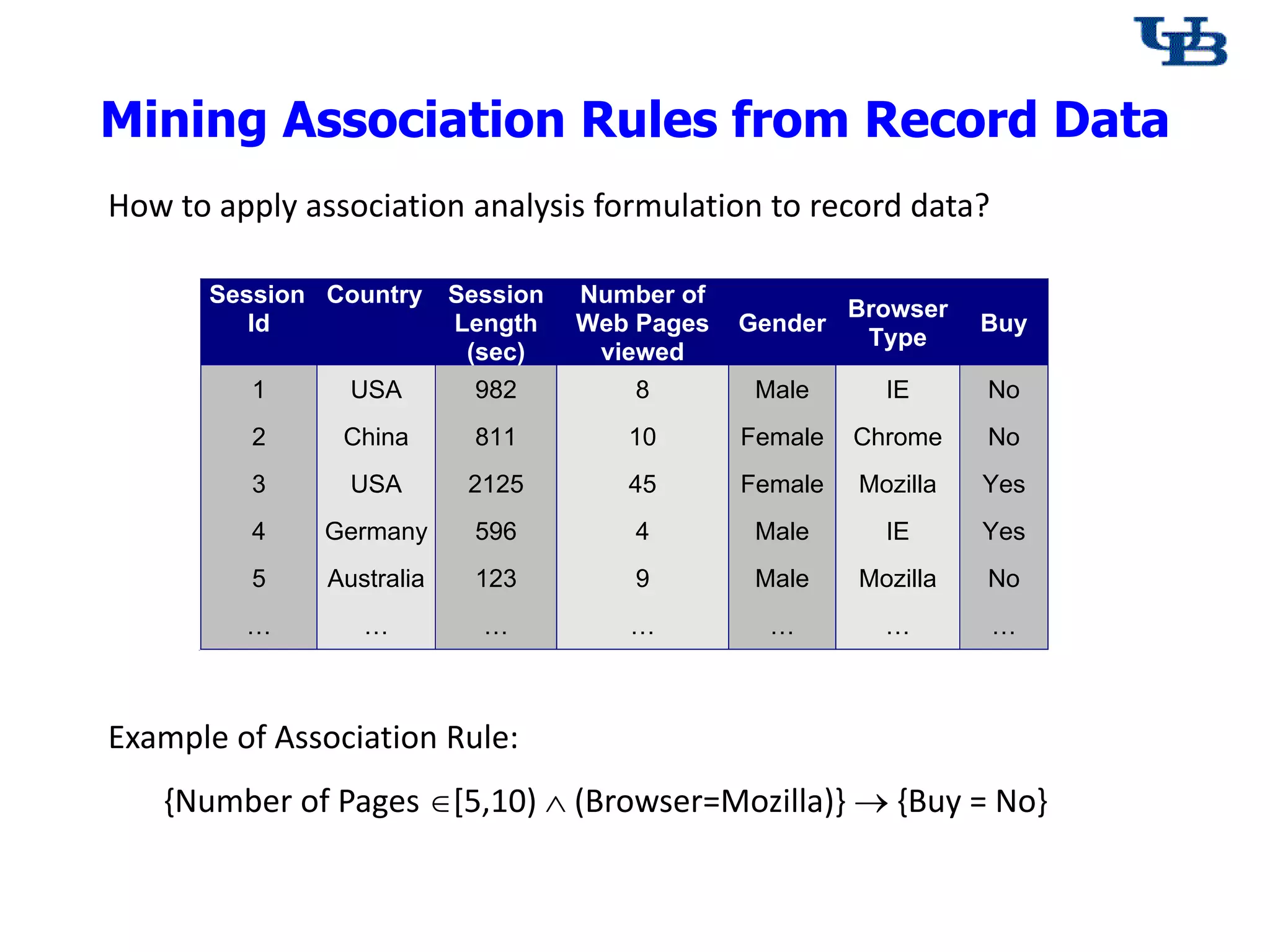
Mining Association Rules from Record Data
Session
Id
Country Session
Length
(sec)
Number of
Web Pages
viewed
Gender
Browser
Type
Buy
1 USA 982 8 Male IE No
2 China 811 10 Female Chrome No
3 USA 2125 45 Female Mozilla Yes
4 Germany 596 4 Male IE Yes
5 Australia 123 9 Male Mozilla No
… … … … … … …
10
Example of Association Rule:
{Number of Pages [5,10)  (Browser=Mozilla)}  {Buy = No}
How to apply association analysis formulation to record data?
Handling Categorical Attributes
• Transform categorical attribute into binary
variables
• Introduce a new “item” for each distinct
attribute-value pair
– Example: replace Browser Type attribute with
• Browser Type = Internet Explorer
• Browser Type = Mozilla
• Browser Type = Chrome
Handling Categorical Attributes
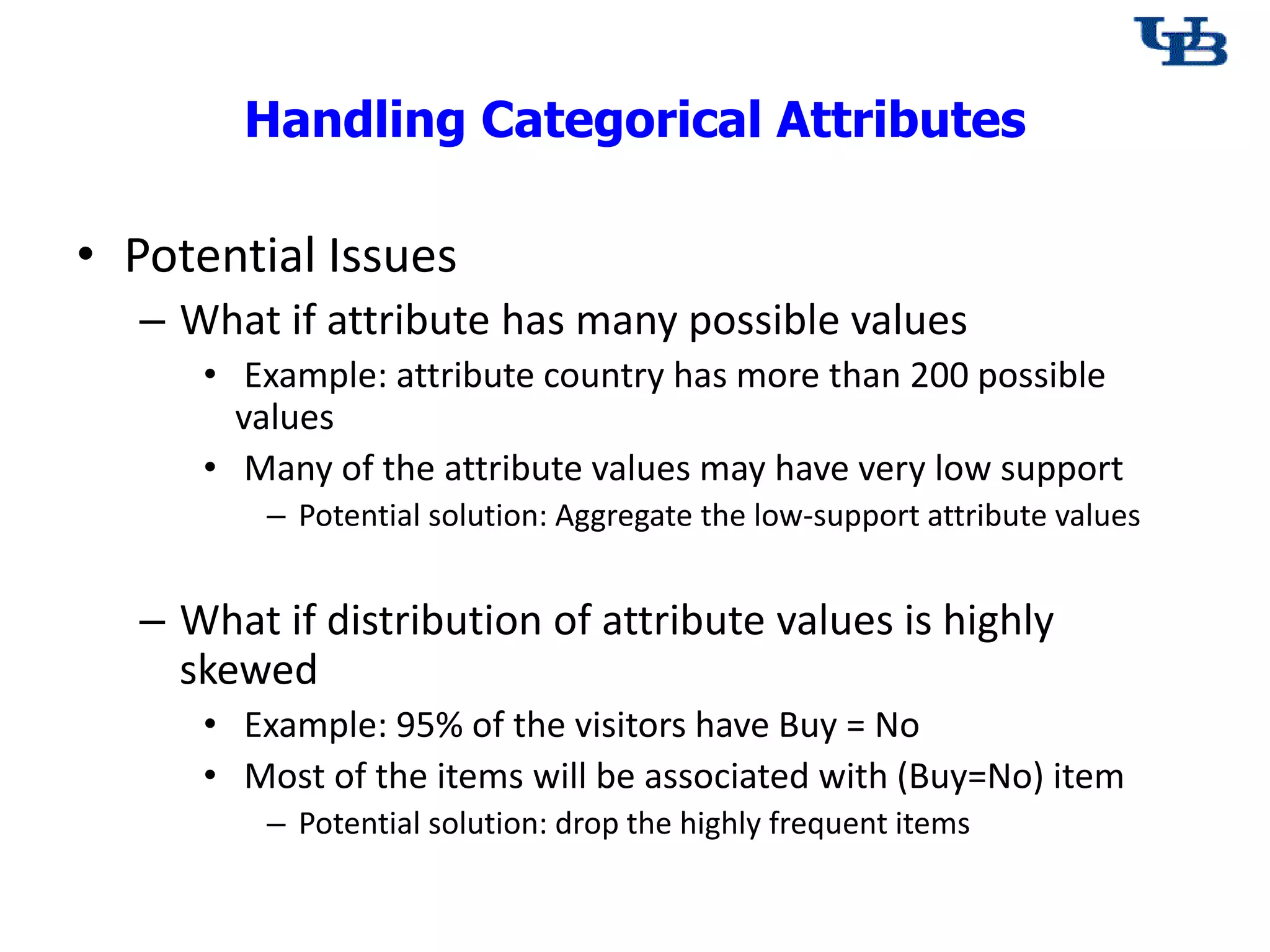
• Potential Issues
– What if attribute has many possible values
• Example: attribute country has more than 200 possible
values
• Many of the attribute values may have very low support
– Potential solution: Aggregate the low-support attribute values
– What if distribution of attribute values is highly
skewed
• Example: 95% of the visitors have Buy = No
• Most of the items will be associated with (Buy=No) item
– Potential solution: drop the highly frequent items
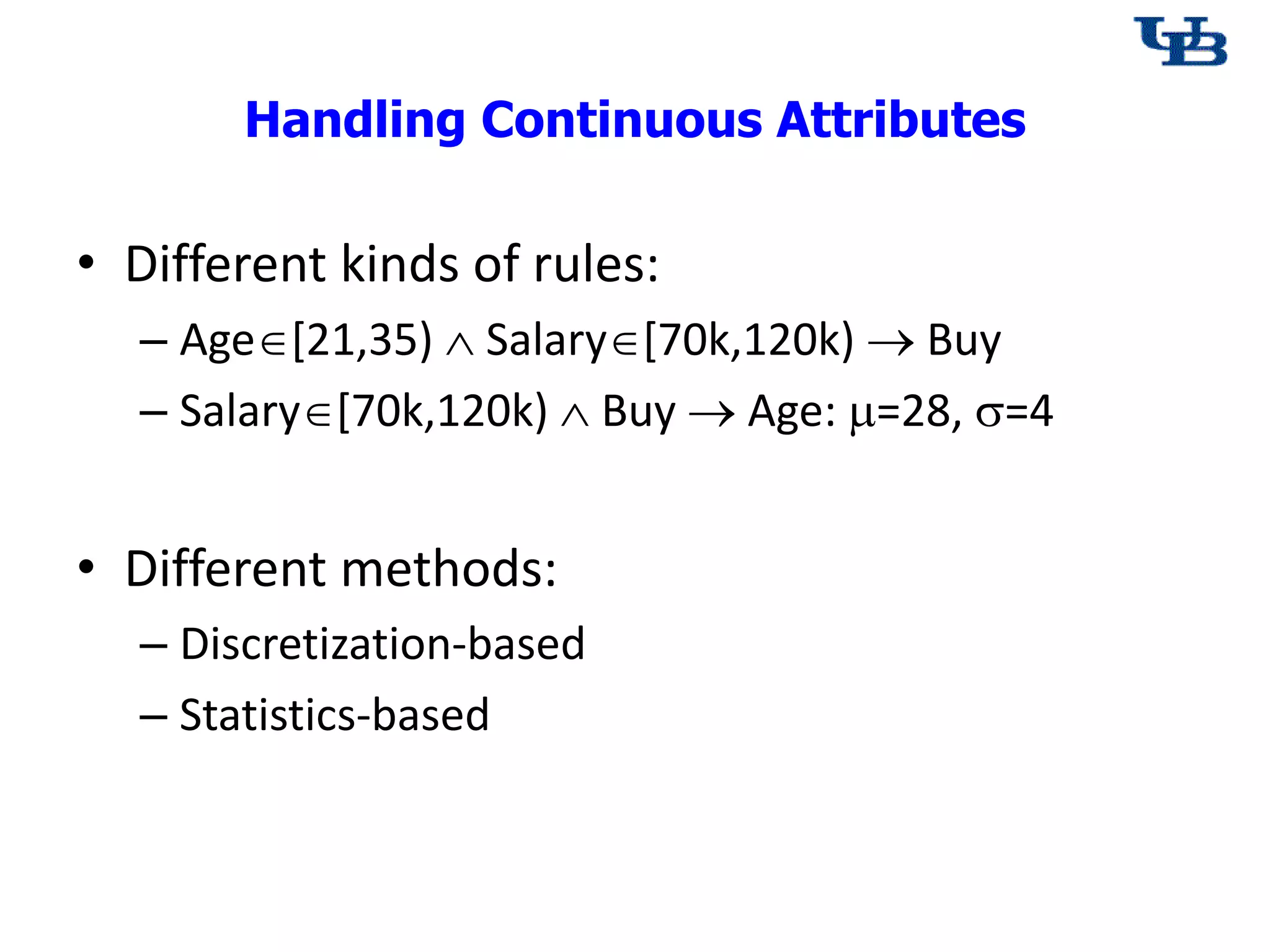
Handling Continuous Attributes
• Different kinds of rules:
– Age[21,35)  Salary[70k,120k)  Buy
– Salary[70k,120k)  Buy  Age: =28, =4
• Different methods:
– Discretization-based
– Statistics-based
Question
• Will association analysis help Wal-mart?
– Start with the “beer and diaper” story
– Discuss possible benefits and challenges in using
association analysis for supermarkets
17

AssociationRule.pdf

  • 1.
    Association Analysis UE 141Spring 2013 1 Jing Gao SUNY Buffalo
  • 2.
    Association Rule Mining •Given a set of transactions, find rules that will predict the occurrence of an item based on the occurrences of other items in the transaction Market-Basket transactions TID Items 1 Bread, Milk 2 Bread, Diaper, Beer, Eggs 3 Milk, Diaper, Beer, Coke 4 Bread, Milk, Diaper, Beer 5 Bread, Milk, Diaper, Coke Example of Association Rules {Diaper}  {Beer}, {Milk, Bread}  {Eggs,Coke}, {Beer, Bread}  {Milk}, Implication means co-occurrence, not causality!
  • 3.
    Definition: Frequent Itemset •Itemset – A collection of one or more items • Example: {Milk, Bread, Diaper} – k-itemset • An itemset that contains k items • Support count () – Frequency of occurrence of an itemset – E.g. ({Milk, Bread,Diaper}) = 2 • Support – Fraction of transactions that contain an itemset – E.g. s({Milk, Bread, Diaper}) = 2/5 • Frequent Itemset – An itemset whose support is greater than or equal to a minsup threshold TID Items 1 Bread, Milk 2 Bread, Diaper, Beer, Eggs 3 Milk, Diaper, Beer, Coke 4 Bread, Milk, Diaper, Beer 5 Bread, Milk, Diaper, Coke
  • 4.
    Definition: Association Rule Example: Beer } Diaper , Milk { 4 . 0 5 2 | T | ) Beer Diaper, , Milk (     s 67 . 0 3 2 ) Diaper , Milk ( ) Beer Diaper, Milk, (      c  Association Rule – An implication expression of the form X  Y, where X and Y are itemsets – Example: {Milk, Diaper}  {Beer}  Rule Evaluation Metrics – Support (s)  Fraction of transactions that contain both X and Y – Confidence (c)  Measures how often items in Y appear in transactions that contain X TID Items 1 Bread, Milk 2 Bread, Diaper, Beer, Eggs 3 Milk, Diaper, Beer, Coke 4 Bread, Milk, Diaper, Beer 5 Bread, Milk, Diaper, Coke
  • 5.
    Association Rule MiningTask • Given a set of transactions T, the goal of association rule mining is to find all rules having – support ≥ minsup threshold – confidence ≥ minconf threshold • Brute-force approach: – List all possible association rules – Compute the support and confidence for each rule – Prune rules that fail the minsup and minconf thresholds  Computationally prohibitive!
  • 6.
    Mining Association Rules Exampleof Rules: {Milk,Diaper}  {Beer} (s=0.4, c=0.67) {Milk,Beer}  {Diaper} (s=0.4, c=1.0) {Diaper,Beer}  {Milk} (s=0.4, c=0.67) {Beer}  {Milk,Diaper} (s=0.4, c=0.67) {Diaper}  {Milk,Beer} (s=0.4, c=0.5) {Milk}  {Diaper,Beer} (s=0.4, c=0.5) TID Items 1 Bread, Milk 2 Bread, Diaper, Beer, Eggs 3 Milk, Diaper, Beer, Coke 4 Bread, Milk, Diaper, Beer 5 Bread, Milk, Diaper, Coke Observations: • All the above rules are binary partitions of the same itemset: {Milk, Diaper, Beer} • Rules originating from the same itemset have identical support but can have different confidence • Thus, we may decouple the support and confidence requirements
  • 7.
    Mining Association Rules •Two-step approach: 1. Frequent Itemset Generation – Generate all itemsets whose support  minsup 2. Rule Generation – Generate high confidence rules from each frequent itemset, where each rule is a binary partitioning of a frequent itemset • Frequent itemset generation is still computationally expensive
  • 8.
    Frequent Itemset Generation null ABAC AD AE BC BD BE CD CE DE A B C D E ABC ABD ABE ACD ACE ADE BCD BCE BDE CDE ABCD ABCE ABDE ACDE BCDE ABCDE Given d items, there are 2d possible candidate itemsets
  • 9.
    Frequent Itemset Generation •Brute-force approach: – Each itemset in the lattice is a candidate frequent itemset – Count the support of each candidate by scanning the database – Match each transaction against every candidate TID Items 1 Bread, Milk 2 Bread, Diaper, Beer, Eggs 3 Milk, Diaper, Beer, Coke 4 Bread, Milk, Diaper, Beer 5 Bread, Milk, Diaper, Coke N Transactions List of Candidates M w
  • 10.
    Reducing Number ofCandidates • Apriori principle: – If an itemset is frequent, then all of its subsets must also be frequent • Apriori principle holds due to the following property of the support measure: – Support of an itemset never exceeds the support of its subsets – This is known as the anti-monotone property of support ) ( ) ( ) ( : , Y s X s Y X Y X    
  • 11.
    Found to be Infrequent null ABAC AD AE BC BD BE CD CE DE A B C D E ABC ABD ABE ACD ACE ADE BCD BCE BDE CDE ABCD ABCE ABDE ACDE BCDE ABCDE Illustrating Apriori Principle null AB AC AD AE BC BD BE CD CE DE A B C D E ABC ABD ABE ACD ACE ADE BCD BCE BDE CDE ABCD ABCE ABDE ACDE BCDE ABCDE Pruned supersets
  • 12.
    12 The Apriori Algorithm—AnExample Database TDB 1st scan C1 L1 L2 C2 C2 2nd scan C3 L3 3rd scan Tid Items 10 A, C, D 20 B, C, E 30 A, B, C, E 40 B, E Itemset sup {A} 2 {B} 3 {C} 3 {D} 1 {E} 3 Itemset sup {A} 2 {B} 3 {C} 3 {E} 3 Itemset {A, B} {A, C} {A, E} {B, C} {B, E} {C, E} Itemset sup {A, B} 1 {A, C} 2 {A, E} 1 {B, C} 2 {B, E} 3 {C, E} 2 Itemset sup {A, C} 2 {B, C} 2 {B, E} 3 {C, E} 2 Itemset {B, C, E} Itemset sup {B, C, E} 2 Supmin = 2
  • 13.
    Mining Association Rulesfrom Record Data Session Id Country Session Length (sec) Number of Web Pages viewed Gender Browser Type Buy 1 USA 982 8 Male IE No 2 China 811 10 Female Chrome No 3 USA 2125 45 Female Mozilla Yes 4 Germany 596 4 Male IE Yes 5 Australia 123 9 Male Mozilla No … … … … … … … 10 Example of Association Rule: {Number of Pages [5,10)  (Browser=Mozilla)}  {Buy = No} How to apply association analysis formulation to record data?
  • 14.
    Handling Categorical Attributes •Transform categorical attribute into binary variables • Introduce a new “item” for each distinct attribute-value pair – Example: replace Browser Type attribute with • Browser Type = Internet Explorer • Browser Type = Mozilla • Browser Type = Chrome
  • 15.
    Handling Categorical Attributes •Potential Issues – What if attribute has many possible values • Example: attribute country has more than 200 possible values • Many of the attribute values may have very low support – Potential solution: Aggregate the low-support attribute values – What if distribution of attribute values is highly skewed • Example: 95% of the visitors have Buy = No • Most of the items will be associated with (Buy=No) item – Potential solution: drop the highly frequent items
  • 16.
    Handling Continuous Attributes •Different kinds of rules: – Age[21,35)  Salary[70k,120k)  Buy – Salary[70k,120k)  Buy  Age: =28, =4 • Different methods: – Discretization-based – Statistics-based
  • 17.
    Question • Will associationanalysis help Wal-mart? – Start with the “beer and diaper” story – Discuss possible benefits and challenges in using association analysis for supermarkets 17