MATCHING SUPPLY & DEMAND IN
SERVICE INDUSTRY , CRM & MGMT
STRATEGY
BY

DEVANAND MENON
PRATHAMESH PARAB
OBJECTIVE
• Explain:
• the underlying issue for capacity-constrained services
• the implications of capacity constraints
• the implications of different types of demand patterns on
matching supply and demand
• Lay out strategies for matching supply and demand
through:
• shifting demand to match capacity or
• flexing capacity to meet demand
• Demonstrate the benefits and risks of yield management
strategies
• Provide strategies for managing waiting lines
Fundamental Issue
the underlying issue for capacity-constrained

services
Lack of inventory



perishability (cannot store up)
simultaneous product and consumption (cannot be
transported from one place to another)
Managing Demand and Capacity
 No buffer for services from

demand.
 Demand volatile
 Goal: supply and demand
balanced at optimum
capacity
 Under utilizing when
demand is below optimum
capacity
 If demand is above
capacity then quality may
suffer
What is the Nature of Demand Relative to
Supply?
Extent to which
supply is
constrained
Peak demand
can usually be
met without a
major delay

Peak demand
regularly
exceeds
capacity

Wide

Narrow

1

2

Electricity
Natural gas
Telephone
Hospital maternity unit
Police and fire
emergencies

Insurance
Legal services
Banking
Laundry and dry cleaning

4
Accounting and tax
preparation
Passenger
transportation
Hotels and motels
Restaurants

3
Services similar to those
in 2 but which have
insufficient capacity for
their base level of
business
Understanding Capacity Constraints and
Demand Patterns
Capacity Constraints
Time, labor,

equipment and
facilities
Optimal versus
maximal use of
capacity

Demand Patterns

• Charting demand
patterns
• Predictable cycles
• Random demand
fluctuations
• Demand patterns
by market segment
Managing Demand
Shift demand from

high to low demand
periods.
Decrease demand
during peak demand
periods.
Stimulate demand
during low demand
periods.
Strategies for Shifting Demand
to Match Capacity
Demand Too High

Demand Too Low
Shift Demand

•
•
•
•
•

Use signage to communicate
busy days and times
Offer incentives to customers for
usage during non-peak times
Take care of loyal or regular
customers first
Advertise peak usage times and
benefits of non-peak use
Charge full price for the service-no discounts

•
•
•
•
•

Use sales and advertising to
increase business from
current market segments
Modify the service offering
to appeal to new market
segments
Offer discounts or price
reductions
Modify hours of operation
Bring the service to the
customer
Shifting Demand

Advantages

Disadvantages

Business is not lost.

Customers may not

Service quality is not

want to shift.
Customers may not
have control over when
they use the service.

adversely affected.
Increased efficiency.
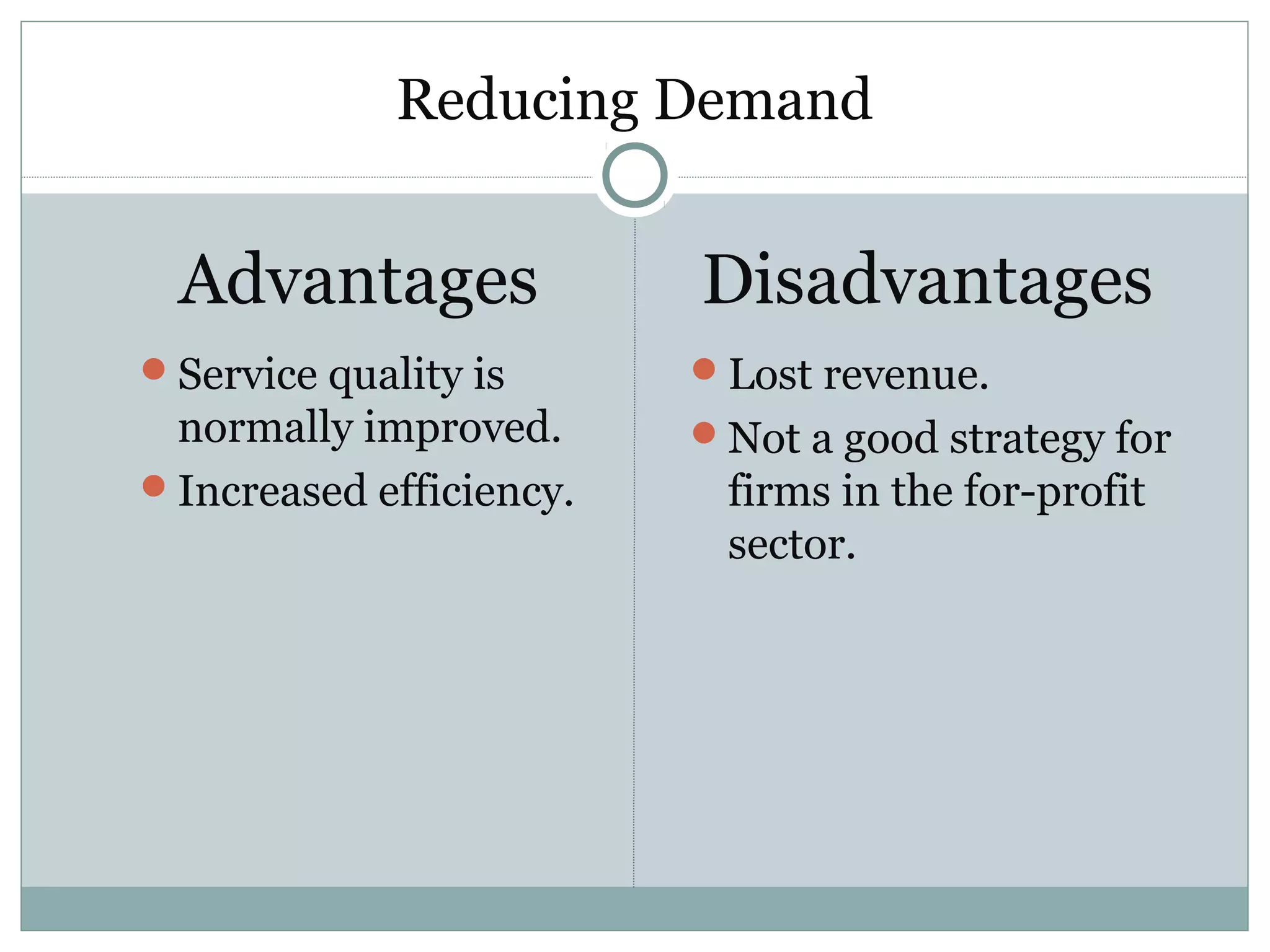
Reducing Demand

Advantages

Disadvantages

Service quality is

Lost revenue.

normally improved.
Increased efficiency.

Not a good strategy for

firms in the for-profit
sector.
Stimulating Demand

Advantages

Disadvantages

Increased

May not be

efficiency.
Increased income.
Increased
utilization of
facility.

profitable.
May cause some
current customers
to shift usage.
Tools for Managing Demand

Reservation

system.
Differential
pricing.
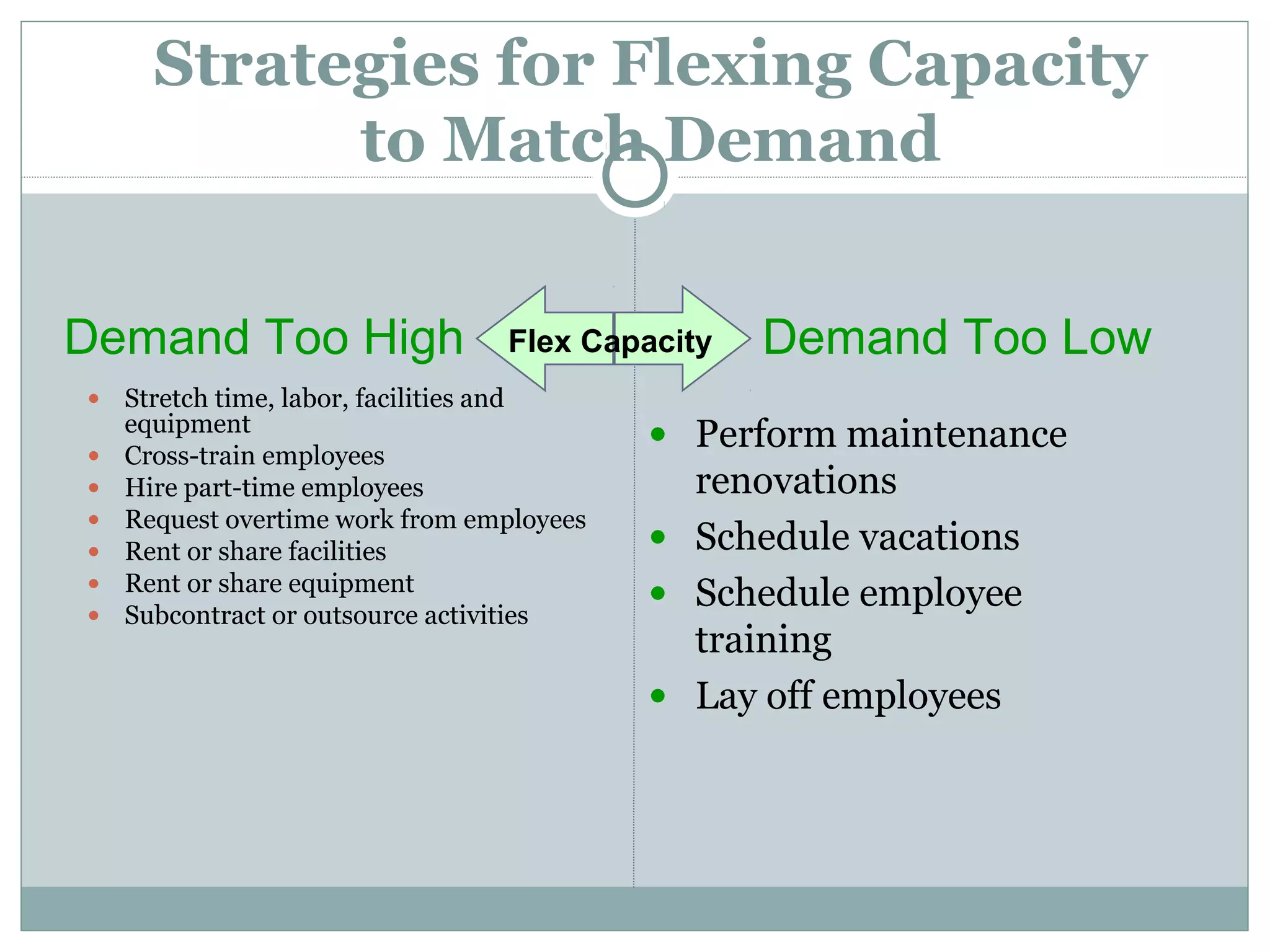
Strategies for Flexing Capacity
to Match Demand
Demand Too High
•
•
•
•
•
•
•

Flex Capacity

Stretch time, labor, facilities and
equipment
Cross-train employees
Hire part-time employees
Request overtime work from employees
Rent or share facilities
Rent or share equipment
Subcontract or outsource activities

•
•
•
•

Demand Too Low

Perform maintenance
renovations
Schedule vacations
Schedule employee
training
Lay off employees
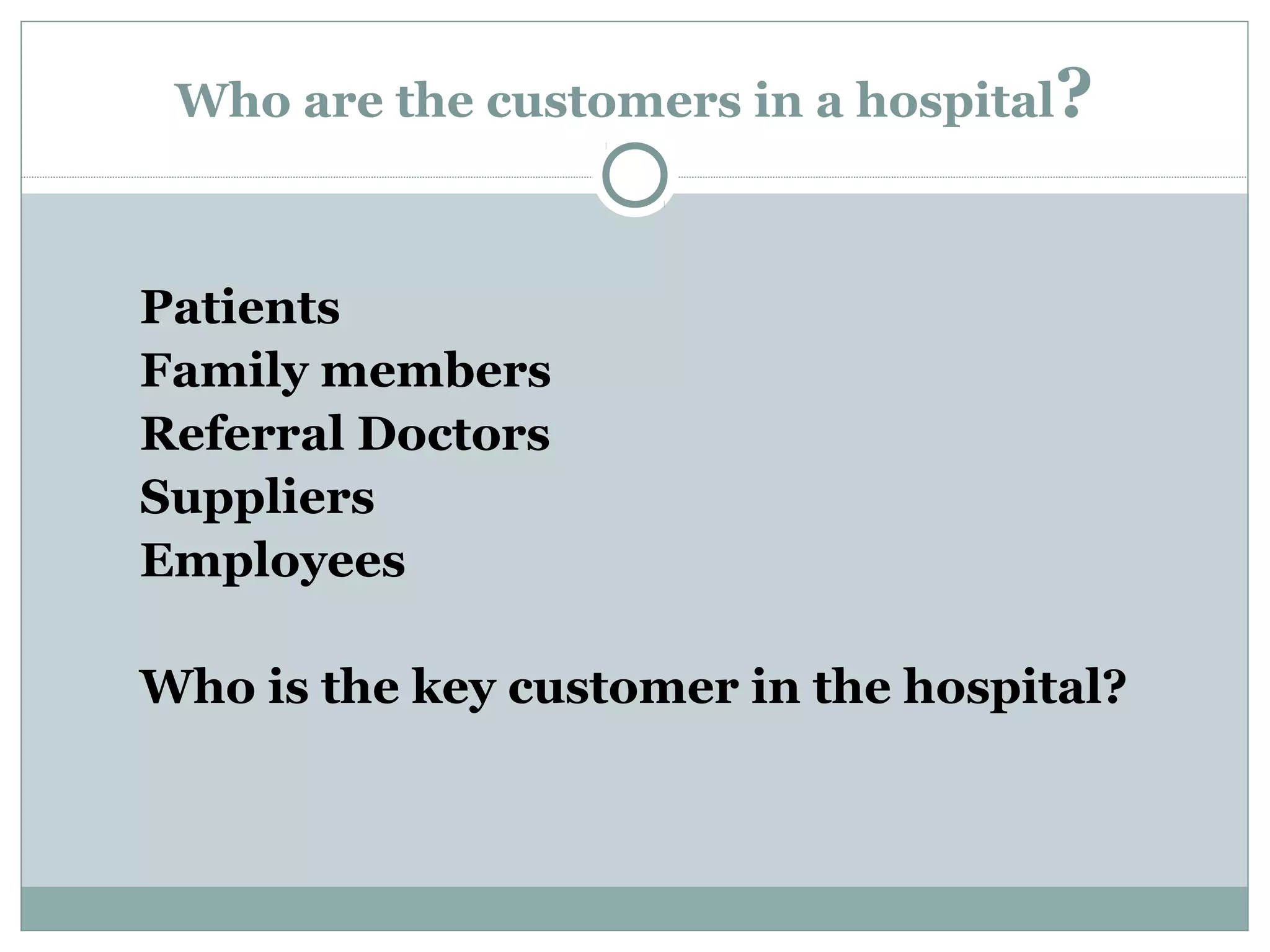
Who are the customers in a hospital?

Patients
Family members
Referral Doctors
Suppliers
Employees
Who is the key customer in the hospital?
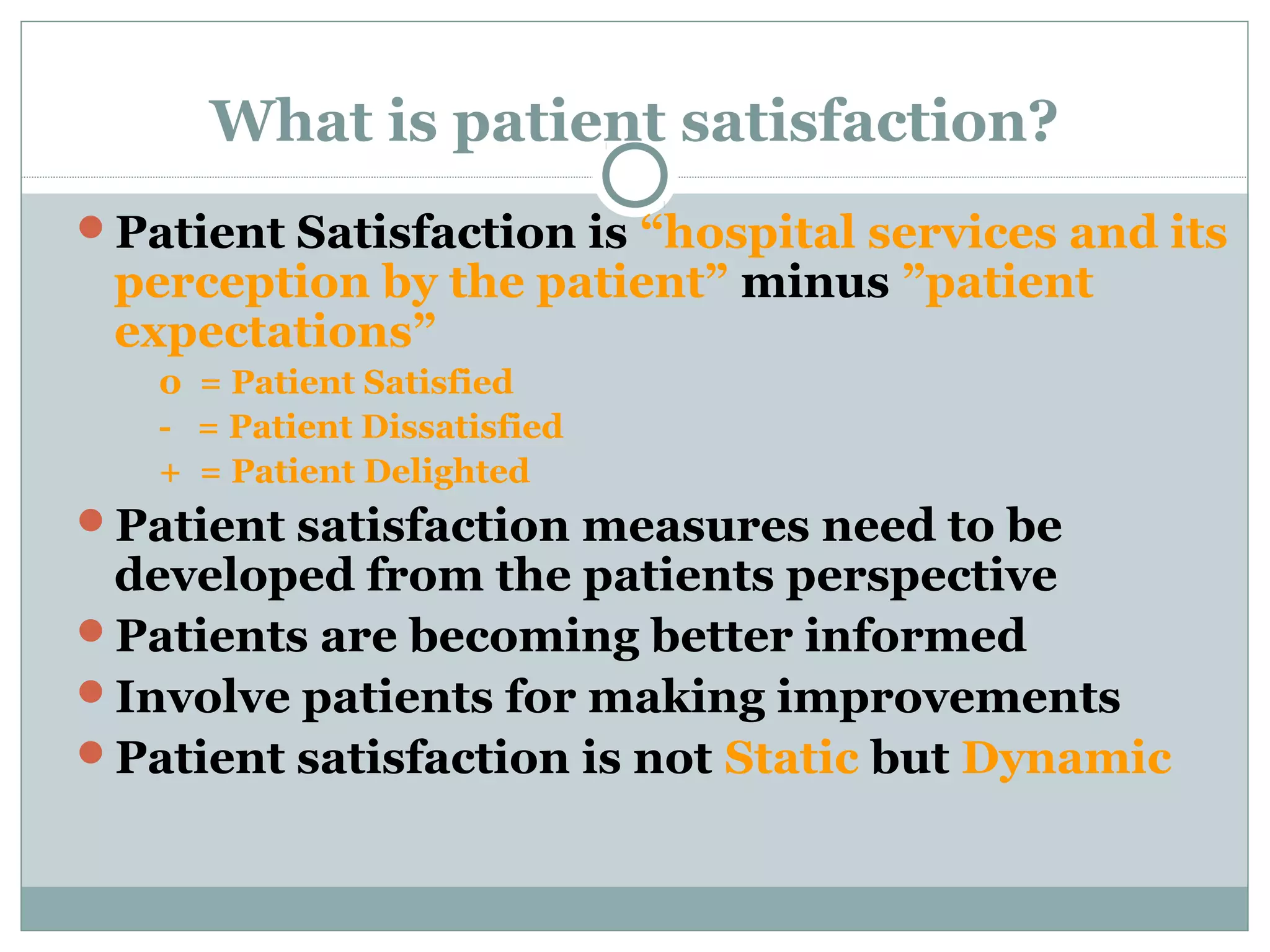
What is patient satisfaction?
Patient Satisfaction is “hospital services and its

perception by the patient” minus ”patient
expectations”
0 = Patient Satisfied
- = Patient Dissatisfied
+ = Patient Delighted

Patient satisfaction measures need to be

developed from the patients perspective
Patients are becoming better informed
Involve patients for making improvements
Patient satisfaction is not Static but Dynamic
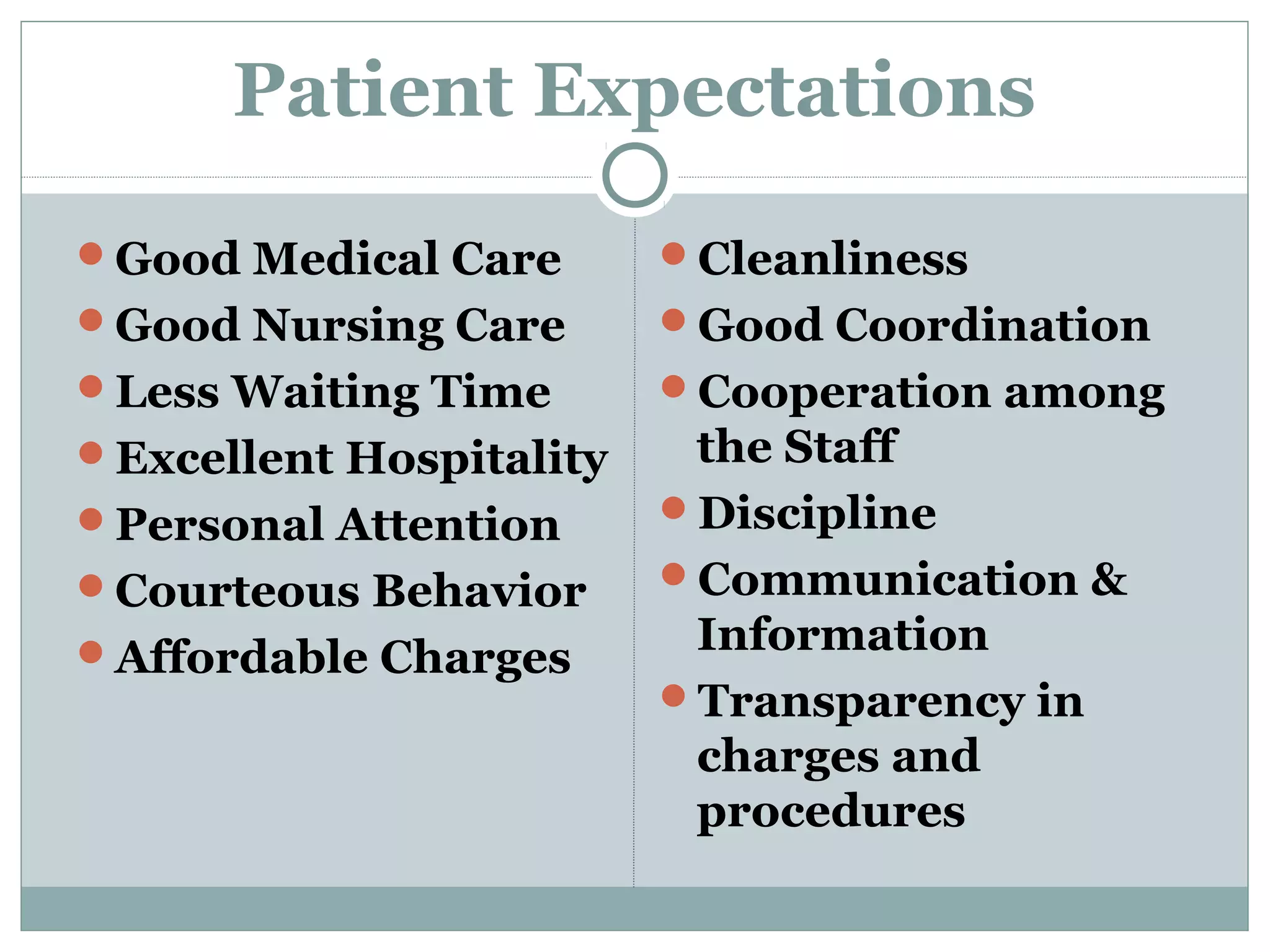
Patient Expectations
Good Medical Care

Cleanliness

Good Nursing Care

Good Coordination

Less Waiting Time

Cooperation among

Excellent Hospitality

the Staff
Discipline
Communication &
Information
Transparency in
charges and
procedures

Personal Attention
Courteous Behavior
Affordable Charges
Challenges in Service Marketing

Giving a feel for the “product”
Managing Demand Fluctuations
Maintaining Quality
Cost Containment
Attitudinal block in using proven marketing

principles in service marketing
Factors that promote Demand Perspective

Services are available for longer or

convenient hours
Patients are provided information through
Brochures, Publicity, etc on services
available
Services are reliable and offered promptly
Required equipment are available
Patient friendly Systems & Procedures
Factors that promote Demand
- Accessibility Perspective

Good public transportation
Centrally located
Outreach Programs to reach out to the

Rural People
Factors that promote Demand
- Affordability Perspective

Standard pricing structure
Charges affordable by most of the people in

the Community
Transparency in Patient Fees – no hidden
charges
Simple procedure for getting
free/subsidized care
Factors that increase Demand

- Promotion Avenues
Structured approach with designated staff
Good Rapport with Community
Publicity through different media
Promotion at Outreach activities
Meetings/seminars for other doctors
Developing a referral network
Promotion through satisfied patients
Industrial tie-up for routine examination of

their employees
Factors that affect Demand
- Attitude Perspective

Reasons for Low Demand:
Sophisticated technology will automatically
trigger demand
Belief that patients, if need eye care, will
definitely come to us
Providing Service as per Providers’ Convenience
Systems & Procedures are not patient friendly
Gap between Patients’ Expectations &
Providers’ Perception
Lack of patient orientation
Factors that demand attitude :- perspective

Skilled Doctor & other staff
Standard Clinical Protocol
Good Administrative System & Procedures
Courtesy & Politeness
Proper Explanation
Clean environment and comforts meeting

or exceeding expectations
Systems to monitor clinical outcomes &
Patient satisfaction
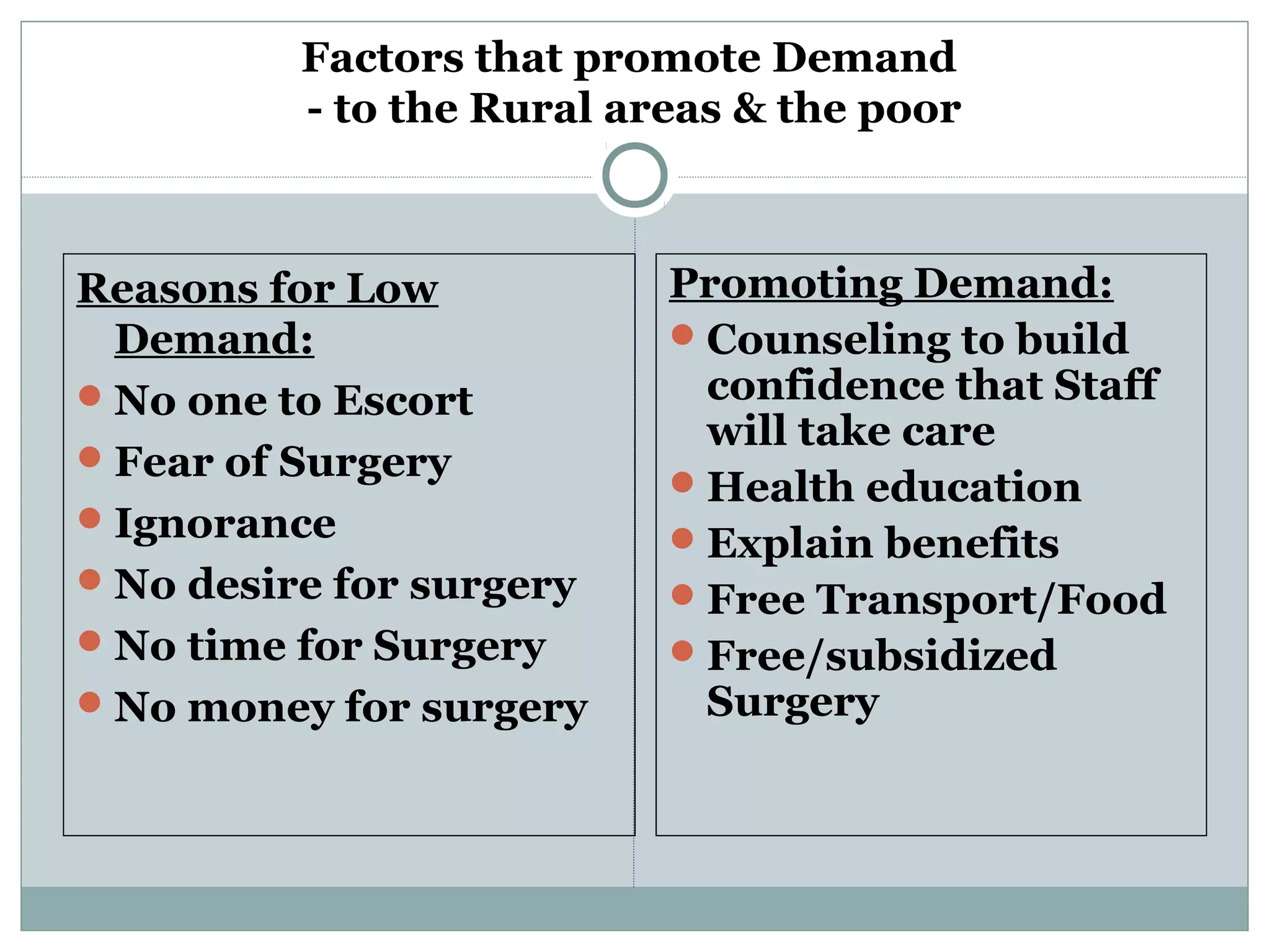
Factors that promote Demand
- to the Rural areas & the poor

Reasons for Low
Demand:
 No one to Escort
 Fear of Surgery
 Ignorance
 No desire for surgery
 No time for Surgery
 No money for surgery

Promoting Demand:
 Counseling to build
confidence that Staff
will take care
 Health education
 Explain benefits
 Free Transport/Food
 Free/subsidized
Surgery
CRM AND STRATEGY
MANAGEMENT
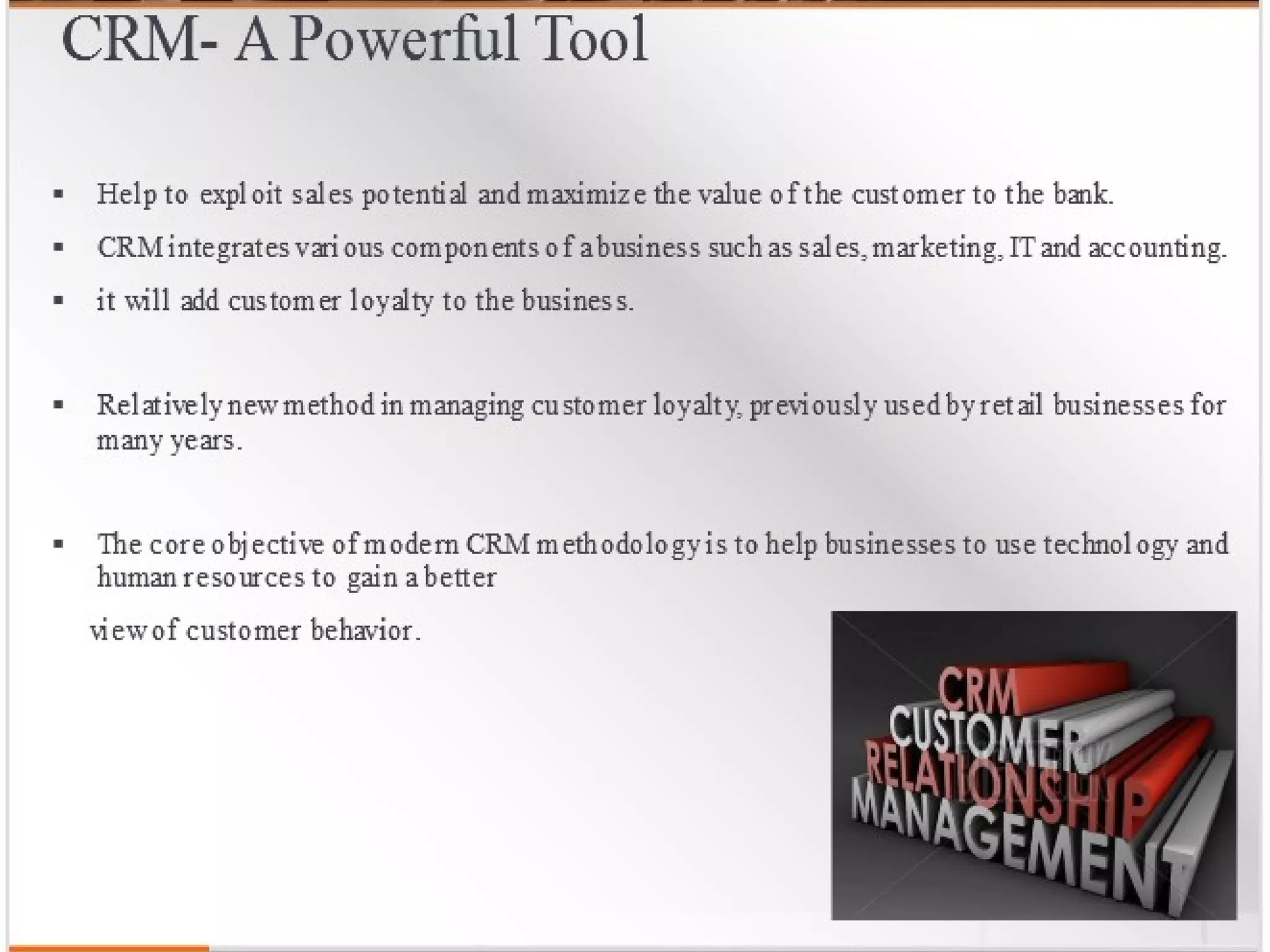
What is CRM?
•

The approach of identifying, establishing,
maintaining, and enhancing lasting relationships
with customers.”

•

CRM “is a business strategy that aims to
understand, anticipate and manage the needs of
an organisation’s current and potential customers”.
(know,target,sell,service)

•

CRM is a shift from traditional marketing as it
focuses on the retention of customers in addition
to the acquisition of new customers
Customer

CRM

Relationship Management ICICI.pdf
Matching Supply & Demand & CRM

Matching Supply & Demand & CRM

  • 1.
    MATCHING SUPPLY &DEMAND IN SERVICE INDUSTRY , CRM & MGMT STRATEGY BY DEVANAND MENON PRATHAMESH PARAB
  • 2.
    OBJECTIVE • Explain: • theunderlying issue for capacity-constrained services • the implications of capacity constraints • the implications of different types of demand patterns on matching supply and demand • Lay out strategies for matching supply and demand through: • shifting demand to match capacity or • flexing capacity to meet demand • Demonstrate the benefits and risks of yield management strategies • Provide strategies for managing waiting lines
  • 3.
    Fundamental Issue the underlyingissue for capacity-constrained services Lack of inventory   perishability (cannot store up) simultaneous product and consumption (cannot be transported from one place to another)
  • 4.
    Managing Demand andCapacity  No buffer for services from demand.  Demand volatile  Goal: supply and demand balanced at optimum capacity  Under utilizing when demand is below optimum capacity  If demand is above capacity then quality may suffer
  • 5.
    What is theNature of Demand Relative to Supply? Extent to which supply is constrained Peak demand can usually be met without a major delay Peak demand regularly exceeds capacity Wide Narrow 1 2 Electricity Natural gas Telephone Hospital maternity unit Police and fire emergencies Insurance Legal services Banking Laundry and dry cleaning 4 Accounting and tax preparation Passenger transportation Hotels and motels Restaurants 3 Services similar to those in 2 but which have insufficient capacity for their base level of business
  • 6.
    Understanding Capacity Constraintsand Demand Patterns Capacity Constraints Time, labor, equipment and facilities Optimal versus maximal use of capacity Demand Patterns • Charting demand patterns • Predictable cycles • Random demand fluctuations • Demand patterns by market segment
  • 7.
    Managing Demand Shift demandfrom high to low demand periods. Decrease demand during peak demand periods. Stimulate demand during low demand periods.
  • 8.
    Strategies for ShiftingDemand to Match Capacity Demand Too High Demand Too Low Shift Demand • • • • • Use signage to communicate busy days and times Offer incentives to customers for usage during non-peak times Take care of loyal or regular customers first Advertise peak usage times and benefits of non-peak use Charge full price for the service-no discounts • • • • • Use sales and advertising to increase business from current market segments Modify the service offering to appeal to new market segments Offer discounts or price reductions Modify hours of operation Bring the service to the customer
  • 9.
    Shifting Demand Advantages Disadvantages Business isnot lost. Customers may not Service quality is not want to shift. Customers may not have control over when they use the service. adversely affected. Increased efficiency.
  • 10.
    Reducing Demand Advantages Disadvantages Service qualityis Lost revenue. normally improved. Increased efficiency. Not a good strategy for firms in the for-profit sector.
  • 11.
    Stimulating Demand Advantages Disadvantages Increased May notbe efficiency. Increased income. Increased utilization of facility. profitable. May cause some current customers to shift usage.
  • 12.
    Tools for ManagingDemand Reservation system. Differential pricing.
  • 13.
    Strategies for FlexingCapacity to Match Demand Demand Too High • • • • • • • Flex Capacity Stretch time, labor, facilities and equipment Cross-train employees Hire part-time employees Request overtime work from employees Rent or share facilities Rent or share equipment Subcontract or outsource activities • • • • Demand Too Low Perform maintenance renovations Schedule vacations Schedule employee training Lay off employees
  • 14.
    Who are thecustomers in a hospital? Patients Family members Referral Doctors Suppliers Employees Who is the key customer in the hospital?
  • 15.
    What is patientsatisfaction? Patient Satisfaction is “hospital services and its perception by the patient” minus ”patient expectations” 0 = Patient Satisfied - = Patient Dissatisfied + = Patient Delighted Patient satisfaction measures need to be developed from the patients perspective Patients are becoming better informed Involve patients for making improvements Patient satisfaction is not Static but Dynamic
  • 16.
    Patient Expectations Good MedicalCare Cleanliness Good Nursing Care Good Coordination Less Waiting Time Cooperation among Excellent Hospitality the Staff Discipline Communication & Information Transparency in charges and procedures Personal Attention Courteous Behavior Affordable Charges
  • 17.
    Challenges in ServiceMarketing Giving a feel for the “product” Managing Demand Fluctuations Maintaining Quality Cost Containment Attitudinal block in using proven marketing principles in service marketing
  • 18.
    Factors that promoteDemand Perspective Services are available for longer or convenient hours Patients are provided information through Brochures, Publicity, etc on services available Services are reliable and offered promptly Required equipment are available Patient friendly Systems & Procedures
  • 19.
    Factors that promoteDemand - Accessibility Perspective Good public transportation Centrally located Outreach Programs to reach out to the Rural People
  • 20.
    Factors that promoteDemand - Affordability Perspective Standard pricing structure Charges affordable by most of the people in the Community Transparency in Patient Fees – no hidden charges Simple procedure for getting free/subsidized care
  • 21.
    Factors that increaseDemand - Promotion Avenues Structured approach with designated staff Good Rapport with Community Publicity through different media Promotion at Outreach activities Meetings/seminars for other doctors Developing a referral network Promotion through satisfied patients Industrial tie-up for routine examination of their employees
  • 22.
    Factors that affectDemand - Attitude Perspective Reasons for Low Demand: Sophisticated technology will automatically trigger demand Belief that patients, if need eye care, will definitely come to us Providing Service as per Providers’ Convenience Systems & Procedures are not patient friendly Gap between Patients’ Expectations & Providers’ Perception Lack of patient orientation
  • 23.
    Factors that demandattitude :- perspective Skilled Doctor & other staff Standard Clinical Protocol Good Administrative System & Procedures Courtesy & Politeness Proper Explanation Clean environment and comforts meeting or exceeding expectations Systems to monitor clinical outcomes & Patient satisfaction
  • 24.
    Factors that promoteDemand - to the Rural areas & the poor Reasons for Low Demand:  No one to Escort  Fear of Surgery  Ignorance  No desire for surgery  No time for Surgery  No money for surgery Promoting Demand:  Counseling to build confidence that Staff will take care  Health education  Explain benefits  Free Transport/Food  Free/subsidized Surgery
  • 25.
  • 27.
    What is CRM? • Theapproach of identifying, establishing, maintaining, and enhancing lasting relationships with customers.” • CRM “is a business strategy that aims to understand, anticipate and manage the needs of an organisation’s current and potential customers”. (know,target,sell,service) • CRM is a shift from traditional marketing as it focuses on the retention of customers in addition to the acquisition of new customers
  • 45.