CCARBON
DRAINAGE
OF
PEATLANDS
1 2 3 4
CCARBON
C0068e/1/04.16
©FAO, 2016
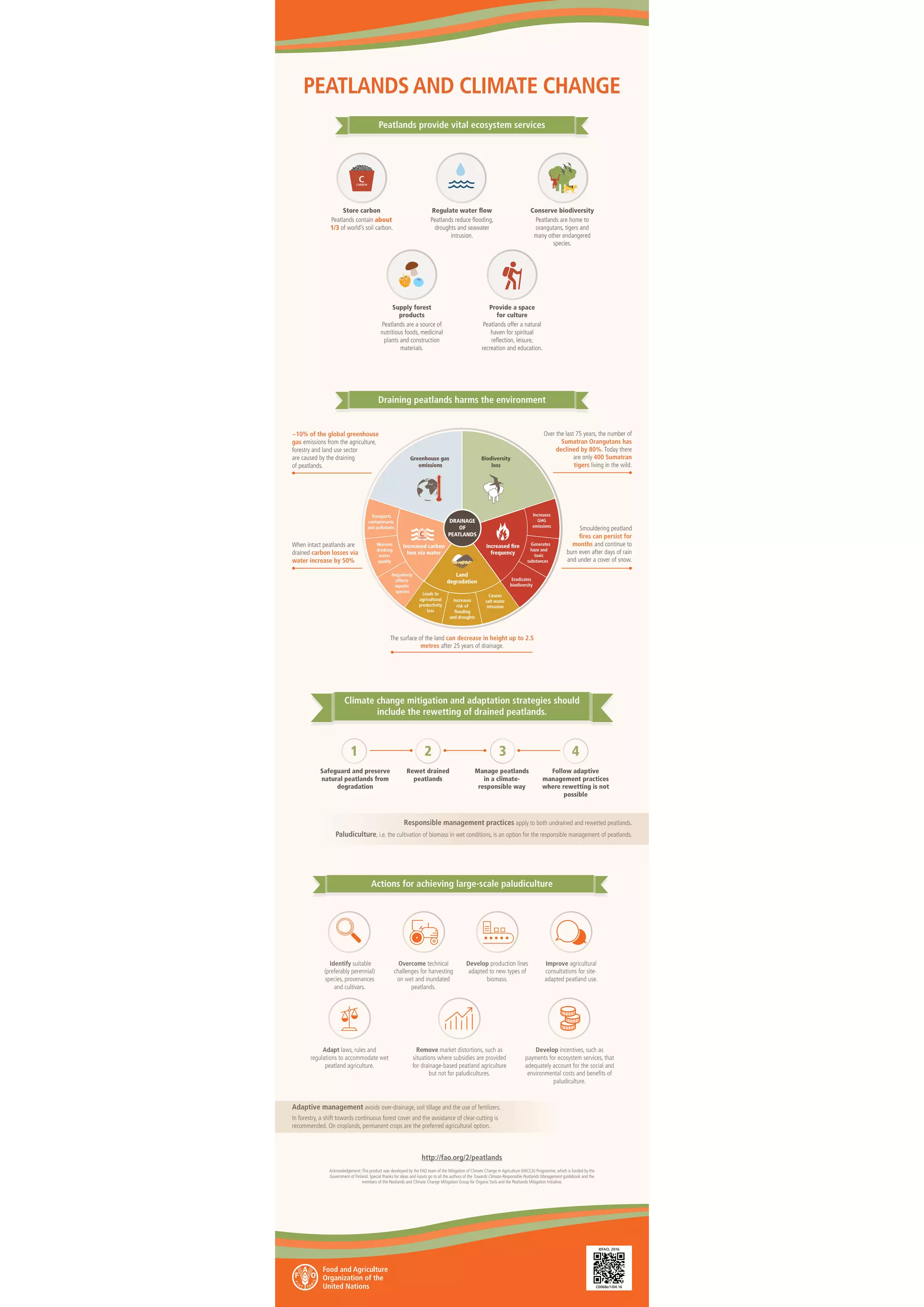
PEATLANDS AND CLIMATE CHANGEPEATLANDS AND CLIMATE CHANGE
Peatlands provide vital ecosystem services
Store carbon
Peatlands contain about
1/3 of world’s soil carbon.
Regulate water flow
Peatlands reduce flooding,
droughts and seawater
intrusion.
Conserve biodiversity
Peatlands are home to
orangutans, tigers and
many other endangered
species.
Supply forest
products
Peatlands are a source of
nutritious foods, medicinal
plants and construction
materials.
Provide a space
for culture
Peatlands offer a natural
haven for spiritual
reflection, leisure,
recreation and education.
The surface of the land can decrease in height up to 2.5
metres after 25 years of drainage.
~10% of the global greenhouse
gas emissions from the agriculture,
forestry and land use sector
are caused by the draining
of peatlands.
Over the last 75 years, the number of
Sumatran Orangutans has
declined by 80%. Today there
are only 400 Sumatran
tigers living in the wild.
When intact peatlands are
drained carbon losses via
water increase by 50%
Smouldering peatland
fires can persist for
months and continue to
burn even after days of rain
and under a cover of snow.
Greenhouse gas
emissions
Biodiversity
loss
Increased fire
frequency
Eradicates
biodiversity
Worsens
drinking
water
quality
Leads to
agricultural
productivity
loss
Causes
salt water
intrusion
Increases
risk of
flooding
and droughts
Generates
haze and
toxic
substances
Negatively
affects
aquatic
species
Increases
GHG
emissions
Transports
contaminants
and pollutants
Land
degradation
Increased carbon
loss via water
Climate change mitigation and adaptation strategies should
include the rewetting of drained peatlands.
Safeguard and preserve
natural peatlands from
degradation
Rewet drained
peatlands
Manage peatlands
in a climate-
responsible way
Follow adaptive
management practices
where rewetting is not
possible
Responsible management practices apply to both undrained and rewetted peatlands.
Paludiculture, i.e. the cultivation of biomass in wet conditions, is an option for the responsible management of peatlands.
Adaptive management avoids over-drainage, soil tillage and the use of fertilizers.
In forestry, a shift towards continuous forest cover and the avoidance of clear-cutting is
recommended. On croplands, permanent crops are the preferred agricultural option.
Actions for achieving large-scale paludiculture
Identify suitable
(preferably perennial)
species, provenances
and cultivars.
Overcome technical
challenges for harvesting
on wet and inundated
peatlands.
Develop production lines
adapted to new types of
biomass.
Improve agricultural
consultations for site-
adapted peatland use.
Adapt laws, rules and
regulations to accommodate wet
peatland agriculture.
Remove market distortions, such as
situations where subsidies are provided
for drainage-based peatland agriculture
but not for paludicultures.
Develop incentives, such as
payments for ecosystem services, that
adequately account for the social and
environmental costs and benefits of
paludiculture.
http://fao.org/2/peatlands
Acknowledgement:This product was developed by the FAO team of the Mitigation of Climate Change in Agriculture (MICCA) Programme, which is funded by the
Government of Finland. Special thanks for ideas and inputs go to all the authors of the Towards Climate-Responsible Peatlands Management guidebook and the
members of the Peatlands and Climate Change Mitigation Group for Organic Soils and the Peatlands Mitigation Initiative.
Draining peatlands harms the environment

Peatlands and Climate Change

  • 1.
    CCARBON DRAINAGE OF PEATLANDS 1 2 34 CCARBON C0068e/1/04.16 ©FAO, 2016 PEATLANDS AND CLIMATE CHANGEPEATLANDS AND CLIMATE CHANGE Peatlands provide vital ecosystem services Store carbon Peatlands contain about 1/3 of world’s soil carbon. Regulate water flow Peatlands reduce flooding, droughts and seawater intrusion. Conserve biodiversity Peatlands are home to orangutans, tigers and many other endangered species. Supply forest products Peatlands are a source of nutritious foods, medicinal plants and construction materials. Provide a space for culture Peatlands offer a natural haven for spiritual reflection, leisure, recreation and education. The surface of the land can decrease in height up to 2.5 metres after 25 years of drainage. ~10% of the global greenhouse gas emissions from the agriculture, forestry and land use sector are caused by the draining of peatlands. Over the last 75 years, the number of Sumatran Orangutans has declined by 80%. Today there are only 400 Sumatran tigers living in the wild. When intact peatlands are drained carbon losses via water increase by 50% Smouldering peatland fires can persist for months and continue to burn even after days of rain and under a cover of snow. Greenhouse gas emissions Biodiversity loss Increased fire frequency Eradicates biodiversity Worsens drinking water quality Leads to agricultural productivity loss Causes salt water intrusion Increases risk of flooding and droughts Generates haze and toxic substances Negatively affects aquatic species Increases GHG emissions Transports contaminants and pollutants Land degradation Increased carbon loss via water Climate change mitigation and adaptation strategies should include the rewetting of drained peatlands. Safeguard and preserve natural peatlands from degradation Rewet drained peatlands Manage peatlands in a climate- responsible way Follow adaptive management practices where rewetting is not possible Responsible management practices apply to both undrained and rewetted peatlands. Paludiculture, i.e. the cultivation of biomass in wet conditions, is an option for the responsible management of peatlands. Adaptive management avoids over-drainage, soil tillage and the use of fertilizers. In forestry, a shift towards continuous forest cover and the avoidance of clear-cutting is recommended. On croplands, permanent crops are the preferred agricultural option. Actions for achieving large-scale paludiculture Identify suitable (preferably perennial) species, provenances and cultivars. Overcome technical challenges for harvesting on wet and inundated peatlands. Develop production lines adapted to new types of biomass. Improve agricultural consultations for site- adapted peatland use. Adapt laws, rules and regulations to accommodate wet peatland agriculture. Remove market distortions, such as situations where subsidies are provided for drainage-based peatland agriculture but not for paludicultures. Develop incentives, such as payments for ecosystem services, that adequately account for the social and environmental costs and benefits of paludiculture. http://fao.org/2/peatlands Acknowledgement:This product was developed by the FAO team of the Mitigation of Climate Change in Agriculture (MICCA) Programme, which is funded by the Government of Finland. Special thanks for ideas and inputs go to all the authors of the Towards Climate-Responsible Peatlands Management guidebook and the members of the Peatlands and Climate Change Mitigation Group for Organic Soils and the Peatlands Mitigation Initiative. Draining peatlands harms the environment