If you’ve ever browsed backend job descriptions at fintech firms, e-commerce giants, or global technology companies, you’ve probably noticed something: the bar is high, and the expectations are even higher.
A modern Java backend engineer isn’t just “someone who writes APIs” anymore.
They are the architects of reliability, the engineers behind millions of transactions, and the guardians of performance in systems where failure-sometimes even slight delays-equates to massive business losses.
In this guide, we’ll break down five non-negotiable skills that make Java backend developers future-proof across industries like Amazon, Netflix, banks, and fast-scaling SaaS companies.
Whether you’re building a personal learning roadmap or planning a career leap into backend engineering, this is the foundation you simply cannot skip.
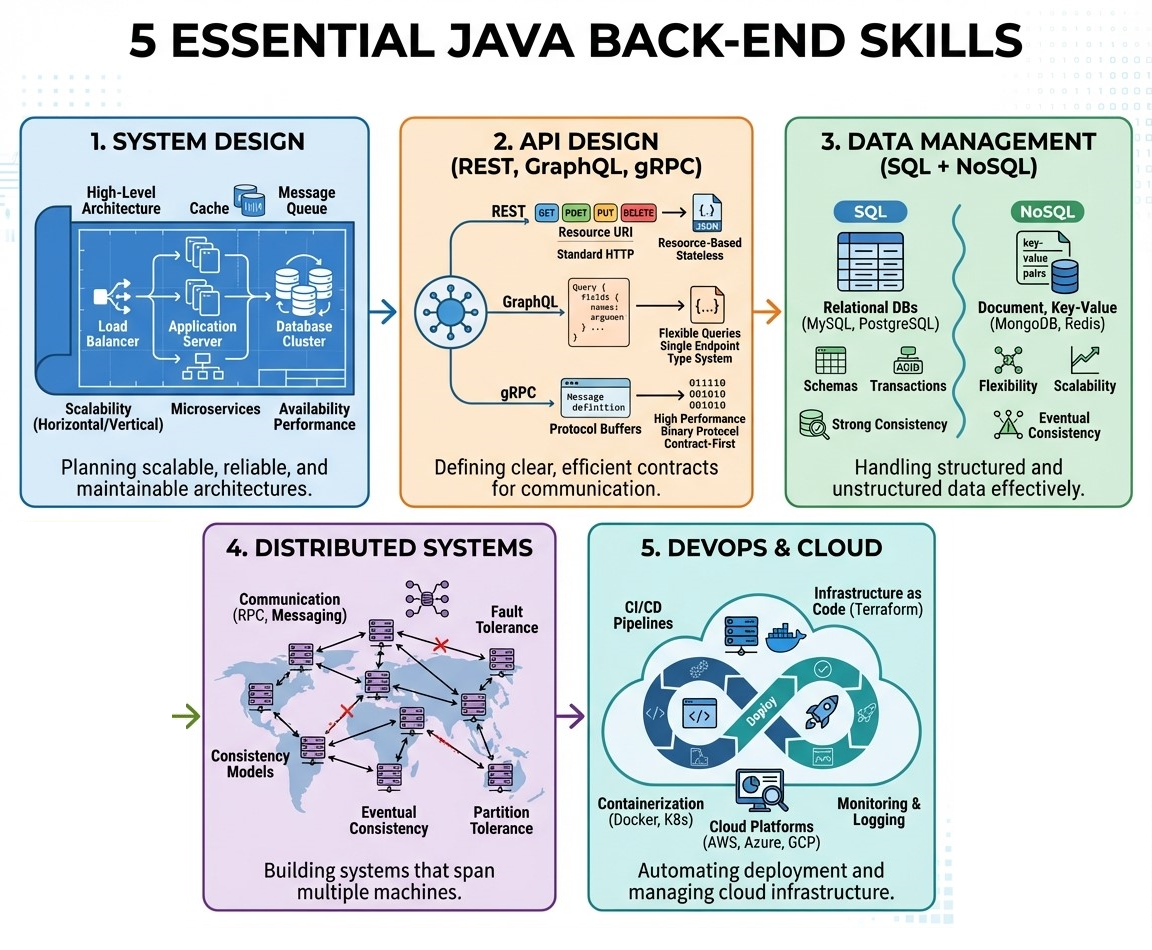
1. System Design – The Backbone Skill for High-Scale Java Engineers
Modern companies-from fintech to e-commerce-expect backend engineers to understand how to build systems that serve millions of requests per day while staying reliable, elastic, and fault-tolerant.
This goes beyond just coding; it’s about thinking in architecture.
Real examples from the industry:
- Backend engineers at Uber and Netflix design microservices for order flows and payment processing.
- Senior Java developers in banking architect real-time transactional systems that must never fail.
What you need to master:
- Microservices architecture & service decomposition
- Scalability patterns (horizontal scaling, autoscaling)
- Load balancing concepts
- Designing services that remain functional even under failures
Put simply: if you can design systems that stay alive during peak traffic spikes, you’re already ahead of most developers.
2. API Design & Optimization – REST, GraphQL, gRPC
Every company with a mobile app, SaaS product, or distributed architecture relies on APIs.
And great backend engineers build APIs that are clean, versioned, secure, and fast.
Industry use cases:
- API developers at PayPal and Stripe craft RESTful APIs for e-wallet transactions.
- Java backend engineers at SaaS companies implement GraphQL APIs to support multiple clients with customizable data needs.
Key areas to learn:
- Best practices for RESTful API design
- Versioning strategies for evolving APIs
- GraphQL for flexible client-driven data
- gRPC for ultra-fast internal microservice communication
If API design is the “language” of backend development, then Java engineers are expected to speak it fluently.
3. Data Management – SQL, NoSQL, and the Art of Query Optimization
Every backend system ultimately revolves around data-how it’s stored, retrieved, indexed, and replicated.
A strong Java engineer understands not just how to interact with databases, but how to design them.
Industry examples:
- Java developers at Fiserv/Swissquote optimize Oracle/PostgreSQL queries for high-throughput banking systems.
- Backend engineers at eBay and Walmart use Redis and MongoDB to speed up product search and caching layers.
What you must learn:
- SQL fundamentals: JOINs, indexing, transactions, ACID
- NoSQL systems: MongoDB, Cassandra, Redis
- Designing schema for performance
- Writing queries that scale
Backend engineers who know how to optimize a slow database query are worth their weight in gold.
4. Distributed Systems – Where “Real Backend Engineering” Begins
When an application grows into millions of active users, everything becomes distributed: data, compute, caching, messaging, and even failure.
This is where Java shines-many of the world’s distributed systems are written in Java.
Real-world scenarios:
- Engineers at Netflix and Amazon design distributed streaming and shopping-cart systems.
- Java teams at PayPal and Stripe manage wallet data synchronized across multiple servers and datacenters.
Core topics to understand:
- Replication & partitioning strategies
- Message queues (Kafka, RabbitMQ) for decoupled communication
- CAP theorem: consistency vs availability tradeoffs
- Event-driven architecture basics
If you want to work at a high-scale tech company, distributed systems knowledge is the real differentiator.
5. DevOps & Cloud – The New Normal for Backend Developers
Gone are the days when developers just wrote code and “threw it over the wall” to operations.
Today, backend engineers are expected to deploy, monitor, and automate their systems-especially on the cloud.
Industry examples:
- Java developers at many companies (Netflix, Amazon, Spotify, J.P. Morgan…) deploy microservices using Docker and Kubernetes.
- AI startups use CI/CD pipelines to deliver new backend features multiple times per day.
What you need to learn:
- CI/CD (Jenkins, GitHub Actions, GitLab CI)
- Docker fundamentals
- Kubernetes for orchestrating microservices
- Cloud deployment on AWS, GCP, or Azure
Mastering cloud-native tools turns you from a coder into a full-stack backend engineer.
Final Thoughts: The Java Roadmap That Actually Gets You Hired
If you want to thrive as a Java backend developer-especially in fintech, e-commerce, or major tech-you need more than syntax and frameworks.
You need architectural thinking.
You need to understand data.
You need to build for millions, not dozens.
And you need DevOps skills to ship and maintain what you build.
These five skills form the backbone of a truly employable, future-proof Java backend engineer:
- System Design
- API Design (REST, GraphQL, gRPC)
- Data Management (SQL + NoSQL)
- Distributed Systems
- DevOps & Cloud
If you commit to mastering them, you won’t just “avoid being jobless.”
You’ll be the candidate companies fight to hire.
You can deploy the container on Digital Ocean with very small budget: 5$/month.
Using referral link below, you will have 200$ in credit over 60 days. After that, you can stop the VPS with no cost.