











Applying PECOS to product retrieval and text autocompletion

Two KDD papers demonstrate the power and flexibility of Amazon’s framework for “extreme multilabel ranking”.

In April, our research team at Amazon open-sourced our PECOS framework for extreme multilabel ranking (XMR), which is the general problem of classifying an input when you have an enormous space of candidate classes. PECOS presents a way to solve XMR problems that is both accurate and efficient enough for real-time use.

At this year’s Knowledge Discovery and Data Mining Conference (KDD), members of our team presented two papers that demonstrate both the power and flexibility of the PECOS framework.
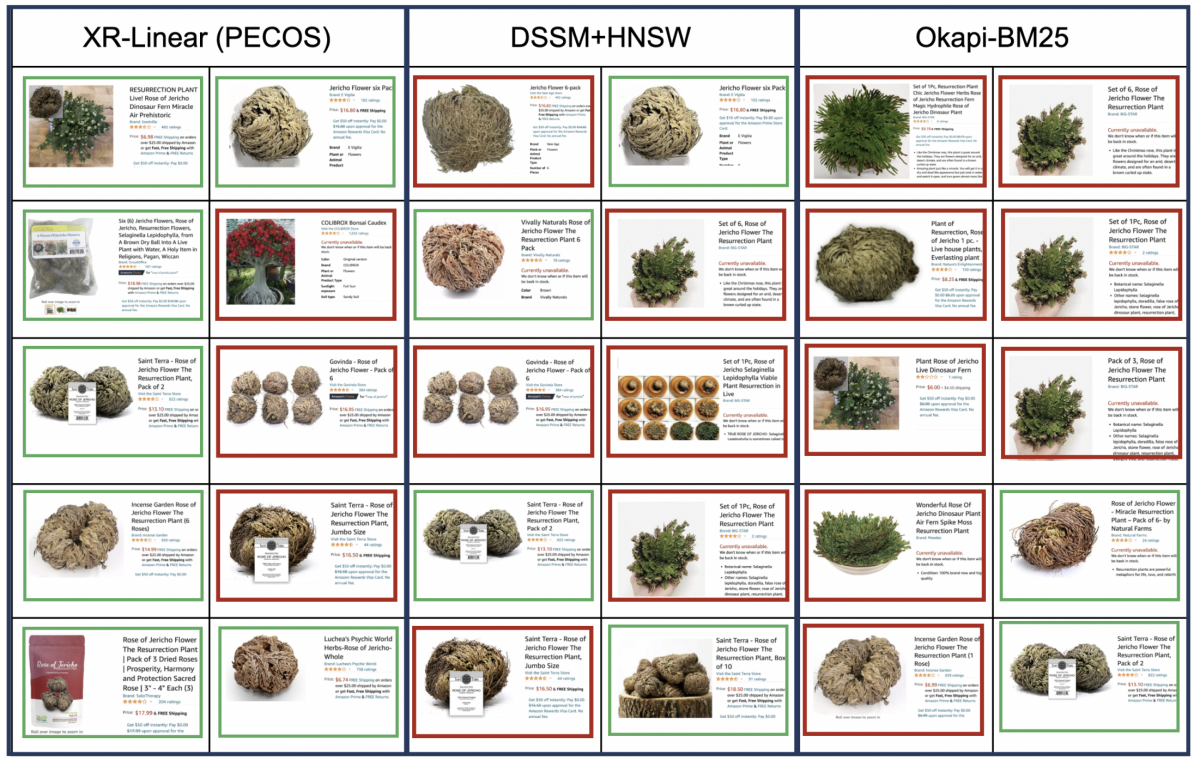
Retrieved products.png
A comparison of the top ten products returned by the PECOS-based product retrieval system and two predecessors for the query "rose of jericho plant". Products outlined in green were purchased by at least one customer performing that search; products outlined in red were not purchased.

One applies PECOS to the problem of product retrieval, a use case very familiar to customers at the Amazon Store. The other is a less obvious application: session-aware query autocompletion, in which an autocompletion model — which predicts what a customer is going to type — bases its predictions on the customer’s last few text inputs, as well as on statistics for customers at large.

In both cases, we tailor PECOS’s default models to the tasks at hand and, in comparisons with several strong benchmarks, show that PECOS offers the best combination of accuracy and speed.

The PECOS model

The classic case of XMR would be the classification of a document according to a handful of topics, where there are hundreds of thousands of topics to choose from.

We generalize the idea, however, to any problem that, for a given input, finds a few matches from among a large set of candidates. In product retrieval, for instance, the names of products would be “labels” we apply to a query: “Echo Dot”, “Echo Studio”, and other such names would be labels applied to the query “Smart speaker”.

PECOS adopts a three-step solution to the XMR problem. First is the indexing step, in which PECOS groups labels according to topic. Next is the matching step, which matches an input to a topic (which significantly shrinks the space of candidates). Last comes the ranking step, which reranks the labels in the matched topic, based on features of the input.
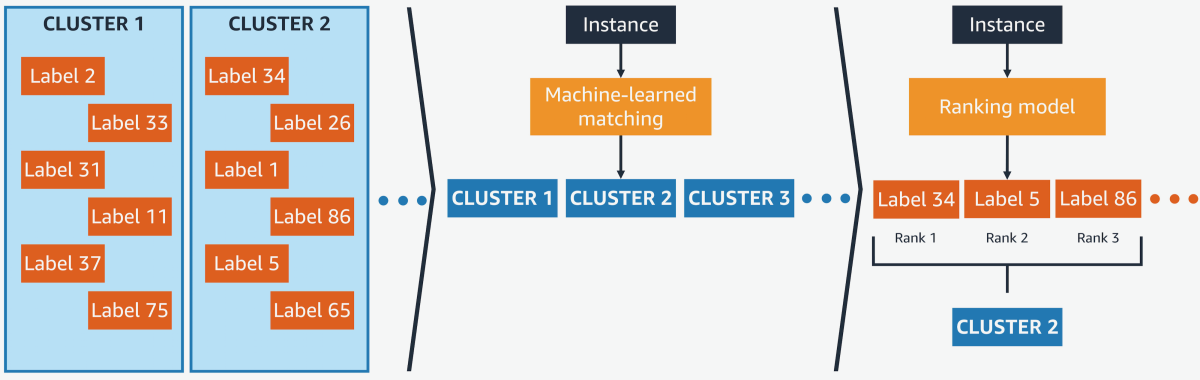
PECOS-framework.png
The three-stage PECOS model.
Credit: Stacy Reilly

PECOS comes with default models for each of these steps, which we described in a blog post about the April code release. But users can modify those models as necessary, or create their own and integrate them into the PECOS framework.

Product retrieval

For the product retrieval problem, we adapt one of the matching models that comes standard with PECOS: XR-Linear. Details are in the earlier blog post (and in our KDD paper), but XR-Linear reduces computation time by using B-ary trees — a generalization of binary trees to trees whose nodes have B descendants each. The top node of the tree represents the full label set; the next layer down represents B partitions of the full set; the next layer represents B partitions of each partition in the previous layer, and so on.

Connections between nodes of the trees have associated weights, which are multiplied by features of the input query to produce a probability score. Matching is the process of tracing the most-probable routes through the tree and retrieving the topics at the most-probable leaf nodes. To make this process efficient, we use beam search: i.e., at each layer, we limit the number of nodes whose descendants we consider, a limit known as the beam width.
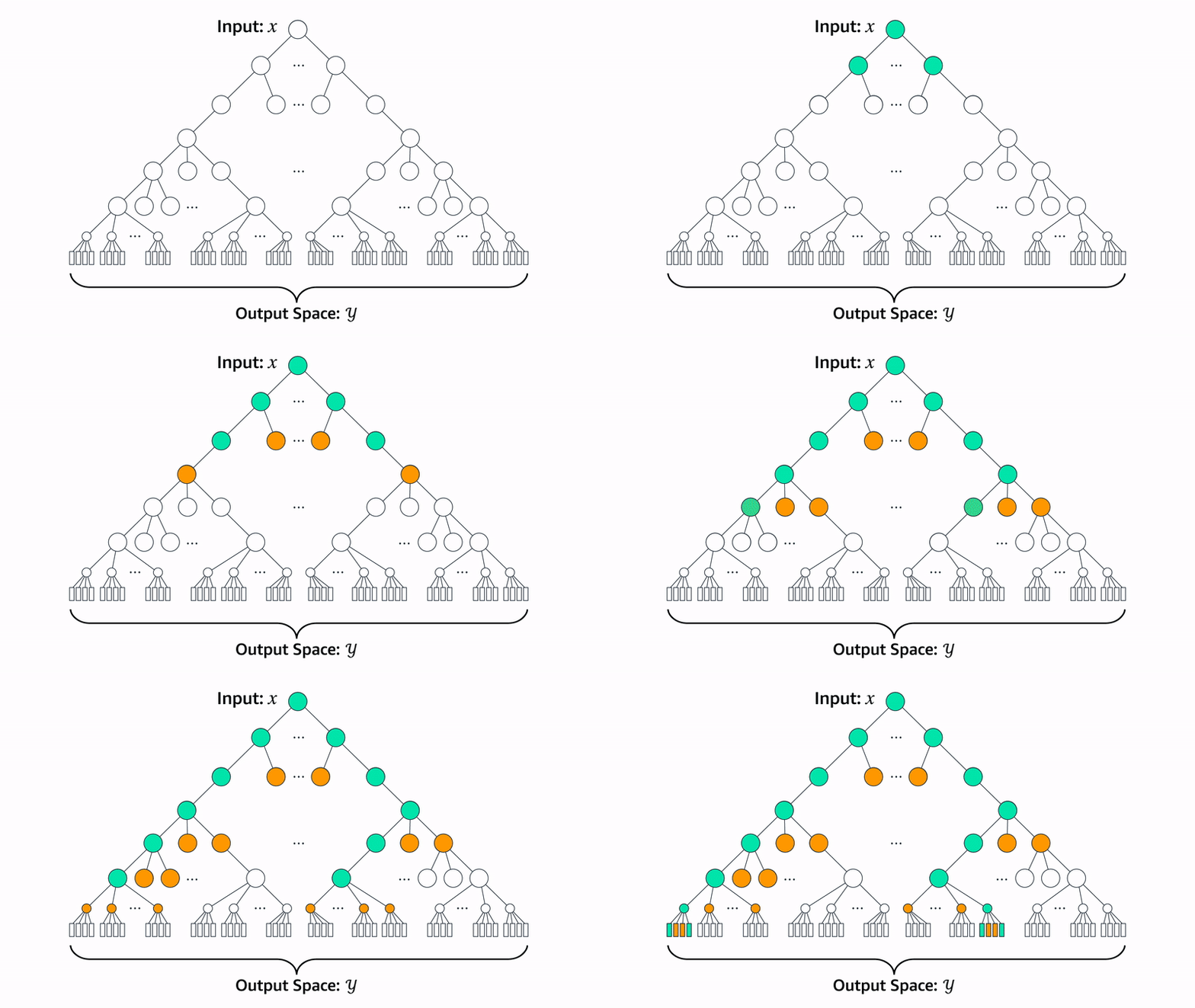
Beam search.gif
An example of linear ranking with a beam width of two. At each level of the tree, two nodes (green) are selected for further exploration. Each of their descendant nodes is evaluated (orange), and two of those are selected for further exploration.
Credit: Giana Bucchino

In our KDD paper on product retrieval, we vary this general model through weight pruning; i.e., we delete edges whose weights fall below some threshold, reducing the number of options the matching algorithm has to consider as it explores the tree. In the paper, we report experiments with several different weight thresholds and beam widths.

We also experimented with several different sets of input features. One was n-grams of query words. For instance, the query “Echo with screen” would produce the 1-grams “Echo”, “with”, “screen”, the 2-grams “Echo with” and “with screen”, and the 3-gram “Echo with screen”. This sensitizes the matching model to phrases that may carry more information than their constituent words.

Similarly, we used n-grams of input characters. If we use the token “#” to denote the end of a word, the same query would produce the character trigrams “Ech”, “cho”, “ho#”, “with”, “ith”, and so on. Character n-grams helps the model deal with typos or word variants.

Finally, we also used TF-IDF (term frequency–inverse document frequency) features, which normalize the frequency of a word in a given text by its frequency across all texts (which filters out common words like “the”). We found that our model performed best when we used all three sets of features.

As benchmarks in our experiments, we used the state-of-the-art linear model and the state-of-the-art neural model and found that our linear approach outperformed both, with a recall@10 — that is, the number of correct labels among the top ten — that was more than double the neural model’s and almost quadruple the linear model’s. At the same time, our model took about one-sixth as long to train as the neural model.

We also found that our model took an average of only 1.25 milliseconds to complete each query, which is fast enough for deployment in a real-time system like the Amazon Store.

Session-aware query autocompletion

Session-aware query autocompletion uses the history of a customer’s recent queries — not just general statistics for the customer base — to complete new queries. The added contextual information means that it can often complete queries accurately after the customer has typed only one or two letters.

To frame this task as an XMR problem, we consider the case in which the input is a combination of the customer’s previous query and the beginning — perhaps just a few characters — of a new query. The labels are queries that an information retrieval system has seen before.

In this case, PECOS didn’t work well out of the box, and we deduced that the problem was the indexing scheme used to cluster labels by topic. PECOS’s default indexing model embeds inputs, or converts them into vectors, then clusters labels according to proximity in the vector space.

We suspected that this was ineffective when the inputs to the autocompletion model were partial phrases — fragments of words that a user is typing in. So we experimented with an indexing model that instead used data structures known as tries(a variation on “tree” that borrows part of the word “retrieve”).

A trie is a tree whose nodes represent strings of letters, where each descendant node extends its parent node’s string by one letter. So if the top node of the trie represents the letter “P”, its descendants might represent the strings “PA” and “PE”; their descendants might represent the strings “PAN”, “PAD”, “PEN”, “PET”, and so on. With a trie, all the nodes that descend from a common parent constitute a cluster.

Clustering using tries dramatically improved the performance of our model, but it also slowed it down: the strings encoded by tries can get very long, which means that tracing a path through the trie can get very time consuming.

So we adopted a hybrid clustering technique that combines tries with embeddings. The top few layers of the hybrid tree constitute a trie, but the nodes that descend from the lowest of these layers represent strings whose embeddings are near that of the parent node in the vector space.
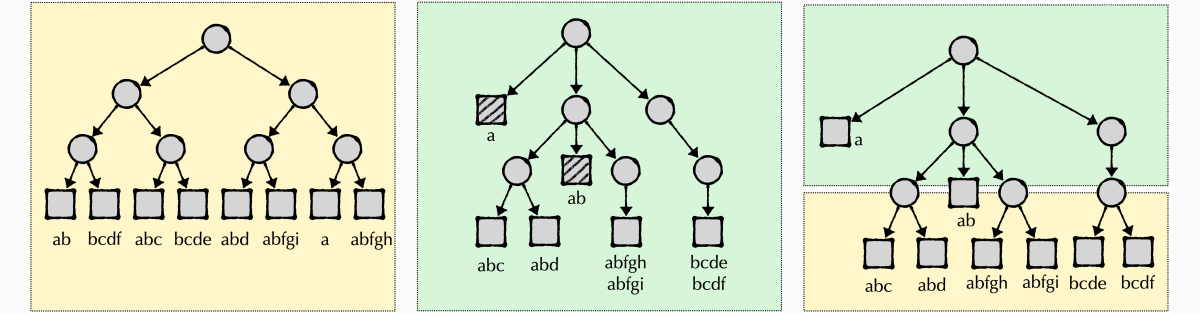
Tree, Trie, Trie-tree hybrid.cloned.png
Three different ways of clustering the eight strings "a", "ab", "abc", "abd", "abfgh", "abfgi", "bcde", and "bcdf". At left is a conventional tree; in the center is a trie; and at right is a trie-tree hybrid.

To ensure that the embeddings in the hybrid tree preserve some of the sequential information encoded by tries, we varied the standard TF-IDF approach. First we applied it at the character level, rather than at the word level, so that it measured the relative frequency of particular strings of letters, not just words.

Then we weighted the frequency statistics, overcounting character strings that occurred at the beginning of words, relative to those that occurred later. This forced the embedding to mimic the string extension logic of the tries.

Once we’d adopted this indexing scheme, we found that the PECOS model outperformed both the state-of-the-art linear model and the state-of-the art neural model, when measured by both mean reciprocal rank and the BLEU metric used to evaluate machine translation models.

The use of tries still came with a performance penalty: our model took significantly longer to process inputs than the earlier linear model did. But its execution time was still below the threshold for real-time application and significantly lower than the neural model’s.

Related content

US, WA, Bellevue
Amazon Leo is an initiative to increase global broadband access through a constellation of 3,236 satellites in low Earth orbit (LEO). Its mission is to bring fast, affordable broadband to unserved and underserved communities around the world. Amazon Leo will help close the digital divide by delivering fast, affordable broadband to a wide range of customers, including consumers, businesses, government agencies, and other organizations operating in places without reliable connectivity. Do you get excited by aerospace, space exploration, and/or satellites? Do you want to help build solutions at Amazon Leo to transform the space industry? If so, then we would love to talk! Key job responsibilities Work cross-functionally with product, business development, and various technical teams (engineering, science, simulations, etc.) to execute on the long-term vision, strategy, and architecture for the science-based global demand forecast. Design and deliver modern, flexible, scalable solutions to integrate data from a variety of sources and systems (both internal and external) and develop Bandwidth Usage models at granular temporal and geographic grains, deployable to Leo traffic management systems. Work closely with the capacity planning science team to ensure that demand forecasts feed seamlessly into their systems to deliver continuous optimization of resources. Lead short and long terms technical roadmap definition efforts to deliver solutions that meet business needs in pre-launch, early-launch, and mature business phases. Synthesize and communicate insights and recommendations to audiences of varying levels of technical sophistication to drive change across Amazon Leo. Export Control Requirement: Due to applicable export control laws and regulations, candidates must be a U.S. citizen or national, U.S. permanent resident (i.e., current Green Card holder), or lawfully admitted into the U.S. as a refugee or granted asylum. About the team The Amazon Leo Global Demand Planning team's mission is to map customer demand across space and time. We enable Amazon Leo's long-term success by delivering actionable insights and scientific forecasts across geographies and customer segments to empower long range planning, capacity simulations, business strategy, and hardware manufacturing recommendations through scalable tools and durable mechanisms.
US, CA, Pasadena
Do you enjoy solving challenging problems and driving innovations in research? As a Research Science intern with the Quantum Algorithms Team at CQC, you will work alongside global experts to develop novel quantum algorithms, evaluate prospective applications of fault-tolerant quantum computers, and strengthen the long-term value proposition of quantum computing. A strong candidate will have experience applying methods of mathematical and numerical analysis to assess the performance of quantum algorithms and establish their advantage over classical algorithms. Key job responsibilities We are particularly interested in candidates with expertise in any of the following subareas related to quantum algorithms: quantum chemistry, many-body physics, quantum machine learning, cryptography, optimization theory, quantum complexity theory, quantum error correction & fault tolerance, quantum sensing, and scientific computing, among others. A day in the life Throughout your journey, you'll have access to unparalleled resources, including state-of-the-art computing infrastructure, cutting-edge research papers, and mentorship from industry luminaries. This immersive experience will not only sharpen your technical skills but also cultivate your ability to think critically, communicate effectively, and thrive in a fast-paced, innovative environment where bold ideas are celebrated. Diverse Experiences AWS values diverse experiences. Even if you do not meet all of the qualifications and skills listed in the job description, we encourage candidates to apply. If your career is just starting, hasn’t followed a traditional path, or includes alternative experiences, don’t let it stop you from applying. Why AWS? Amazon Web Services (AWS) is the world’s most comprehensive and broadly adopted cloud platform. We pioneered cloud computing and never stopped innovating — that’s why customers from the most successful startups to Global 500 companies trust our robust suite of products and services to power their businesses. Inclusive Team Culture Here at AWS, it’s in our nature to learn and be curious. Our employee-led affinity groups foster a culture of inclusion that empower us to be proud of our differences. Ongoing events and learning experiences, including our Conversations on Race and Ethnicity (CORE) and AmazeCon (gender diversity) conferences, inspire us to never stop embracing our uniqueness. Mentorship & Career Growth We’re continuously raising our performance bar as we strive to become Earth’s Best Employer. That’s why you’ll find endless knowledge-sharing, mentorship and other career-advancing resources here to help you develop into a better-rounded professional. Work/Life Balance We value work-life harmony. Achieving success at work should never come at the expense of sacrifices at home, which is why we strive for flexibility as part of our working culture. When we feel supported in the workplace and at home, there’s nothing we can’t achieve in the cloud. Hybrid Work We value innovation and recognize this sometimes requires uninterrupted time to focus on a build. We also value in-person collaboration and time spent face-to-face. Our team affords employees options to work in the office every day or in a flexible, hybrid work model near one of our U.S. Amazon offices. This is not a remote internship opportunity. About the team Amazon Web Services (AWS) Center for Quantum Computing (CQC) is a multi-disciplinary team of theoretical and experimental physicists, materials scientists, and hardware and software engineers on a mission to develop a fault-tolerant quantum computer.
US, CA, Pasadena
We’re on the lookout for the curious, those who think big and want to define the world of tomorrow. At Amazon, you will grow into the high impact, visionary person you know you’re ready to be. Every day will be filled with exciting new challenges, developing new skills, and achieving personal growth. How often can you say that your work changes the world? At Amazon, you’ll say it often. Join us and define tomorrow. The Amazon Web Services (AWS) Center for Quantum Computing (CQC) in Pasadena, CA, is looking for a Quantum Research Scientist Intern in the Device and Architecture Theory group. You will be joining a multi-disciplinary team of scientists, engineers, and technicians, all working at the forefront of quantum computing to innovate for the benefit of our customers. Key job responsibilities As an intern with the Device and Architecture Theory team, you will conduct pathfinding theoretical research to inform the development of next-generation quantum processors. Potential focus areas include device physics of superconducting circuits, novel qubits and gate schemes, and physical implementations of error-correcting codes. You will work closely with both theorists and experimentalists to explore these directions. We are looking for candidates with excellent problem-solving and communication skills who are eager to work collaboratively in a team environment. Amazon Science gives you insight into the company’s approach to customer-obsessed scientific innovation. Amazon fundamentally believes that scientific innovation is essential to being the most customer-centric company in the world. It’s the company’s ability to have an impact at scale that allows us to attract some of the brightest minds in quantum computing and related fields. Our scientists continue to publish, teach, and engage with the academic community, in addition to utilizing our working backwards method to enrich the way we live and work. A day in the life Why AWS? Amazon Web Services (AWS) is the world’s most comprehensive and broadly adopted cloud platform. We pioneered cloud computing and never stopped innovating — that’s why customers from the most successful startups to Global 500 companies trust our robust suite of products and services to power their businesses. AWS Utility Computing (UC) provides product innovations — from foundational services such as Amazon’s Simple Storage Service (S3) and Amazon Elastic Compute Cloud (EC2), to consistently released new product innovations that continue to set AWS’s services and features apart in the industry. As a member of the UC organization, you’ll support the development and management of Compute, Database, Storage, Internet of Things (Iot), Platform, and Productivity Apps services in AWS. Within AWS UC, Amazon Dedicated Cloud (ADC) roles engage with AWS customers who require specialized security solutions for their cloud services. Inclusive Team Culture Here at AWS, it’s in our nature to learn and be curious. Our employee-led affinity groups foster a culture of inclusion that empower us to be proud of our differences. Ongoing events and learning experiences, including our Conversations on Race and Ethnicity (CORE) and AmazeCon (gender diversity) conferences, inspire us to never stop embracing our uniqueness. Diverse Experiences AWS values diverse experiences. Even if you do not meet all of the qualifications and skills listed in the job description, we encourage candidates to apply. If your career is just starting, hasn’t followed a traditional path, or includes alternative experiences, don’t let it stop you from applying. Mentorship & Career Growth We’re continuously raising our performance bar as we strive to become Earth’s Best Employer. That’s why you’ll find endless knowledge-sharing, mentorship and other career-advancing resources here to help you develop into a better-rounded professional. Work/Life Balance We value work-life harmony. Achieving success at work should never come at the expense of sacrifices at home, which is why we strive for flexibility as part of our working culture. When we feel supported in the workplace and at home, there’s nothing we can’t achieve in the cloud. Export Control Requirement: Due to applicable export control laws and regulations, candidates must be either a U.S. citizen or national, U.S. permanent resident (i.e., current Green Card holder), or lawfully admitted into the U.S. as a refugee or granted asylum, or be able to obtain a US export license. If you are unsure if you meet these requirements, please apply and Amazon will review your application for eligibility.
US, MA, N.reading
Amazon Industrial Robotics is seeking exceptional talent to help develop the next generation of advanced robotics systems that will transform automation at Amazon's scale. We're building revolutionary robotic systems that combine cutting-edge AI, sophisticated control systems, and advanced mechanical design to create adaptable automation solutions capable of working safely alongside humans in dynamic environments. This is a unique opportunity to shape the future of robotics and automation at an unprecedented scale, working with world-class teams pushing the boundaries of what's possible in robotic dexterous manipulation, locomotion, and human-robot interaction. We are seeking a talented Applied Scientist to join our advanced robotics team, focusing on developing and applying cutting-edge simulation methodologies for advanced robotics systems. This role centers on research and development of physics-based simulation techniques, sim-to-real transfer methods, and machine learning approaches that enable rapid development, testing, and validation of robotic systems operating in complex, real-world environments. Key job responsibilities - Advance physics-based simulation fidelity for contact-rich manipulation and locomotion - Design and build high-performance simulation tools integrated into a production robotics stack - Translate research ideas into robust, scalable software pipelines - Develop methods to quantify and reduce simulation-to-reality gaps across design, safety, and control - Architect scalable simulation solutions for rigid and deformable body dynamics - Build simulation pipelines optimized for large-scale reinforcement and policy learning - Establish frameworks for continuous simulation improvement using real-world deployment data - Collaborate with engineering, science, and safety teams on simulation requirements and validation About the team Our team is building a comprehensive simulation platform for advanced robotics development, combining locomotion and manipulation capabilities. We operate at the cutting edge of physics simulation, reinforcement learning, and sim-to-real transfer, collaborating with world-class robotics engineers, applied scientists, and mechanical designers in a fast-paced, innovation-driven environment. This role uniquely combines fundamental research with real-world deployment. You will pursue core research questions in physics-based simulation while seeing your work translated into production systems, validated on real hardware, and informed by deployment data. Working alongside Simulation Software Engineers, you will help transform research ideas into scalable, production-grade simulation capabilities that directly impact how robots are designed, trained, and deployed.
US, WA, Redmond
Amazon Leo is Amazon’s low Earth orbit satellite network. Our mission is to deliver fast, reliable internet connectivity to customers beyond the reach of existing networks. From individual households to schools, hospitals, businesses, and government agencies, Amazon Leo will serve people and organizations operating in locations without reliable connectivity. Export Control Requirement: Due to applicable export control laws and regulations, candidates must be a U.S. citizen or national, U.S. permanent resident (i.e., current Green Card holder), or lawfully admitted into the U.S. as a refugee or granted asylum. This position is part of the Satellite Attitude Determination and Control team. You will design and analyze the control system and algorithms, support development of our flight hardware and software, help integrate the satellite in our labs, participate in flight operations, and see a constellation of satellites flow through the production line into orbit. Key job responsibilities - Design and analyze algorithms for estimation, flight control, and precise pointing using linear methods and simulation. - Develop and apply models and simulations, with various levels of fidelity, of the satellite and our constellation. - Component level environmental testing, functional and performance checkout, subsystem integration, satellite integration, and in space operations. - Manage the spacecraft constellation as it grows and evolves. - Continuously improve our ability to serve customers by maximizing payload operations time. - Develop autonomy for Fault Detection and Isolation on board the spacecraft. A day in the life This is an opportunity to play a significant role in the design of an entirely new satellite system with challenging performance requirements. The large, integrated constellation brings opportunities for advanced capabilities that need investigation and development. The constellation size also puts emphasis on engineering excellence so our tools and methods, from conceptualization through manufacturing and all phases of test, will be state of the art as will the satellite and supporting infrastructure on the ground. You will find that Amazon Leo's mission is compelling, so our program is staffed with some of the top engineers in the industry. Our daily collaboration with other teams on the program brings constant opportunity for discovery, learning, and growth. About the team Our team has lots of experience with various satellite systems and many other flight vehicles. We have bench strength in both our mission and core GNC disciplines. We design, prototype, test, iterate and learn together. Because GNC is central to safe flight, we tend to drive Concepts of Operation and many system level analyses.
IN, KA, Bengaluru
The Amazon Alexa AI team in India is seeking a talented, self-driven Applied Scientist to work on prototyping, optimizing, and deploying ML algorithms within the realm of Generative AI. Key responsibilities include: - Research, experiment and build Proof Of Concepts advancing the state of the art in AI & ML for GenAI. - Collaborate with cross-functional teams to architect and execute technically rigorous AI projects. - Thrive in dynamic environments, adapting quickly to evolving technical requirements and deadlines. - Engage in effective technical communication (written & spoken) with coordination across teams. - Conduct thorough documentation of algorithms, methodologies, and findings for transparency and reproducibility. - Publish research papers in internal and external venues of repute - Support on-call activities for critical issues
US, WA, Redmond
Amazon Leo is Amazon’s Low Earth Orbit satellite network. Our mission is to deliver fast, reliable internet connectivity to customers beyond the reach of existing networks. From individual households to schools, hospitals, businesses, and government agencies, Amazon Leo will serve people and organizations operating in locations without reliable connectivity. The Leo Software Defined Networking (SDN) team designs, implements and operates the network virtualization stack and SDN control plane signaling. Our scope spans over beam planning, routing, and forwarding through our SDN Controller, Agents, and Applications that provides a high throughput telecom service comprised of Low Earth Orbit satellites, customer terminals, gateways, cloud services and terrestrial network infrastructure that connects into public and private networks. We are looking for a talented Senior Applied Scientist to design and develop Network Observability solutions for an advanced global telecom service via both space and terrestrial networks. As a scientist on this team, you will collaborate with a mix of network engineers and software engineers to create novel mechanisms that increase our end-to-end observability tools and deliver high quality, secure and fault tolerant software used in Low Earth Orbit (LEO) satellites, ground gateways, and Consumer/Enterprise class customer terminals. You will define the long-term science roadmap for the team and its products. The candidate must have expertise with modern development practices and will have demonstrated the capability to deliver best-in-class software systems that solve some of today's hardest problems. Key job responsibilities * Take responsibility for designing and delivering modern, flexible, scalable science solutions to complex challenges for operating and planning satellite constellations * Work with peer teams and customers to design innovative science solutions to fulfill the business needs * Write code for production cloud native software systems * Utilize AWS and other Amazon technologies to deliver highly-available science solutions * Help on-board and mentor new science team members * Lead science roadmap definition efforts and decide what solutions to build A day in the life You will collaborate with various stakeholders to create the world’s most innovative products. You will understand operational challenges and existing blind-spots for network observability and be part of a team of scientists and engineers developing tools that fill these gaps. You will join our development and integration efforts and deliver high qualify software for production environments.
IN, KA, Bengaluru
Selection Monitoring team is responsible for making the biggest catalog on the planet even bigger. In order to drive expansion of the Amazon catalog, we develop advanced ML/AI technologies to process billions of products and algorithmically find products not already sold on Amazon. We work with structured, semi-structured and Visually Rich Documents using deep learning, NLP and image processing. The role demands a high-performing and flexible candidate who can take responsibility for success of the system and drive solutions from research, prototype, design, coding and deployment. We are looking for Applied Scientists to tackle challenging problems in the areas of Information Extraction, Efficient crawling at internet scale, developing ML models for website comprehension and agents to take multi-step decisions. You should have depth and breadth of knowledge in text mining, information extraction from Visually Rich Documents, semi structured data (HTML) and advanced machine learning. You should also have programming and design skills to manipulate Semi-Structured and unstructured data and systems that work at internet scale. You will encounter many challenges, including: - Scale (build models to handle billions of pages), - Accuracy (requirements for precision and recall) - Speed (generate predictions for millions of new or changed pages with low latency) - Diversity (models need to work across different languages, market places and data sources) You will help us to - Build a scalable system which can algorithmically extract information from world wide web. - Intelligently cluster web pages, segment and classify regions, extract relevant information and structure the data available on semi-structured web. - Build systems that will use existing Knowledge Base to perform open information extraction at scale from visually rich documents. Key job responsibilities - Use AI, NLP and advances in LLMs/SLMs and agentic systems to create scalable solutions for business problems. - Efficiently Crawl web, Automate extraction of relevant information from large amounts of Visually Rich Documents and optimize key processes. - Design, develop, evaluate and deploy, innovative and highly scalable ML models, esp. leveraging latest advances in RL-based fine tuning methods like DPO, GRPO etc. - Work closely with software engineering teams to drive real-time model implementations. - Establish scalable, efficient, automated processes for large scale model development, model validation and model maintenance. - Lead projects and mentor other scientists, engineers in the use of ML techniques. - Publish innovation in research forums.
US, WA, Seattle
Prime Video is a first-stop entertainment destination offering customers a vast collection of premium programming in one app available across thousands of devices. Prime members can customize their viewing experience and find their favorite movies, series, documentaries, and live sports – including Amazon MGM Studios-produced series and movies; licensed fan favorites; and programming from Prime Video add-on subscriptions such as Apple TV+, Max, Crunchyroll and MGM+. All customers, regardless of whether they have a Prime membership or not, can rent or buy titles via the Prime Video Store, and can enjoy even more content for free with ads. Are you interested in shaping the future of entertainment? Prime Video's technology teams are creating best-in-class digital video experience. As a Prime Video technologist, you’ll have end-to-end ownership of the product, user experience, design, and technology required to deliver state-of-the-art experiences for our customers. You’ll get to work on projects that are fast-paced, challenging, and varied. You’ll also be able to experiment with new possibilities, take risks, and collaborate with remarkable people. We’ll look for you to bring your diverse perspectives, ideas, and skill-sets to make Prime Video even better for our customers. With global opportunities for talented technologists, you can decide where a career Prime Video Tech takes you! As an Applied Scientist in the Prime Video Playback Intelligence Organization, you will have deep subject matter expertise in applied machine learning and data science, with specializations in video streaming optimization, information retrieval, anomaly detection and root-causing systems, large language models and generative AI across various modalities. Key job responsibilities - Work with multiple teams of scientists, engineers, and product managers to translate business and functional requirements into concrete deliverables leading strategic efforts to enhance customer quality of experiences. - Work on problems spaces such as: improving the customer playback quality of experience across Video on Demand, Live Events and Linear Content. - Reduce the time/cost/effort to optimize the customer experience as well as detect, root-cause, and mitigate defects in the customer experience. You’ll seek to understand the depth and nuance of streaming video at scale and identify opportunities to grow our business and improve customer quality of experience via principled ML/AI solutions. - Lead integration of new algorithms and processes into existing modeling stacks, simplify and streamline the existing modeling stacks, and develop testing and evaluation strategies. Ultimately, you'll work backwards from the desired outcomes and lead the way on determining the ideal solution (statistical techniques, traditional ML, GenAI, etc). A day in the life We love solving challenging and hard problems in our quest to innovate on behalf of our customers and provide the best video streaming experience. We push the boundaries to leverage and invent technologies which help create unrivaled experiences for our customers to help us move fast in a growing and changing environment. We use data to guide our decisions, work closely with our engineering and product counterparts, and partner with other Science teams as well as academic institutions to learn and guide in an environment of innovation.
BR, SP, Sao Paulo
Do you like working on projects that are highly visible and are tied closely to Amazon’s growth? Are you seeking an environment where you can drive innovation leveraging the scalability and innovation with Amazon's AWS cloud services? The Amazon International Technology Team is hiring Applied Scientists to work in our Machine Learning team in Mexico City. The Intech team builds International extensions and new features of the Amazon.com web site for individual countries and creates systems to support Amazon operations. We have already worked in Germany, France, UK, India, China, Italy, Brazil and more. Key job responsibilities About you You want to make changes that help millions of customers. You don’t want to make something 10% better as a part of an enormous team. Rather, you want to innovate with a small community of passionate peers. You have experience in analytics, machine learning, LLMs and Agentic AI, and a desire to learn more about these subjects. You want a trusted role in strategy and product design. You put the customer first in your thinking. You have great problem solving skills. You research the latest data technologies and use them to help you innovate and keep costs low. You have great judgment and communication skills, and a history of delivering results. Your Responsibilities - Define and own complex machine learning solutions in the consumer space, including targeting, measurement, creative optimization, and multivariate testing. - Design, implement, and evolve Agentic AI systems that can autonomously perceive their environment, reason about context, and take actions across business workflows—while ensuring human-in-the-loop oversight for high-stakes decisions. - Influence the broader team's approach to integrating machine learning into business workflows. - Advise leadership, both tech and non-tech. - Support technical trade-offs between short-term needs and long-term goals.