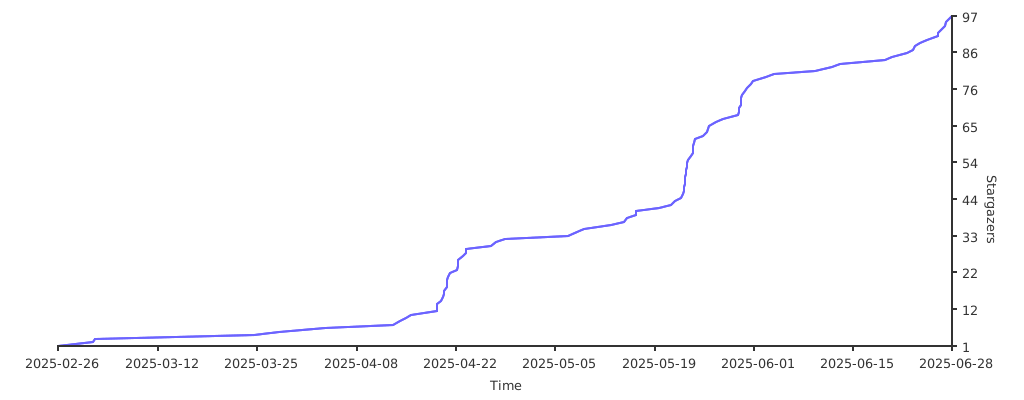

Modern Java IDEs, such as Cursor AI, provide ways to customize how the Agent model behaves using reusable and scoped instructions. In Cursor, this is achieved through Cursor rules, which can be understood as System prompts in generic terms.
Provide a collection of Cursor rules for Java (System prompts) which help software engineers in their daily work.
The available Cursor Rules for Java cover aspects like Build system based on Maven, Design, Coding, Testing, Refactoring & JMH Benchmarking, Performance testing (JMeter), Profiling (Async profiler, jps, jstack, jcmd & jstat) & Documentation.
The repository was designed to offer support for Cursor, but other tools have evolved and now offer better support for System prompts. The repository executes regular regression testing for IDEs like Cursor, Cursor CLI, Claude Code, GitHub Copilot & JetBrains Junie.
A system prompt is a set of instructions given to an AI model that defines how it should behave, what role it should take on, and what guidelines it should follow when responding to users. Think of it as the "operating manual" that shapes the AI's personality, capabilities, and boundaries.

Read the following document to understand how to use System prompts in development
If you are interested in using this repository, please read the following document to get started.
The cursor rules in this repository follow The Three-Node Quality Framework for AI Prompts, which ensures both comprehensive responses and safe execution. This framework consists of three distinct pillars: constraints, output-format and safeguards. Each node operates at different phases of the AI interaction timeline, creating a defense-in-depth strategy.
The constraints act as gate-keeping mechanisms that define hard requirements and blocking conditions before any work begins - essentially asking "Can I start?" The output-format provides prescriptive guidance during execution, ensuring comprehensive coverage and organized responses by defining "What should I deliver?" Finally, safeguards implement protective measures throughout and after execution, continuously asking "Did it work safely?" This temporal flow from pre-execution validation to structured execution to continuous monitoring ensures quality at every stage.
This framework transforms AI from a general assistant into a specialized consultant with built-in quality controls and safety measures, making it particularly suitable for critical applications like Java software development. By embedding domain-specific expertise directly into the prompt structure, the cursor rules provide predictable, comprehensive, and safe interactions while reducing cognitive load for developers and ensuring system integrity throughout the development process.
From the beginning, you need to know that results provided by interactions with the different Cursor rules are not deterministic due to the nature of the models, but this fact should not be considered negative. Software engineers do not always have the same idea to solve a problem, and you could find an analogy in this fact.
Models are able to generate code but they cannot run code with your local data. To address this limitation, you can observe that a few prompts provide scripts to bridge the gaps on the model side.
If you have great ideas, read the following document for contributing.
The rules were tested with the following examples:
- General: Maven Java project
- Microservices: Spring Boot application
- Microservices: Spring Boot application with Memory leaks
- Microservices: Spring Boot application with Performance Bottleneck
- Microservices: Spring Boot application with JMeter Load Testing
- Microservices: Quarkus application
- Serverless: AWS Lambda
- Serverless: Azure Function
- Review the CHANGELOG for further details
Java uses JEPs as the vehicle to describe the new features to be added in the language. The repository continuously reviews which JEPs could improve any of the cursor rules present in this repository.
- https://www.cursor.com/
- https://docs.cursor.com/context/rules
- https://docs.cursor.com/context/@-symbols/@-cursor-rules
- https://openjdk.org/jeps/0
- https://github.com/jabrena/101-cursor
- https://github.com/jabrena/pml
- https://github.com/jabrena/cursor-rules-agile
- https://github.com/jabrena/cursor-rules-java
- https://github.com/jabrena/cursor-rules-spring-boot
- https://github.com/jabrena/cursor-rules-examples
- https://github.com/jabrena/plantuml-to-png-cli
- https://github.com/jabrena/setup-cli