A powerful Python application that demonstrates Retrieval Augmented Generation (RAG) using Google's Gemini AI and LangChain. This project enables intelligent question-answering over PDF documents by combining document retrieval with large language model generation.


- ** PDF Document Processing**: Extract and process text from multiple PDF files
- ** Intelligent Document Retrieval**: Use FAISS vector database to efficiently retrieve relevant information from large document collections
- ** AI-Powered Generation**: Leverage Google's Gemini Pro model to generate accurate, context-aware answers
- ** Interactive Chat Interface**: User-friendly Streamlit web interface for document interaction
- ** Semantic Search**: Advanced embedding-based similarity search for finding relevant document chunks
- ** Context-Aware Responses**: Combines retrieved context with LLM capabilities for detailed answers
- ** Fast Vector Search**: FAISS-based indexing for rapid similarity search at scale
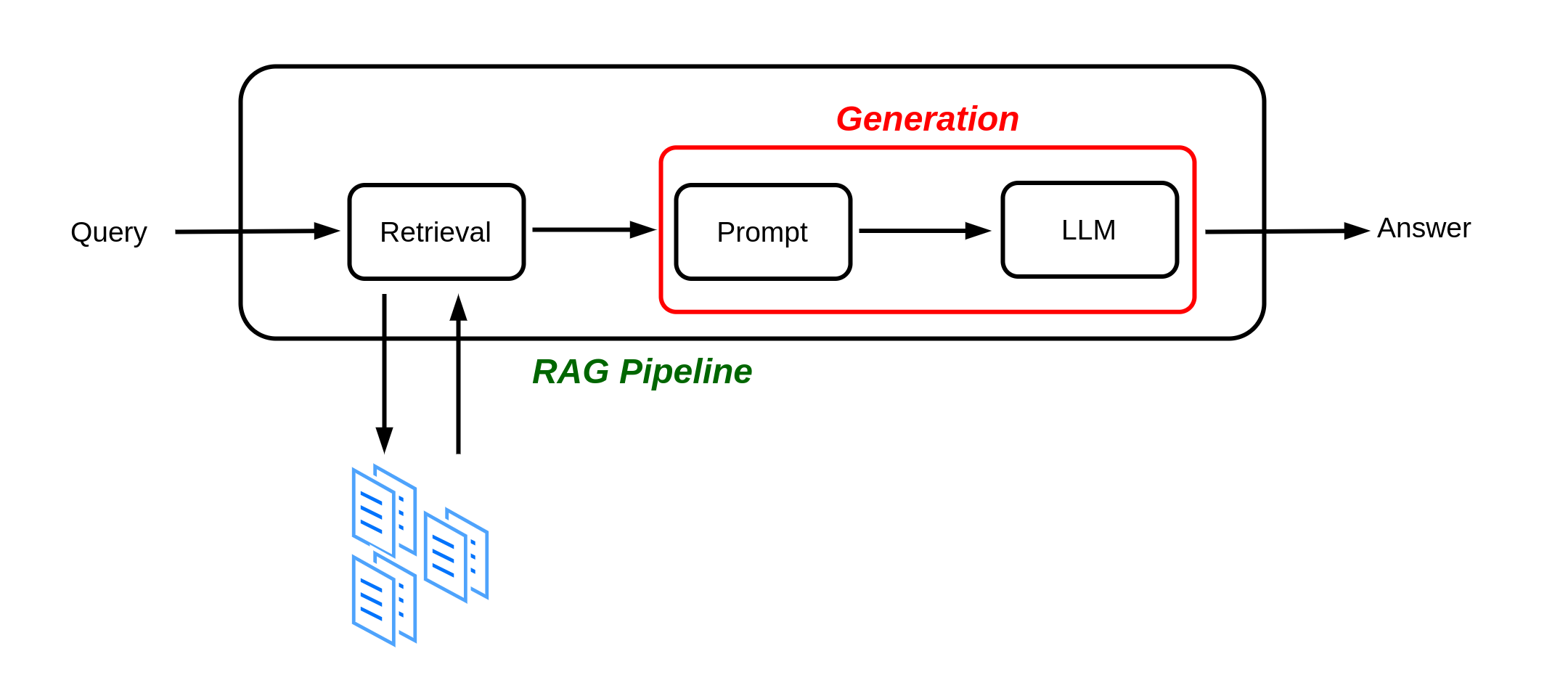
The application implements a complete RAG pipeline:
- Document Ingestion: Upload PDF documents through the web interface
- Text Extraction: Extract text content from PDF files using PyPDF2
- Text Chunking: Split documents into manageable chunks using RecursiveCharacterTextSplitter
- Embedding Generation: Convert text chunks into vector embeddings using Google's embedding model
- Vector Storage: Store embeddings in FAISS vector database for efficient retrieval
- Query Processing: Convert user questions into embeddings
- Similarity Search: Find most relevant document chunks based on semantic similarity
- Answer Generation: Generate detailed answers using Gemini Pro with retrieved context
- Python 3.8 or higher
- Google API key for Gemini AI (Get it here)
- pip package manager
-
Clone the repository
git clone https://github.com/CodeX-Addy/Retrieval_Augmented_Generation.git cd Retrieval_Augmented_Generation -
Install required dependencies
pip install -r requirements.txt
-
Set up environment variables
Create a
.envfile in the project root directory:touch .env
Add your Google API key to the
.envfile:GOOGLE_API_KEY=your_google_api_key_here
Launch the interactive web interface:
streamlit run app.pyThis will open a browser window with the application. Then:
- Upload PDFs: Use the sidebar to upload one or more PDF files
- Process Documents: Click "Submit & Process" to extract and index the content
- Ask Questions: Enter your questions in the text input field
- Get Answers: Receive detailed, context-aware responses based on your documents
For programmatic access or integration into other scripts:
python chatbot-assistance.pyNote: This version requires you to modify the script to specify PDF file paths directly in the code.
Retrieval_Augmented_Generation/
│
├── app.py                      # Main Streamlit web application
├── chatbot-assistance.py       # Command-line version of the chatbot
├── requirements.txt            # Python dependencies
├── .env                        # Environment variables (create this)
├── .gitignore                 # Git ignore rules
├── LICENSE                    # MIT License
├── README.md                  # This file
└── faiss_index/               # Generated FAISS vector store (created at runtime)
| Variable | Description | Required |
|---|---|---|
GOOGLE_API_KEY |
Your Google Generative AI API key | Yes |
The application uses the following models:
- Embeddings:
models/embedding-001(Google Generative AI) - Generation:
gemini-pro(Google Generative AI) - Temperature: 0.3 (for consistent responses)
- Current Implementation: FAISS (Facebook AI Similarity Search)
- Alternative Support: ChromaDB is included in dependencies for potential future use or custom implementations
You can adjust these parameters in the code for better performance:
- Chunk Size: 100 characters (default - consider increasing to 500-1000 for better context)
- Chunk Overlap: 100 characters (default)
Note: The current chunk size of 100 characters is quite small and may be suboptimal for some use cases. For better retrieval performance, consider increasing it to 500-1000 characters depending on your document structure.
- Streamlit: Web application framework
- LangChain: Framework for building LLM applications
- Google Generative AI (Gemini): Large language model for generation
- FAISS: Vector similarity search library
- PyPDF2: PDF text extraction
- python-dotenv: Environment variable management
google-generativeai
python-dotenv
langchain
PyPDF2
faiss-cpu
langchain_google_genai
chromadb
streamlit
Contributions are welcome! Here's how you can help:
- Fork the repository
- Create a new branch (
git checkout -b feature/amazing-feature) - Make your changes
- Commit your changes (
git commit -m 'Add some amazing feature') - Push to the branch (
git push origin feature/amazing-feature) - Open a Pull Request
Please ensure your code follows the existing style and includes appropriate documentation.
- Research: Query academic papers and research documents
- Legal: Search through legal documents and contracts
- Education: Study materials and textbooks question-answering
- Business: Analyze reports, policies, and documentation
- Personal: Organize and query personal document collections
- API keys are stored securely in
.envfiles (not committed to version control) - Documents are processed locally
- FAISS index is stored locally on your machine
- No data is shared with third parties except Google AI for embeddings and generation
- Currently supports PDF files only
- Requires internet connection for API calls to Google Generative AI
- Answer quality depends on document content and question clarity
- Large documents may take longer to process
- Default chunk size (100 characters) may need adjustment for optimal performance with your specific documents
This project is licensed under the MIT License - see the LICENSE file for details.
- RAG diagram from RAG eBook by mallahyari
- Built with LangChain and Google Generative AI
- Inspired by the growing field of Retrieval Augmented Generation
Aditya Tomar - [email protected]
Project Link: https://github.com/CodeX-Addy/Retrieval_Augmented_Generation
⭐ If you find this project helpful, please consider giving it a star!