Without the need for complex configurations, adopting Coordinate’s web and mobile app was simple and easy to do for our employees. Since we were able to run Maps Coordinate on our existing smartphone network and back-end technology, we deployed the mobile and web-based apps across S&ESW within weeks. This helped us to further reduce development time and costs.
Integrating Google Maps has changed the way we communicate and operate our business. Its allowed us to achieve an impressive ROI and save thousands of dollars in printing costs alone. Above all, we’re meeting demands for better quality service and providing the clean water that our customers depend on everyday.
In addition to having instant, mobile insights, our Smallworld applications give users access to data visualization on a map that is familiar and accurate. Teams in the field can use features like Google Street View, helping them more efficiently locate assets that are hard to uncover, such as transmission lines, or a repair job.
From planning electric, gas and water distribution systems to designing telecommunications networks, having the right tools to visualize and manage complex infrastructure is critical for today’s utility industry. But with Google Maps integrated as part of our applications, we’re making it a little easier.
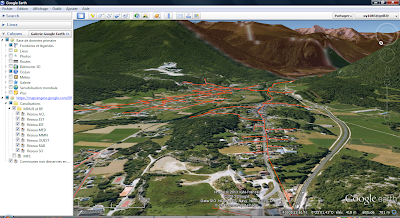
Prospective customers use Gazm@ps when they visit our customer website and enter their address to instantly find out if they are eligible for GrDF service. Each eligible customer is connected with a salesperson who can access relevant information, including a Street View of the service location and details about the municipality they live in. Since we launched Gazm@ps in July 2012, our user base has grown by 30 percent per quarter and the site now accounts for 10 percent of GrDF’s overall site traffic.
We’re also using Google Maps for Business to create Gazm@ps System, an external site that will help heating and plumbing service providers, home builders and local authorities access our mapping data. Using Google Maps to share this information is much easier than the expansive spreadsheets we used before. We’re also developing Gazm@ps Zio, a tool for infrastructure operators that verifies mapping data the partners send to the government for its national database of power distribution, sewerage and telecommunications systems in France.
We serve more than three-quarters of the French population while managing vast amounts of infrastructure, so having accurate, easily accessible data about our pipelines and our customers is essential. While we connect all the pipes underground, we use Google Maps for Business to help us better connect with our new and old customers above the ground.
I love running a food truck company, but it’s also a chaotic undertaking. We employ more than 25 people, dish out at least six menu items, and make stops at more than 30 different locations in the Los Angeles area each week. Organization is key and having the proper lines of communication is essential. I moved the company to Google Apps in June of 2011 primarily for dependable email, but we realized quickly that Calendar and Docs were just as indispensable.
Our shared Google calendar is our time management lifeblood. We have an invite for each truck that details each day’s menu and shift schedule, so everyone can see who’s working where, when they have to be there, and what they’re serving. Most importantly, we can update it at any time and know our whole team is looking at the right information. That way, if we run out of Crab Ceviche and have to switch in the Yum Yum Lamb Sandwich, we just update the shared calendar invite, and everyone knows what’s on the menu.
We got one of our partner farms to switch to Apps, and it’s made our communication with them significantly faster and easier. Now, we track everything in Docs - ingredients, quantities and delivery addresses - so all the the latest information is in one place. Getting notifications when someone adds a comment in a doc lets me and our farm know exactly where someone needs help or that something has changed.
Before using Google Apps, I felt more like a project manager than a business owner. Now, I get to focus on what I love - helping my company grow. I just opened my first restaurant, TLT Food, in Westwood and I'm writing a cookbook. Food is my life and The Lime Truck is my passion – well, that and our amazing Ahi Tuna Poke Nachos - and I wouldn’t be where I am without the help of Google Apps.
Celebrating the launch of the “Schools Gone Google” program at the University of the Philippines
This week institutions of higher learning in the Philippines are joining the move to the cloud. At the launch of the “Schools Gone Google” program yesterday, The University of the Philippines (UP) and 15 other schools, such as University of San Jose Recoletos and Ateneo de Zamboanga, announced they too would be moving to Google Apps for Education. UP joins over 40 universities in the Philippines that have migrated to, or are in the process of going Google, including AMA Computer University (with 150,000 students and faculty), Ateneo de Manila University, De La Salle University and Silliman University.
We have been humbled to support this investment in the future of the Philippines and have been working with these institutions to help them get the most out of their experience. The “Schools Gone Google” program aims to provide Google Apps for Education to as many education institutions in the country as possible through the Google Apps Supporting Program (GASP). We’re looking forward to seeing where the cloud takes the education sector in the Philippines and continuing to provide students and teachers with the educational support and tools to flourish.
Google Apps allows us to be more than a traditional brick and mortar restaurant. We’re constantly evolving, changing and growing, and we realized early on that we needed our technology to be as flexible as the ingredients on our menu. We’re growing quickly - we’re opening two new markets this year - and we need technology that can grow with us.
We change our menu every month to highlight seasonal ingredients and keep things fresh. Our customers are generally curious about what they’re eating and what farm the ingredients come from, so we send talking points to the store managers. Google Sheets and Docs make this all happen for us. We have a running spreadsheet with the local ingredients and plan out each month in advance. The spreadsheet is then turned into a newsletter, and the great thing about Google is throughout that process every group has a chance to jump in and contribute. Once it’s completed, we send the newsletter out to our stores.
We also use Google Drive, which allows us to collaborate between departments. Marketing, Finance and HR can all look at one document at the same time, add their thoughts, and keep track of the changes each person makes along the way with revision history. It makes transparent communication easy, especially when we’re moving really fast (which is always).
Five years after the first seed was planted for this idea, we have more than 400 employees and 17 restaurants in four cities. At Sweetgreen, we believe in creating experiences that go beyond the transaction, and Google Apps has helped make that possible.
This Small Business Week, we want to celebrate you. We're grateful to you for everything you do for us and our communities. Whether you fix people’s cars, offer music lessons to aspiring musicians, or make the world’s best homemade ice cream - when you do what you love, our lives get better.
As part of the celebration, we’ll be highlighting some amazing small businesses across the country, so keep an eye on the Google+ Your Business page. And in the meantime, check out some of the Google tools that are designed to help you take care of business.
We aimed to build a solution that could deliver the same level of scalability, security and reliability that more than 5 million businesses have known to expect from Google Apps. In order to make sure our training software could run seamlessly, we chose Google Cloud Platform to support our backend.
We run on Google App Engine, and can automatically scale up to accommodate organizations of any size, anywhere in the world. Google Cloud Storage and Google Cloud SQL handle all of our data needs and provide cost-effective integration with App Engine. We can rely on the 99.95% uptime delivered by App Engine to ensure our customers have training available when they need it. When we deliver automatic training updates for new applications and features to our clients, they can trust us to provide the same level of security that they find with Google Apps. The Google Cloud Platform is powered by the same Google data centers that power Google Apps; it takes care of our backend infrastructure and enables us to focus on our product.
We chose to develop our solution as a Chrome Extension because we can deeply integrate with Google Apps through the browser, as well as provide IT administrators with rapid software deployment options. This allows us to layer our interactive training on top of real Google Apps and provide automatic software updates. With the Chrome Management console, the extension can be deployed to an entire fleet of Chrome browsers and Chromebooks with a few simple clicks.
When we went live with our first enterprise client, we were both impressed with how effortlessly our software deployed to the entire organization and scaled up to support them. By choosing Google Cloud Platform and Chrome, we can focus on providing scalability, security and reliability to our clients who have chosen to run their organizations on Google Apps.
These results indicate that the Internet offers huge potential for energy savings. We’re especially excited that Berkeley Lab has made its model publicly available so other researchers and experts can plug in their own assumptions and help refine and improve the results.
Of course, understanding the impact of shifting office applications to the cloud is only part of the story, which is why last week we hosted a summit called “How Green is the Internet?” to explore these questions in greater detail. At the summit, experts presented data on how the growth of Internet infrastructure, including devices like phones and tablets, can impact the environment. We also saw great excitement about the potential for entirely new Internet-enabled tools in areas like transportation, e-commerce and digital content to deliver huge energy and carbon savings. We’ve posted the videos from those sessions and invite you to take a look.
One of our goals in hosting the summit and supporting the Berkeley Lab study was to identify and encourage new research on this topic. We’ll continue to work to answer some of these questions, and we hope others will too.
Google Apps allows us to do things our way, wherever and whenever we want. Our staff use Gmail, Google Calendar and Google Drive to stay on top of their day to day work, and Google+ is helping our teams stay in touch, share information and build local communities. Ultimately, all of these tools help to make sure our customers get the groceries they order, on time and in the best possible condition.
But we didn’t stop there. We looked at other ways we could use Google’s technology to help us run our business and started using Google App Engine for building internal applications. For example, we used App Engine to create a new version of our "Where's My Order” application, which our customers will soon be using to find out where their orders are within our production cycle. Once their order is on the road, the integration with Google Maps allows them to see exactly where their delivery van is. So we’re taking what used to be a chore, grocery shopping, and making it a simple experience that you can do from the convenience of your own home, or wherever you may be.
Our most recent project was on Google Compute Engine. Within our warehouses there are certain tasks that are repetitive and arduous for humans to do, like picking heavy six packs of bottled water into customer orders. So our robotics team is developing solutions that use robots to automate these sorts of tasks and thus release staff for other more important work. But these robots need sophisticated 3D vision systems to enable them to see what they are doing. These are very computationally intensive applications and by providing the instantly flexible and scalable computing power to crunch all those numbers, Compute Engine provided the perfect solution. And, we are already using the cloud to store and process some of the huge volumes of data that our business spits out every minute. But with an eye to future growth and international expansion, we have plans to use Compute Engine and Cloud Storage to move other parts of our production systems to the cloud.
So walk into an Ocado warehouse in the future and you might run into a robot if you’re not careful. Like I said, we’re not your typical corner grocery store.