

订阅
0有用+1
在算法层面,SWAR方法通过分组统计实现并行计算,具有O(1)时间复杂度;树状相加法则作为基础解决方案应用于无专用指令的处理器。针对数据位中0占多数的情况,采用X与X-1相与的迭代法可减少运算次数。相关优化策略已被应用于密码学及数据处理中。在编码理论研究领域,广义汉明重量(又称高维重量或支持重量)作为线性码的参数之一,与周期分布共同构成BCH码、射影Reed-Muller码等特殊线性码的研究对象 [2]。
- 中文名
- 汉明重量
- 本 质
- 一串符号中非零符号的个数
- 特 点
- 等于同长度全零符号串的汉明距离
目录
SWAR算法“计算汉明重量”
播报编辑
第一步:
计算出来的值i的二进制可以按每2个二进制位为一组进行分组,各组的十进制表示的就是该组的汉明重量。
第二步:
计算出来的值i的二进制可以按每4个二进制位为一组进行分组,各组的十进制表示的就是该组的汉明重量。
第三步:
计算出来的值i的二进制可以按每8个二进制位为一组进行分组,各组的十进制表示的就是该组的汉明重量。
第四步:
i * (0x01010101)计算出汉明重量并记录在二进制的高八位,>>24语句则通过右移运算,将汉明重量移到最低八位,最后二进制对应的十进制数就是汉明重量。
算法时间复杂度是O(1)的。
相关代码
// 计算32位二进制的汉明重量
int32_t swar(int32_t i)
{
i = (i & 0x55555555) + ((i >> 1) & 0x55555555);
i = (i & 0x33333333) + ((i >> 2) & 0x33333333);
i = (i & 0x0F0F0F0F) + ((i >> 4) & 0x0F0F0F0F);
i = (i * (0x01010101) >> 24);
return i
}
实现
播报编辑
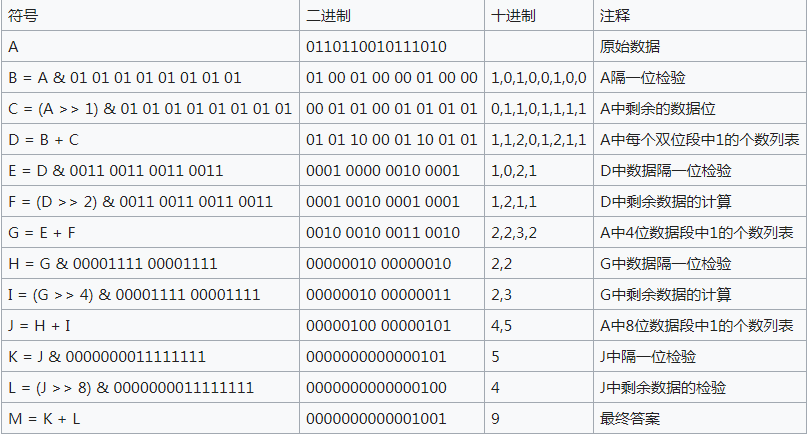 图一
图一//types and constants used in the functions below
typedef unsigned __int64 uint64; //assume this gives 64-bits
const uint64 m1 = 0x5555555555555555; //binary: 0101...
const uint64 m2 = 0x3333333333333333; //binary: 00110011..
const uint64 m4 = 0x0f0f0f0f0f0f0f0f; //binary: 4 zeros, 4 ones ...
const uint64 m8 = 0x00ff00ff00ff00ff; //binary: 8 zeros, 8 ones ...
const uint64 m16 = 0x0000ffff0000ffff; //binary: 16 zeros, 16 ones ...
const uint64 m32 = 0x00000000ffffffff; //binary: 32 zeros, 32 ones ...
const uint64 hff = 0xffffffffffffffff; //binary: all ones
const uint64 h01 = 0x0101010101010101; //the sum of 256 to the power of 0,1,2,3...
//This is a naive implementation, shown for comparison,
//and to help in understanding the better functions.
//It uses 24 arithmetic operations (shift, add, and).
int popcount_1(uint64 x) {
x = (x & m1 ) + ((x >> 1) & m1 ); //put count of each 2 bits into those 2 bits
x = (x & m2 ) + ((x >> 2) & m2 ); //put count of each 4 bits into those 4 bits
x = (x & m4 ) + ((x >> 4) & m4 ); //put count of each 8 bits into those 8 bits
x = (x & m8 ) + ((x >> 8) & m8 ); //put count of each 16 bits into those 16 bits
x = (x & m16) + ((x >> 16) & m16); //put count of each 32 bits into those 32 bits
x = (x & m32) + ((x >> 32) & m32); //put count of each 64 bits into those 64 bits
return x;
}
//This uses fewer arithmetic operations than any other known
//implementation on machines with slow multiplication.
//It uses 17 arithmetic operations.
int popcount_2(uint64 x) {
x -= (x >> 1) & m1; //put count of each 2 bits into those 2 bits
x = (x & m2) + ((x >> 2) & m2); //put count of each 4 bits into those 4 bits
x = (x + (x >> 4)) & m4; //put count of each 8 bits into those 8 bits
x += x >> 8; //put count of each 16 bits into their lowest 8 bits
x += x >> 16; //put count of each 32 bits into their lowest 8 bits
x += x >> 32; //put count of each 64 bits into their lowest 8 bits
return x &0xff;
}
//This uses fewer arithmetic operations than any other known
//implementation on machines with fast multiplication.
//It uses 12 arithmetic operations, one of which is a multiply.
int popcount_3(uint64 x) {
x -= (x >> 1) & m1; //put count of each 2 bits into those 2 bits
x = (x & m2) + ((x >> 2) & m2); //put count of each 4 bits into those 4 bits
x = (x + (x >> 4)) & m4; //put count of each 8 bits into those 8 bits
return (x * h01)>>56; //returns left 8 bits of x + (x<<8) + (x<<16) + (x<<24) + ...
}
在最坏的情况下,上面的实现是所有已知算法中表现最好的。但是,如果已知大多数数据位是0的话,那么还有更快的算法。这些更快的算法是基于这样一种事实即X与X-1相与得到的最低位永远是0。例如图二:
 图二
图二//This is better when most bits in x are 0
//It uses 3 arithmetic operations and one comparison/branch per "1" bit in x.
int popcount_4(uint64 x) {
uint64 count;
for (count=0; x; count++)
x &= x-1;
return count;
}
//This is better if most bits in x are 0.
//It uses 2 arithmetic operations and one comparison/branch per "1" bit in x.
//It is the same as the previous function, but with the loop unrolled.
#define f(y) if ((x &= x-1) == 0) return y;
int popcount_5(uint64 x) {
if (x == 0) return 0;
f( 1) f( 2) f( 3) f( 4) f( 5) f( 6) f( 7) f( 8)
f( 9) f(10) f(11) f(12) f(13) f(14) f(15) f(16)
f(17) f(18) f(19) f(20) f(21) f(22) f(23) f(24)
f(25) f(26) f(27) f(28) f(29) f(30) f(31) f(32)
f(33) f(34) f(35) f(36) f(37) f(38) f(39) f(40)
f(41) f(42) f(43) f(44) f(45) f(46) f(47) f(48)
f(49) f(50) f(51) f(52) f(53) f(54) f(55) f(56)
f(57) f(58) f(59) f(60) f(61) f(62) f(63)
return 64;
}
//Use this instead if most bits in x are 1 instead of 0
#define f(y) if ((x |= x+1) == hff) return 64-y;

